

I quit my job. I am no longer an airline pilot. I will never again button on the four striped epilates of my uniform and fly a winged marvel through the heavens, and I could not be more excited. Let me explain.
Nearing my 64th year on this planet, I find my brain full of many thoughts. Most of them are inconsequential, like “What pair of shorts to wear today?”. And strangely (or not), some even fall into the realm of the nonsensical, like: “Do I look like an idiot floating in my pool on a 6-foot yellow duck?” (Do not feel obligated to answer that.) Some, however, are far more serious and far-reaching, such as whether I should take the “early retirement” package that my airline is offering.
As we all know, the world has become pear-shaped, and the airline industry finds itself in a quandary (like it seems to do every few decades, even without a worldwide pandemic). A mere 6 months ago, we were setting records in passenger counts, pilot hiring, and profit-sharing checks; now, all that has changed. Jets are parked in the desert by the hundreds, the ones flying are essentially empty, and we find ourselves with a massive glut of aviators. Where we were hiring pilots as fast as they were being born (almost), we now have thousands more than we can use. The airlines (mine included) know they must do something, and one option is to furlough the young new-hire pilots, but this is an ugly option to be sure. The industry has done this during its long history; my college roommate was hired at American Airlines in the late 1970s, completed his training, and was promptly furloughed for three and a half years. He hung storm doors and did other odd jobs, finally landing a job flying a corporate turboprop. For the airlines, the pain is just as real; the cost of essentially re-training a huge chunk of your pilot force is monumental. As pilots drop off the bottom of the seniority list, the rest are forced to fly smaller machines and possibly forfeit their Captain position to become a First Officer again. The training cycles are almost endless.
Another avenue is to offer the “grey beards” like yours truly an attractive enough package to turn out to pasture voluntarily. At my line, the top third of our pilot list is roughly my age, and (trust me) now that the airlines are back in the mode of being “pear-shaped”, we have all been looking toward the horizon and the day when we can list “retired” as our occupation.
So, they did it, my line offered an acceptable package (Deb and I were mostly concerned about the medical insurance part of the offer), and we sensed that the horizon was closer than we thought. Since I only have a year and a few days until the FAA requires that I hang up my spurs, we thought long and hard about it (and spoke with our financial team), and decided that it was time.
I believe that over four decades spent in the cockpit of airliners, and roughly 10 years prior to that in the business end of civilian machines, can be considered a “full flying career.” Right?
Will this blog end? Of course not! I have dozens of pieces written over the years, now safely stored in the “hermetically sealed, guarded around the clock” secret vault that houses the vast treasures of the BBall empire…whatever that would be…lol.
I will continue to write about my past adventures in the sky, with an occasional word-vomit geared toward current events (not too political, I hope). Our plans include travel (mostly on the highways and byways…I love to drive) to spend long overdue time with dear friends and loved ones. We also plan on seeing parts of this unbelievable country that we have never seen (the historian in me is giddy thinking of places like Gettysburg, Kill Devil Hill, the Wright Patterson Museum of the Air Force, Niagara Falls, the many incredible National Parks that we’re blessed with, etc.), and of course, we plan on spending lots of time with our amazing children and grandchildren.
This newly found proverbial “freedom from the suitcase” might also include a bit of golf, some quality time logged at the various shooting ranges in the area, lots of “flying” on the ol’ computer, and of course, our required daily 3:00 “pool time” here in the sunny climes of Arizona. There is the rumor of an attempt to publish my yarns into a hard-bound book of “Logbooks” as it were…we shall see.
One thing is for sure…the journey continues.
I originally penned this piece over 20 years ago, and it holds a very special place in my list of Logbooks. Several months after I put it up on the old (now defunct) flight simulation website, the wife of the (now deceased) subject called and told me she was running an internet search, and my piece showed up. She relayed how much she loved reading it…this, of course, made it even more special to this old pelican. I titled it simply…
Captain Al
As a professional airline crewmember, I am tasked with working in a very demanding and stressful environment, sitting barely four feet from another individual for days on end. This leads to a wide range of experiences within the realm of human psychology. However, given that most pilots are essentially cut from the same mold (personality-wise), it is mostly a very enjoyable experience. Over the last five decades of piloting air machines, I’ve flown with countless folks who were strangers and are now close friends. They came from vastly different walks of life and had all manner of life experiences, but they shared one thing in common (other than being professional aviators). They are all generally happy individuals and are truly interesting human beings. I have flown with former doctors, musicians, scientists, economists, police officers, homemakers, psychologists, teachers, military personnel, and day laborers. I have flown with Jews, Gentiles, men, and women, black, white, and everything in between…and 99.9% of them have been wonderful. Truly, I have met some of the most interesting people on the planet, and spent days on end with them in the “small closet with windows” that sits at the pointed end of the airplane…and enjoyed every minute of it. With that said, there are times when we, as crew members (read: humans), do not “mesh” well. This friction can be the result of all manner of things: ideological differences, differences in experiences (former military versus civilian flying), personality quirks, or as basic as the difference between oil and water…we don’t groove, as it were. On those rare occasions, the job of piloting a several-hundred-thousand-pound piece of machinery through the heavens becomes more like work than not.
Again, most of the time I’m very much at ease with my cockpit companions, but those “other times” are more of a “this person is a pain in the ass, let’s get through the trip, and get on with our lives” type experience. Even in those rare circumstances, due to stringent operational procedures (and years of training and check-rides in the simulators), personalities take a back seat to flying the jet, and the job gets done with an astounding level of safety. It is just not nearly as much fun. To make up for this type of person (that invariably elicits a groan when you see their name on the crew sign-in page), there exists a kind of crewmember that is such a delight to work with that they deserve a special category of their own. The person I am about to throw words onto a blank page about should head up that division of super-awesome-type pilots, for he was one in a million. Honestly, I can count a dozen or so folks that I have had the pleasure (and the honor) to fly with over the last 40+ years, who would automatically fall into that category, and he certainly is one of them.

(The pilot’s seats in the “front office” of the Boeing 727.)
Captain Al Thompson was great to fly with. Wait a tic, that is a horribly gross understatement, and I would like to try it again. He was, without a doubt, one of my favorite Captains to work with over the last two and a half decades of flying for Northwest Orient Airlines. I was fortunate enough to share a cockpit with him as a new-hire Boeing 727 Flight Engineer in the early 1980s, and several years later, as his First Officer, crewing DC-10s over the warm Hawaiian waters and the frigid North Atlantic icebergs.
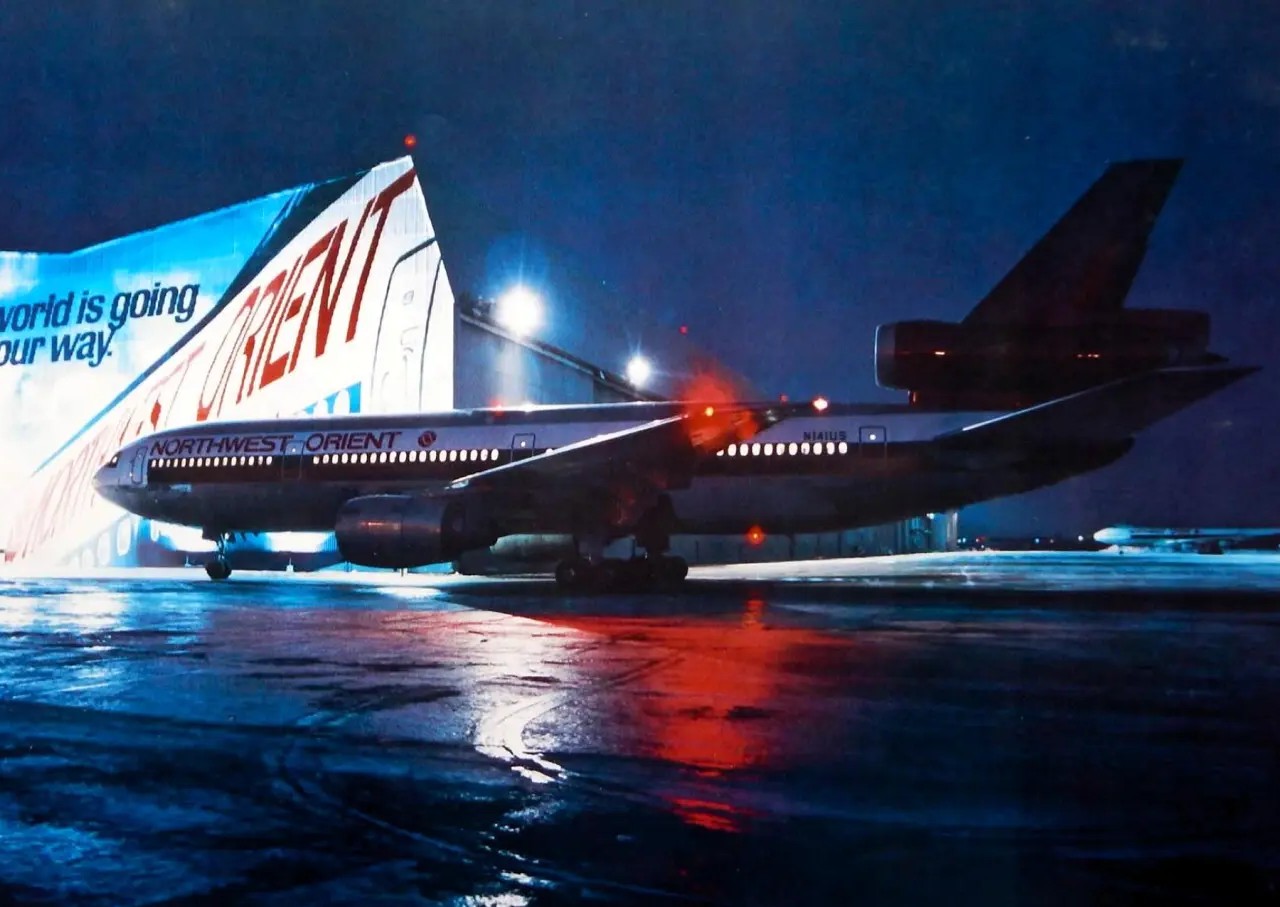
(One of the DC-10-40s that Al and I crewed. It was even more of a joy to fly than the 727. Photo by Captain Bill Adkins.)
Al was always quick with a smile, fast with a joke, and/or a smart-ass remark. This type of person seems to mesh well with my personality… maybe because I tend to have a somewhat impertinent way of looking at life. More than anything else, Al was supremely easy to work with. As simple as that sounds, as the commander of a crew of 3 pilots (and a dozen or so cabin attendants), it can be a very difficult thing to accomplish. Cruising at 8 miles a minute, seven miles above the Earth, with hundreds of trusting souls sitting behind the cockpit door, being “easy” to work for is (for some) low on the list of what is important as an airline captain, but not for Al. Perhaps the best way to describe his laid-back work environment is to say that it was borne of the marriage of his personality and his confidence to command. The job of being the boss of a vehicle in low Earth orbit does not lend itself to being a popularity contest. Side note: Over the many years I have served as commander of a low Earth orbit vehicle, one thing has become clear: a relaxed cockpit is a happy cockpit. On those rare occasions, when things get ugly and turn deadly serious, it quickly becomes time to put on the pilot mask and leave the jocularity behind. In those moments, the relaxed atmosphere can become rather tense, rather quickly, but that’s not an issue. Even though the job can go from (relatively speaking) “easy” to very difficult in an instant, we are used to that. We climb that ladder with confidence, and we excel at it. It is what we do, it is what we love, it is what we get paid for.
Not every airline flight deck has this brand of atmosphere, but every GOOD airline captain strives to achieve it. They are a bit like the circus ringmaster, effortlessly working several “shows” at once, and being detachedly involved with each as they unfold. This stems from a combination of being comfortable with their knowledge of the machine, being confident in the talent of their supporting crew members, and the assurance that they can master any situation that might arise. Great Captains also seem to have an uncanny ability to command the crew in such a way that the plethora of small problems that occur on every flight are solved without requiring their approval. Micromanaging all the issues of a typical airline flight is never a good idea. I learned years ago (from Captains like Al) to trust your other crewmembers (cockpit and cabin) to be good at their jobs, empower them to do that job, and make sure they know that you will support them if an issue arises. Again, all captains work for this type of cockpit atmosphere, but very few achieve it on the level that Captain Thompson did.
I was curious as to the first time I had the pleasure to fly with Al, so I dug up one of my logbooks to refresh the ol’ memory bank. Here is the entry for that first day that involved two legs:
Date: 10 March 1984 (*side note* I had been hired by the airline the previous November, spent two months in training before being “released” to fly the line…hence, I had been flying for Northwest Orient Airlines a total of just over a month!)
Flights: Northwest (NW) flight 206, KMSP-KLGA, NW 225, KLGA-KMKE.
Aircraft Type: Boeing 727-251/ Boeing 727-100
Ships: N252US/ N460US
Flight time breakdown:
4.5 hours Multi-engine Land
4.5 Turbojet
3.2 Day
1.3 Night
4.5 As Flight Engineer
4.5 Total Duration of Flight
Under the “Remarks and Endorsements” section of that entry, I wrote: “Capt. Al Thompson… super/ KLGA a real pit.” So, I guess that neatly sums it up. No, not really. One word does not do Captain Thompson true justice. To attempt that feat, allow me to tell you about a day we flew together several weeks after the above logbook entry. Oh, and while we are on the subject, simply calling New York’s LaGuardia Airport “a real pit” does not exactly do that place any justice either…lol.
Here is the tale of a very special day on the next journey with Captain Al.
It was day 3 of a 4-day trip, and was proceeding nicely. The day had started before sunrise at what was then called National Airport in Washington, D.C. After an uneventful flight up the east coast to Boston, we found ourselves headed toward THE world’s busiest airport. This massive airline hub, surrounded by an iconic city sitting on the windswept banks of Lake Michigan, can be such a “zoo” that to an inexperienced pilot, the mere mention of its name can strike fear into the most stout-hearted aviator. It is named for one of the true heroes of the Battle of Midway, during America’s first real engagement (and victory) against the Imperial Japanese Navy in World War II. His name is Navy Lt. Cmdr. Edward “Butch” O’Hare, and I highly recommend researching his story; it is indeed fascinating. This huge airport bearing his namesake is a dizzying mix of crisscrossing and parallel runways that can be quite a challenge for someone who’s not previously piloted an airplane into that conglomeration. The FAA air traffic control folks are unquestionably some of the best in the country (and probably the world), and their staccato rhythm of non-stop clearances over the radio is something that has to be heard to be believed. Intimidating hardly describes it…you bring your “A game” into Chicago’s O’Hare Airport…or you do not go.
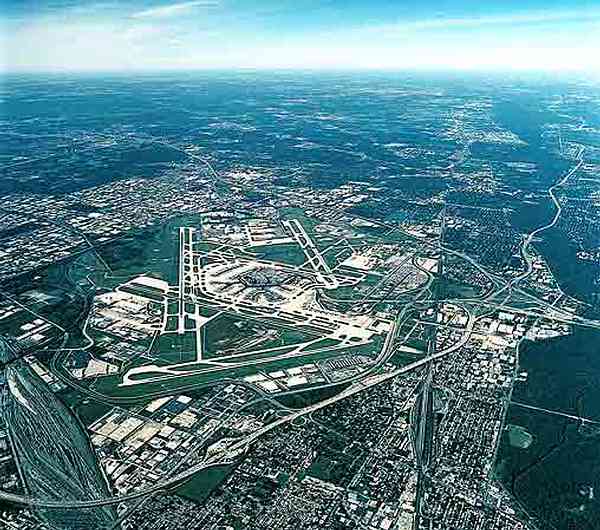
(Chicago’s O’Hare Airport. For years, it was the busiest patchwork of runways on the planet.)
Starting a few hundred miles from O’Hare (FAA code KORD), the ATC en route controllers begin to talk a bit faster, be a bit more reserved in their “friendliness” (or lack thereof), and the atmosphere they build exudes a no-nonsense approach to choreographing this never-ending queue of inbound airliners. All this leads to a general feeling of anxiety in ANY cockpit inbound to O’Hare, and it builds to a crescendo about the time you line up for the runway they’ve vectored you to land on. On a crappy weather day, it can be a nightmare; on a sunny day like this, it can be a bit of fun. Again, you always know it’s going to be a challenge, but you hike up your “big-boy” (or big-girl) britches and do your job.
According to my logbook entries, I had been a party to this “O’Hare pressure cooker” a total of 10 times before this day (including once on the day before this little adventure). But for me, all trips in and out of this monstrosity had been “flown” from the back seat of the 727 cockpit (the Flight Engineer station), for I was barely three months removed from my new hire training at Northwest Orient Airlines. Needless to say, I was darned happy that I was the F/E and NOT the one holding onto the yoke and thrust levers of the big Boeing “3-holer” (the old heads’ nickname for the Boeing 727… referring to the three engines, of course). I was even more relieved not to be the guy talking on the radio to the air traffic controllers. From my limited experiences at massively busy airports (LAX, DFW, ATL, etc.), I find this infinitely more stressful than actually flying the jet. Dealing with the rapid-fire instructions and clearances from the O’Hare TRACON (Terminal Radar Approach Control), O’Hare Control Tower or Ground controllers can be super intimidating, and being slow, confused or (heaven forbid) asking an ATC guy to repeat their last transmission can stain one with the worst type of shame…sounding like a rank amateur on the radio in front of dozens of other airline pilots. Professional aviators preen at their reputation of always sounding calm, cool and collected (even during an emergency), and tarnishing that simply will not do.
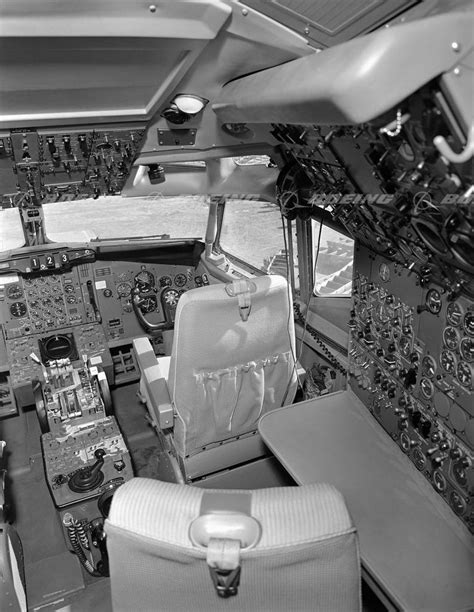
(My little world of the Boeing 727 Flight Engineer. Lots of “funny clocks”, switches and dials, and it is damned hard to see out of the cockpit windows.)
None of this happened on that beautiful, clear morning as we found ourselves maneuvering to line up for runway 14R. Wayne (the First Officer) was at the controls, and Al was doing his usual excellent job of “flying the radios” as we say. All was going great; in fact, Al seemed very relaxed as he calmly responded to the vectors for the final approach from ATC, configured the flaps and gear as Wayne requested, and then acknowledged my “Approach” and “Landing” checklist inquiries with the appropriate responses. He was the epitome of the “steely-eyed” professional, effortlessly conversing on the radio, and hence, since he sounded like he was awesome, we were all branded as such. Life was good.
His body language showed that he was alert, but at ease with our situation, and all was well in our little world… until Wayne did what everyone who has ever flown the Boeing 727 has done. He made the perfect approach and landing flare, and then, right before landing, when rounding out for the touchdown…WHAM, we hit the runway like a ton of bricks! We bounced back into the air a few feet, and he, attempting to recover, slammed the landing gear onto the pavement like the hammer of Thor himself! From what I could tell, he did everything perfectly from his First Officer’s seat, but he got completely cheated on the (hoped-for) smooth touchdown… not necessarily his fault. The design of the 727, with its main landing gear positioned so far aft, was notorious for turning a great, stabilized approach into a very rough landing. In most machines, when you “flare” for landing, the main gear slows its downward trend, and you gently touch down; not in the 727. In that beast, when you bring the nose up into the flare, the main landing gear actually travels downward several feet. If done incorrectly (or, as in Wayne’s case, you get unlucky), you can be left with a supremely ugly landing and a very red face. This is exactly what happened to Wayne. He had bruised the runway, and now he and his bruised ego had to take it like a man.
As we slowed to an appropriate taxi speed, Al and Wayne seamlessly swapped duties (since only the captain’s seat has a “tiller wheel” to steer the jet on the ground); so, as Al controlled the machine on the taxiways, Wayne became the dude on the radio. He was instantly one busy caballero responding to the control tower’s instructions regarding which exit to leave the runway, retracting the flaps on Al’s command, switching the radio frequency to “Ground Control”, and repeating their taxi route clearance. I too was very busy, for after clearing the runway I was tasked with many things; starting the Auxiliary Power Unit located on the aft wall of the cockpit, calling the NWA Operations folks to announce our arrival (this is done electronically nowadays with a datalink marvel known as ACARS), making sure the cabin was depressurizing on schedule, running several checklists and a zillion other things that I can’t remember.

(One of Northwest Airlines’ Boeing 727-100 aircraft. Much shorter than its big brother, the -200…we referred to it as “the Stubby”.)
As we taxied toward the gate, Al unexpectantly made the following statement. It shocked me ALMOST as much as it shocked Wayne.
“Well, that was truly a shitty landing (turning to his right to flash a big smile at Wayne). Bill, you think you can do any better than that?”
I was confused. Being busy talking on the radio to our station Operations, I was not 100% sure I had heard him correctly, so I asked him to repeat what he had just said. He did, and I mumbled something unintelligible (all the while thinking…WTF?). “Well, good then…you fly us up to Madison on the next leg, and Wayne, you sit at Bill’s panel and run the systems.” HOLY SH*T #1! I was going to “get a leg,” and I didn’t know what to say.
“Getting a leg” in airline lingo means that I was going to fly the jet! It was a peculiar situation, for even though I was rated as an Airline Transport Pilot (and had thousands of hours of flying experience in many other aircraft), I was not specifically trained to fly in the First Officer’s seat on the Boeing 727. After our required 6-month simulator check ride at the F/E’s panel, we Second Officers were required by the FAA to spend some time flying the 727 simulator from the First Officer’s seat…in other words, just getting some stick time. We were not officially trained, checked out, certified, and thus ordained as First Officers. Still, we all practiced flying the big Boeing to keep our piloting skills from getting too rusty, albeit in the simulator (which did not fly exactly like the real airplane, but it was not bad). Could we fly the jet? Hell yeah, we could! Was it totally legal? Hell no, it wasn’t!
I was excited, to say the least. Except for a brief time flying in the right seat of a Learjet Model 23 a few years earlier, I had no actual flight time piloting a jet-powered machine. My total flight time thus far amounted to roughly 5000 hours, with time spent in everything from small, single-engine trainers to rather large twin turboprop aircraft…but no time in jets (save the 10 hours in the Lear). Wayne, however, was WAY less than enthused about moving back to the Flight Engineer’s seat for the short leg up to Madison. Although he had spent several years in that chair before becoming a First Officer, and was comfortable with all the systems and/or checklists, I think he saw this as the supreme “no confidence vote” from his boss, and he was a bit embarrassed by it all. It was the first trip I had flown with Wayne, and I would have to say that he was not the most personable guy on the planet. He seemed to be a rather unhappy bloke, and I think his general sour disposition did not go very far to endear him to Al. Did this play into Al’s offer? Not sure and did not care.
After an hour or so at the gate doing our preflight tasks, I strapped myself into the First Officer’s seat and made sure Al knew that I had never actually touched the controls of the real 727, but only in that make-believe world of the simulator. He just laughed and said something to the effect of “don’t worry; I’ll talk you through it.” I was nervous and a bit apprehensive. Again, the line pilot’s unwritten “policy” of giving a leg to an un-FAA-certified crewmember was not only technically illegal, but it was frowned upon by the higher-ups in the Chief Pilot’s Office. A huge part of the story (and the epicenter of my anxiety) is the exposure to being fired from this coveted job. I was in my first few months at the airline, and while on my year-long “probationary period,” I had no union protection in the event I screwed something up. I could be summarily fired with no recourse, and bending a big, beautiful Northwest Orient Boeing 727 would most certainly fall into the category of “screwing” something up. Did I for a millisecond contemplate turning down Al’s offer? Nope, not on your life.
Again, Al said he was going to “talk me through it” …and did he ever! I distinctly remember that on takeoff, when I pulled back on the yoke, it literally felt like the big jet leapt into the sky (remember, we were only going a hundred or so miles … we had a very small fuel load and were extremely light). It flew like a dream and was far more responsive on the controls than I remembered the simulator being. I was busy responding to Al’s instructions, but within a few short minutes, I settled in and got comfortable flying this marvel. At some point, I began to steal lots of glances out the window to see the magnificent Wisconsin countryside go whizzing by. Being a Flight Engineer is like being a glorified secretary to the folks up in the front of the cockpit; you are more of a spectator than a participant (and you have no window to look out of). I was now back in the world of being an actual PILOT again, and it was wonderful! (Plus, I had a window!)
Within minutes, my joyride began to take on a serious tone as we started our approach to Madison. With Al’s help, I got the big jet slowed down, extended the slats and flaps when he advised, and asked for the gear to be lowered as we turned onto our base leg. Before I knew it, we were rolling out on final approach for runway 36. I tried very hard to concentrate and do exactly as Al instructed, attempting to maintain the proper approach speed, pitch angle, and glide path. As we crossed the runway threshold, I began to flare precisely when and how he told me to, and VIOLA! I absolutely painted the jet onto the runway…a damn near perfect “grease job” landing! Al started laughing as the aircraft slowed below 80kts and he again took control. I was grinning from ear to ear, but I could feel the heat from Wayne’s evil-eye stare boring a hole into the back of my (now inflated) head.

(One of our Boeing 727-200s showing the new “bowling shoe” livery we adopted following the merger with Republic Airlines in the late 1980s. I took this holding short of runway 30R at MSP on a cold, windy October afternoon.)
As we were taxiing into the gate at Madison, the lead Flight Attendant poked her head into the cockpit to ask the Flight Engineer (me) to order more soft drinks to be catered for the flight back to Chicago. She looked a bit puzzled to see Wayne in my seat, and me in his, but she shrugged it off, got the message delivered to whoever was plopped into the F/E seat, and closed the door.
I would love to say that the story ends here. Not true. Al set the brakes at the gate in Madison, and he and I responded to the “Shutdown” and “Parking” checklist from the (pissed off) guy sitting behind us. He then did something that floored me (and Wayne) AGAIN! He uttered these (in hindsight) infamous words, “Well, hotshot, you did such a good job of flying us up from Chicago, why don’t you fly us back to Chicago?” HOLY SH*T #2!
To make a long story short, Wayne was even MORE pissed off now than he was before, and I was beginning to feel like the kid who always gets picked first for the football team. Al just took it all in stride and talked me through the flight back into that melee called O’Hare Airport. The one huge difference from the previous flight is that my landing back in Chicago was not like the one in Madison; in fact, it was a bit harder than Wayne’s landing several hours earlier. In fact, it truly sucked. Instead of another “grease job,” I now landed the jet like a Navy plane, doing a bone-jarring “trap” on the aircraft carrier! I did not let it bother me, for I (again) did just as Al instructed, but, alas, the “Gods of the good landings” would not/could not smile on me twice in one day. Ah, well…back to being a lowly Flight Engineer.
A side note to this story concerns the aforementioned Lead Flight Attendant. It seems that she had quite a sense of humor, and when informed by Al at the gate in Madison that I would be flying us back to Chicago, she planned a little surprise of her own for me. As we taxied toward the gate in O’Hare following my “firm” landing, she stepped into the cockpit and exclaimed rather loudly…” WHO THE HELL MADE THAT LANDING!?” I turned around to behold a woman who was sporting a “slightly” altered appearance. Her hair was a tangled mess, she had lipstick smeared down the side of her mouth, her blouse was rumpled and half untucked from her skirt, and her pantyhose were around her ankles! To top off the look of having just survived the unsurvivable… she had a “demo” oxygen mask and hose wrapped around her neck!!!
I laughed until my sides began to hurt. God bless her.
Later that evening, sitting in a dimly lit bar where we had started that long fateful day (Washington D.C.), I turned to the waitress and muttered, “You see this distinguished gentleman I’m sitting with? (Meaning of course, Al) Well, today is his birthday, and he is feeling a bit down and far from home.” She proceeded to gather the other young ladies serving in this establishment, and within minutes, they produced a cupcake complete with a single burning candle. As they all gathered around Al (one sitting in his lap) and sang him a very sweet and sincere “Happy Birthday”, he glanced at me and said with a sly grin…” You know I can have your job for this…”
I replied, “Sure, Al, sure.”
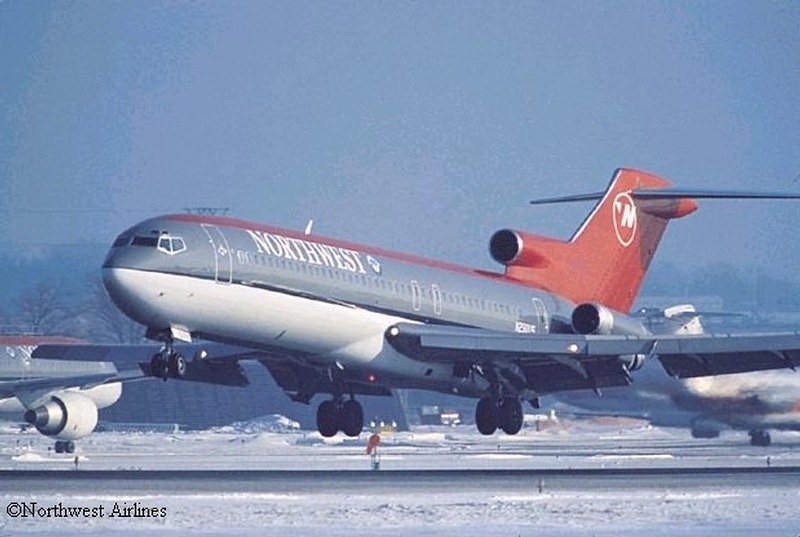
(As mentioned earlier, the positioning of the main landing gear made this beast an “interesting” machine to land smoothly. Every captain seemed to have “their way” of attempting it. Most were quite good at it, but none seemed to find a way to do it consistently. Regardless, it was a wonderful machine to fly.)
Addendum.
My story ends here. Captain Al Thompson flew his last flight for Northwest Airlines several years ago, and sadly, he “flew West” a few months ago after a brave battle with cancer. I was not with him during his illness, but after reading about his passing the other day in our Flight Operations office, I have been with him spiritually. Seeing his name brought back many good memories of those wonderful days when we shared a cockpit, and I felt that this little part of his story should be told.
My logbook entry for that day up to Madison and back reads: “**First two legs in right seat of N251US! Flies like a dream! Beautiful night in DCA.”
“Thank you, Al,” for those first legs flying that magical machine so many years ago; also, thank you for allowing me to serve as your First Officer on many more flights in other magical machines to far-flung destinations. I did not realize it at the time, but I was using you to form a “template” for the type of aircraft commander I would someday strive to become. I can only hope I have done you proud. You will be missed, but not forgotten.
I wish you calm seas, starry nights, and following winds, my friend…
‘till next time.
BBall
 BBALL'S LOGBOOK