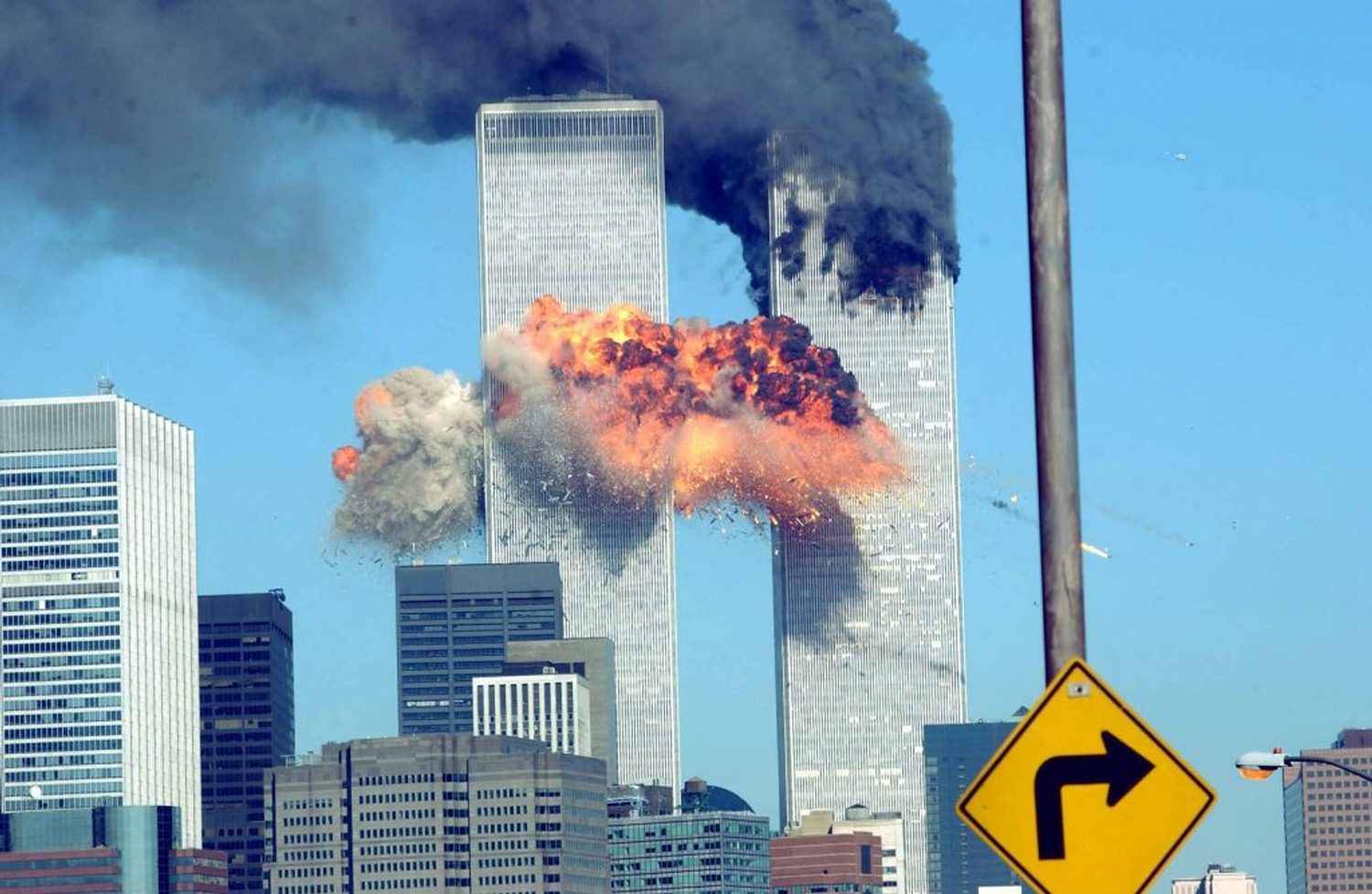
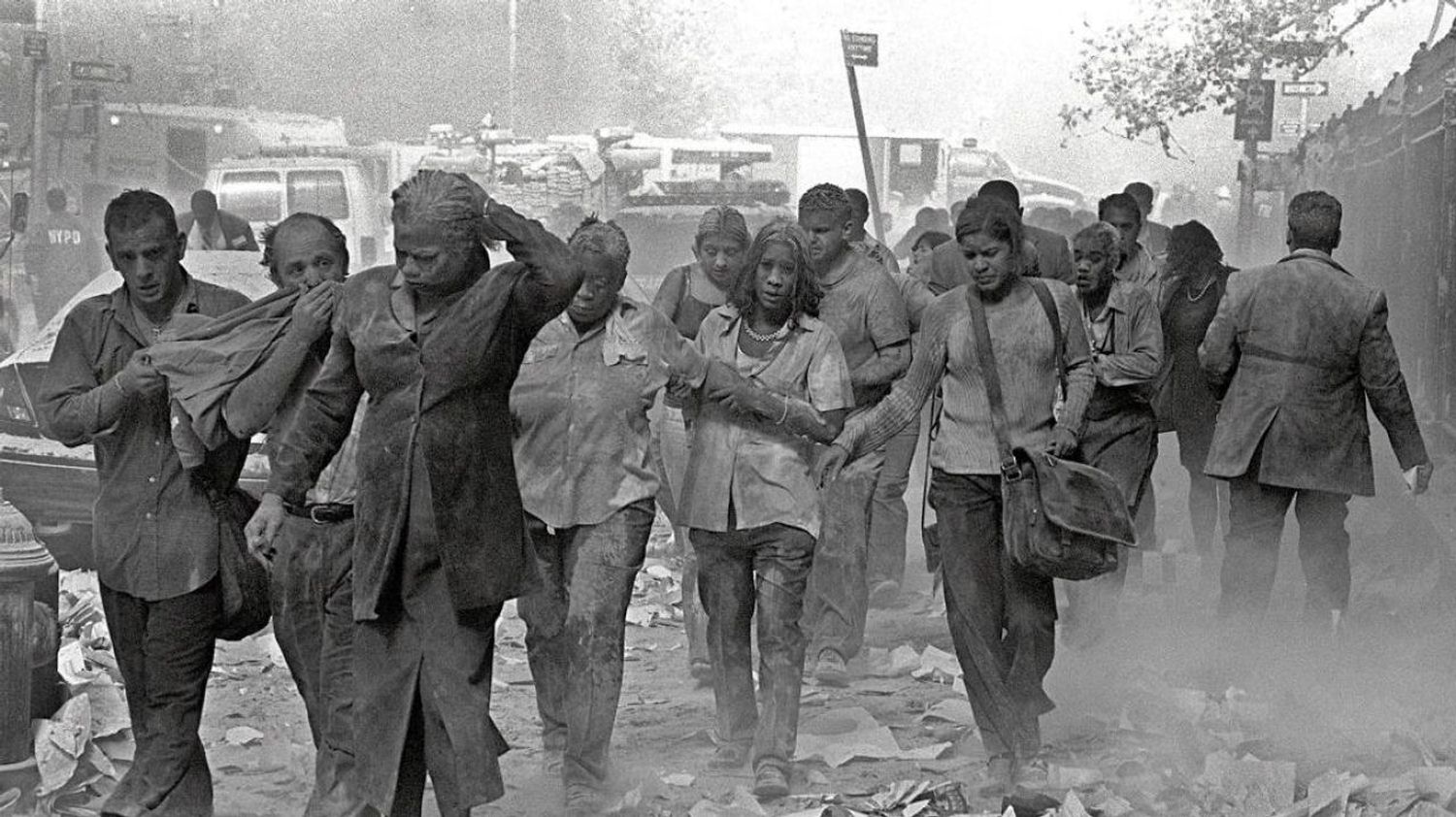
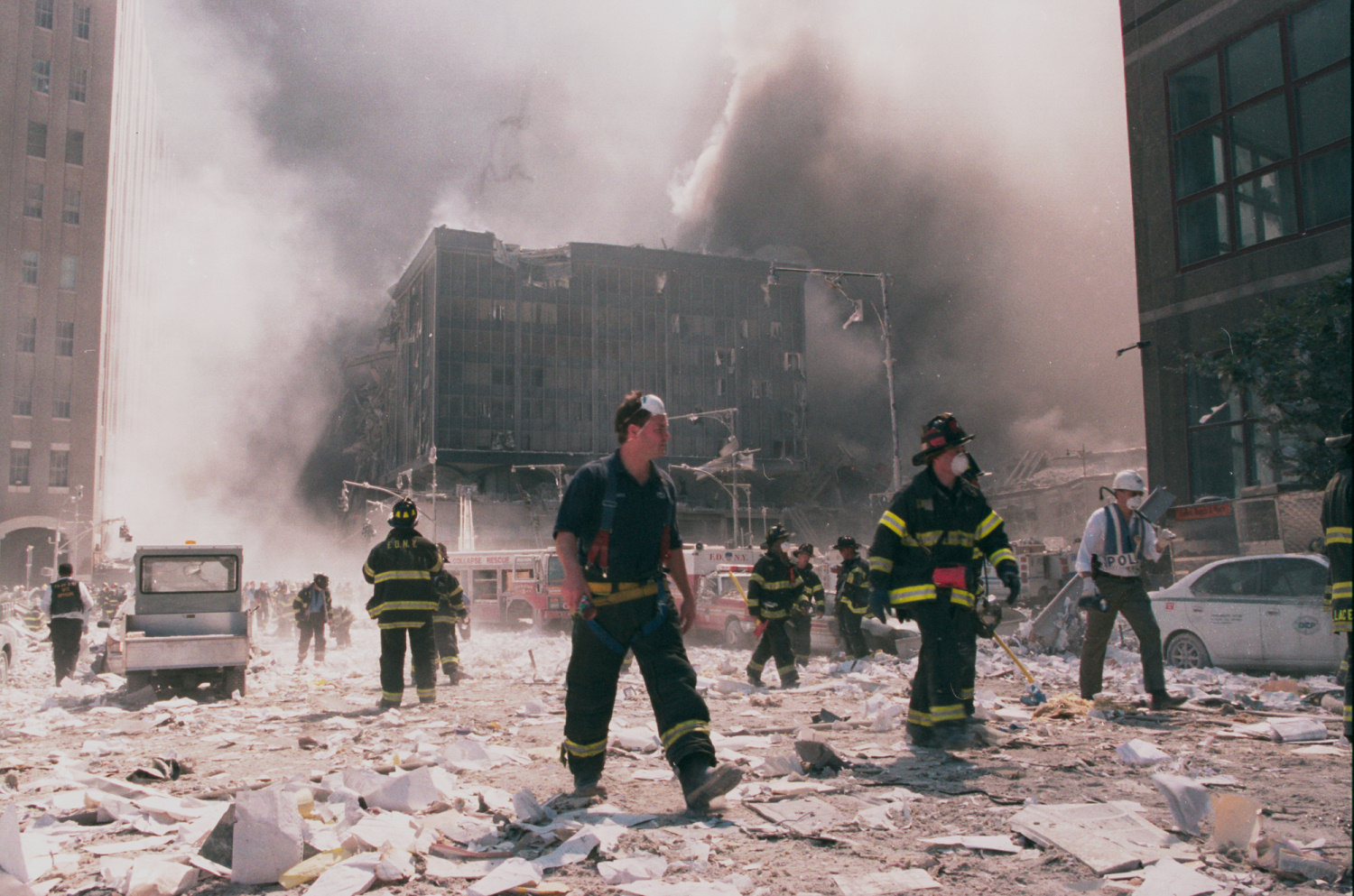
I am reposting this on the 25th anniversary of that horrific “Day of Days.”
It is a day I will never forget (nor should I…or the rest of humanity). I awoke to clear blue skies, dropped my beautiful 5-year-old off at preschool, and returned to my home to witness mass murder on a scale unheard of in my lifetime.
I posted the following shortly after another unspeakable act of terror on the streets of America. This one on the sun-baked streets of California. It tore at my soul, and I opened the keyboard once again to share my thoughts. It ended with a reposting of a “letter” to my dear, departed father that I penned just a few days following 9-11. He too was an aviator, and I knew that, like me, he would recoil in horror at what had happened on that beautiful Tuesday morning in September 2001.
It was quiet, a deathly, eerie, uncomfortable kind of quiet that leaves you feeling that you’re not alone; yet you are, utterly alone. Save for the gentle breeze blowing through the Pisonia Grandis trees, the only sound was the crunch of white coral rocks beneath my tennis shoes. The date was Friday, November 7th, 2008. I had parked the rented moped scooter and was slowly walking the mile-and-a-half-long stretch of the sun-bleached gravel of Runway “Able.” I was just shy of 7000 miles from hearth and home; nearly at the exact opposite side of the planet. I knew my loved ones might be in the midst of an early winter “snow event,” but the puffy white clouds above me were dancing in an 86-degree tropical breeze, and the sticky 80% humidity had me rhythmically wiping sweat from my brow as I trekked toward the far end of the runway.
I might as well have been on the moon, for I was alone on the northern tip of a (nearly) deserted island in the middle of the Central Pacific. Every sense in my body told me I was not alone; that I was surrounded by a legion of long-past spirits. On the precise spot where I was standing, sixty-three years in the past, the mission that would change humanity forever began from this runway. The entire world would be changed by the very ghosts that would be my afternoon companions, and I knew what they did on that steamy night those many years ago (they lifted off at precisely 0245) was both mind-boggling and unspeakably terrifying. Before the sun would set on that fateful day, nearly 100,000 people would not be alive to see the next sunrise. Through the lens of history, I felt the troubling weight of their epic flight deep in my soul.
Three weeks earlier, as I digested the results of my November schedule bid, I was excited and (I will admit) a bit anxious to see the trip I had been awarded. I had flown to (and within) the Far East for several years as a Boeing 747 Flight Engineer, but that was two decades prior, and this 11-day trip would be radically different. On this journey, I would not be the “third in charge” of the three-person cockpit crew; I would be THE person in charge. I would be the Commander of the machine (the Boeing 757), tasked with conducting nearly two weeks of safe flights across Asia to dozens of destinations whose names had graced the pages of many of my most prized history books.
Tokyo, Saipan, Guam, Manila, Palau, Hong Kong, Singapore, Seoul, Osaka, and Nagoya; they were a roll call of destinations that sparked fascination and curiosity within the recesses of my brain. As a child, I had seen a few of the WWII battlefields of Europe, but these would be from the “other” theater of that horrendous conflict. The stories of these hallowed fields had occupied my library for years, and I would now have the opportunity to walk where the men and women of those tales walked. I hoped to gain maybe a modicum of understanding of the world they lived in, the world they fought in, and the world in which many thousands of them died. The amateur historian within me felt the excited anticipation of a child awaiting Christmas morning.
After a 12-hour deadhead to Tokyo (actually, to the modest town of Narita that lies 30 miles east; the location of the massive international airport), I logged a restless night anticipating the next day’s flight. It was the by-product of being an excited traveler, and (a very big and) the international pilot’s ever-present, ugly comrade…jet lag and/or sleep deprivation. Flying from New York to Los Angeles can test even the stoutest of flyers, but add 8 more hours and the crossing from “today” into “tomorrow,” at the same time you are still living your “today,” and every sense, every bodily function, every mental process can become severely bruised. Saying that it takes a hefty toll on one’s physical well-being is an understatement of gross proportions.
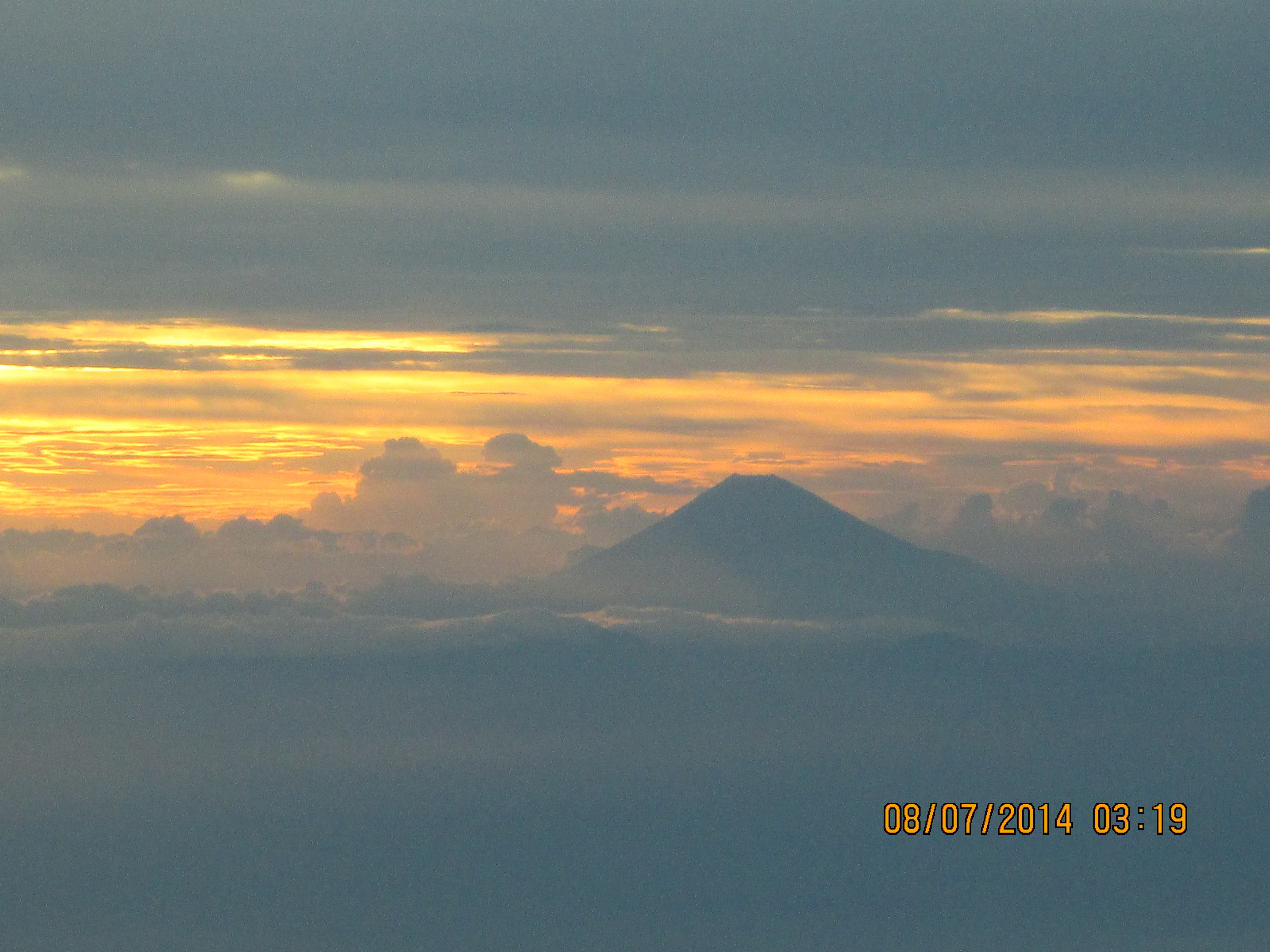
(The most photographed place on the planet… Mt. Fuji. I snapped this on a return flight into Tokyo from Guam.)
I managed a few hours of restless slumber and greeted dawn with a cup of (typically) strong Japanese coffee in hand. My brain was brimming with excited thoughts and questions. The first destination in this new chapter of my flying career on the opposite side of the planet was an island whose name would, indeed, live in infamy (sadly, Asia hosts many of those). This small island, lying within the Mariana Islands archipelago, had me conjuring images of a horrific, bloody conflict that raged for weeks in the summer of 1944. It would claim thousands of American, Japanese, and civilian lives, and history would paint it as one of the seminal turning points of the war in the Pacific. I knew much about the battle for the island of Saipan, but almost nothing about the island itself.
Later in my Pacific flying, our cockpit crews (Captain and First Officer) stayed together for the entire two-week trip, but in the early 2000’s, when I began flying in Asia on the 757, that was not the case. I had my First Officer’s name on the crew orders, and I knew he would be flying in from Nagoya and continuing south with me to Saipan, but that was all I knew. He was roughly halfway through his 12-day trip and would depart Saipan the next morning, while I would remain there for an additional day, joining my next F/O on day 3, shortly before we departed for our return to Narita. Why Northwest Airlines played this game of “Where’s Waldo?” with the flight crews is anyone’s guess; but knowing that management, I would guess a “bean counter” convinced someone it would save money. Maybe it did, who knows? Those decisions came from the rarified air of a Minneapolis boardroom far above my pay grade.
Throughout the day (we were scheduled for a 9 p.m. launch that evening), I logged a few hours reviewing tons of training material concerning “all things Asia flying,” and even attempted a nap (unsuccessfully). A long walk was just what the doctor ordered, and it was actually very nice to find myself back in the world of our Japanese cousins. It had been several decades since I last spent time in this wonderful world, and, as in the last 1000 years, it was comforting to see that the rhythm of this mystical world of smiling, bowing, friendly people seemed unchanged. One still walked on the left, smiled a lot, bowed at every opportunity, and, for heaven’s sake, when crossing the street, looked for traffic in the opposite direction from what we do here in America. They drive on the “wrong side” of the road, and more than one crew member has been rudely reminded of this (sadly, we had a few fatalities as a result). Within a short time, the shock of being in a world so foreign to my “American psyche” vanished, and I was once again in a land that I would grow to respect and love.
A few hours after sunset, I boarded the hotel bus (with the crews bound for Taipei, Bangkok, and Manila) and, after being deposited at the South Wing terminal curb (having no idea where our Northwest Airlines Pilot Planning room might be located), I adopted a “follow the herd” mentality and took up a spot in the parade. After an elevator ride, several long, winding hallways and coded doors (and one very lonely checkpoint manned by the Japanese security version of the “Maytag repair man”), we finally arrived at this mythical room. Fortunately for me, this herd of pilots readily accepted this “noob” and even pointed out several landmarks en route to the office that would become as familiar to me over the next decade as my own residence.
Meeting up with my F/O John R., he (patiently) took this new Asia Captain under his wing and walked me through the many steps required to get the big Boeing (N5641US) out of the gate and 1500 miles south to the largest island in the Northern Mariana chain. I was not new to the jet (having transitioned from the 727 eleven years earlier), but the differences between flying from Minneapolis to Orlando and from Tokyo to Saipan would be monumental.
Things like navigation, ATC communications, FAA (or in this case, JAA) rules and regulations, weather issues, and dozens of other items that every domestic pilot knows cold would all be radically different. Couple that with the inevitable contrast between how the book teaches it and how it’s “actually done on the line”, and those first several trips to an international destination could leave you with a little of the “taking a sip from a fire hydrant” feeling.
Two final items to mention here. One is the seriously important issue of taking a two-engine flying machine over a vast expanse of ocean and suffering an engine failure, thus leaving one with the exact number of engines that Orville and Wilbur employed. The second is the ability to communicate with the various air traffic control facilities.
The first is more of a planning issue (in case of the very serious issue of losing ½ of your thrust); it’s called an ETP (equal time point…in the movie “The High and the Mighty” they refer to it as “the point of no return” lol), whereby, if the worst occurs, it would take less time to fly straight ahead to your destination (or ETP alternate airport), then to turn around and return to your point of departure (or ETP alternate airport). We routinely used a very small island, which lies roughly halfway along this route, as an alternate; more on that later. Still, even though it was the only airport along this route (literally), it came with its own set of issues. The Japanese military operated it, and you needed prior notice (read: permission) before landing. During the next decade, IIRC, we had but one aircraft divert to this airport; (thankfully) it was during daylight hours, and the story had a happy ending.
Finally, as mentioned in one of my prior pieces, our “line of sight” communications radios were useless over the ocean, so vitally important information like traffic separation and weather avoidance clearances became, at the very least, far more complicated, and at the extreme, nearly impossible (in later years, we would adopt a datalink satellite system that worked well, but that was years in the future). At this point, we used a system of HF (high-frequency) radios that were finicky and susceptible to factors such as sunspots, time of day, lightning strikes, and other atmospheric anomalies. We would be provided with a list of HF frequencies that the NWA Dispatch Office predicted would be usable on that route (at that time of day …or night), and crossed our fingers.
I found out early in my “Asia career” that using these radios was far more art than science, and the NWA provided list of frequencies was often useless. Fortunately, our manuals offered more options, and we spent many nights head down in the manual, tuning the next frequency and hoping for the best. I always envisioned the old black-and-white movies: the disheveled DC-4 radio operator, one hand pressed to an earpiece, frantically trying to contact a ground station with the plea, “Rangoon, Rangoon… come in Rangoon…do you read me Rangoon?” A simple ATC position report would (at times) be like pulling a tooth. In the end, we would “shake and bake,” and when the San Francisco dude could hear us but the Guam guy couldn’t, we would give our report to a bloke 2500 miles away and have him forward it to the guy just a few hundred miles in front of us. Again, “science” in the form of art.
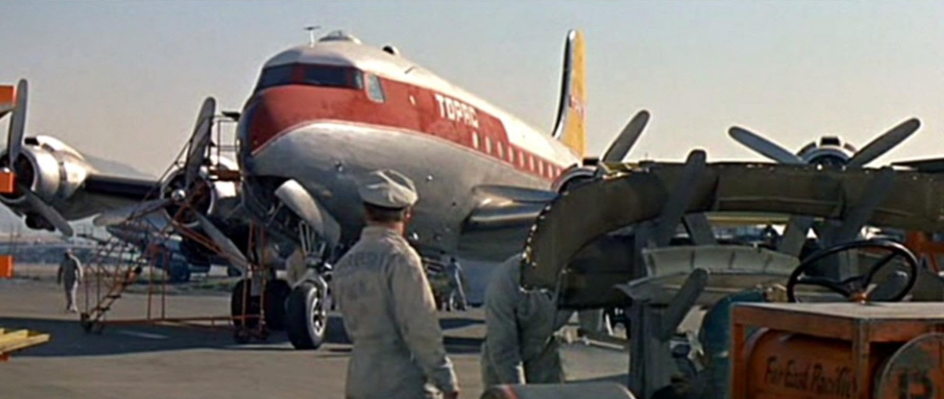
(The beautiful lines of the Douglas DC-4 are timeless.)
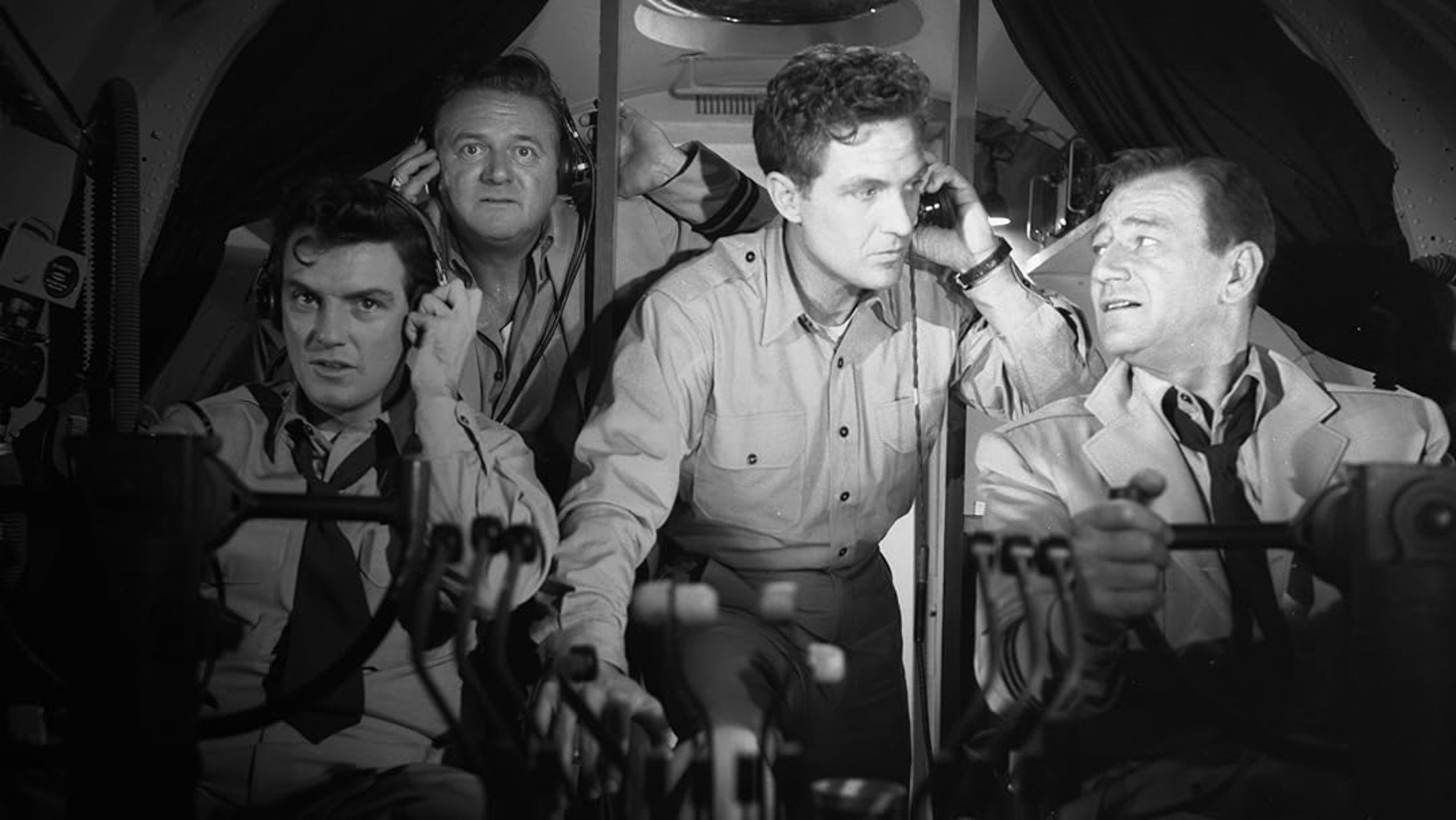
(I’m hoping that when I was a lowly Flight Engineer on the Boeing 747, I never looked quite as “bug-eyed” as the dude on the back left.)
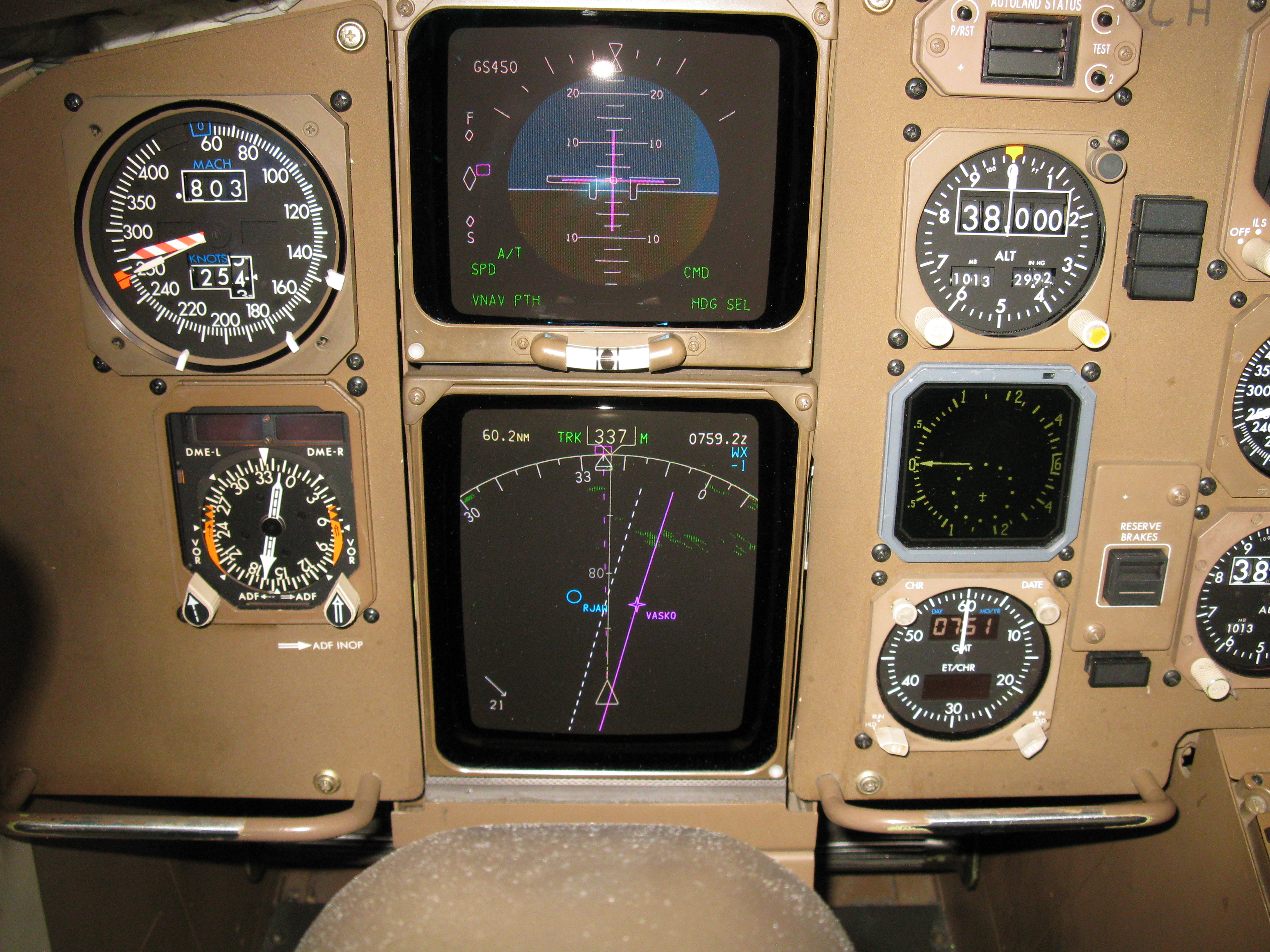
With all that said, we launched shortly after 9:00 p.m., and within the hour we had flown out of any radar and ATC coverage. I had opted to be the “PF” (pilot flying) for the leg and give John the “joy” of working the radios. Roughly an hour and a half into the flight, I noticed a blue circle on our Navigation CRT (denoting an airfield with a runway length of at least 5000’). It was an island whose name was etched into the pantheon of warfare as the bloodiest battle of the Pacific War. It was a tiny island (roughly 5 miles in length, 2.5 miles in width) that would have the distinction of claiming more American lives than Japanese. A total of 26000 American casualties versus approximately 18000 Japanese would be killed, wounded, or missing before the 36-day battle was over. On day four of the battle, a photographer from the Associated Press would snap the most iconic picture of the Pacific conflict, earning him a Pulitzer Prize. His name was Joe Rosenthal, and the island was Iwo Jima.
(The display on our lower CRT depicting the island of Iwo Jima. This was snapped on 09 October, 2011 as we were heading northbound at 38,000’ [or as we say “Flight Level 380”]. The little triangle [representing our aircraft] can be seen turning northwest from the airway as we begin to navigate around the storms depicted along the airway north of the “VASKO” intersection (the green blobs superimposed from our weather radar).
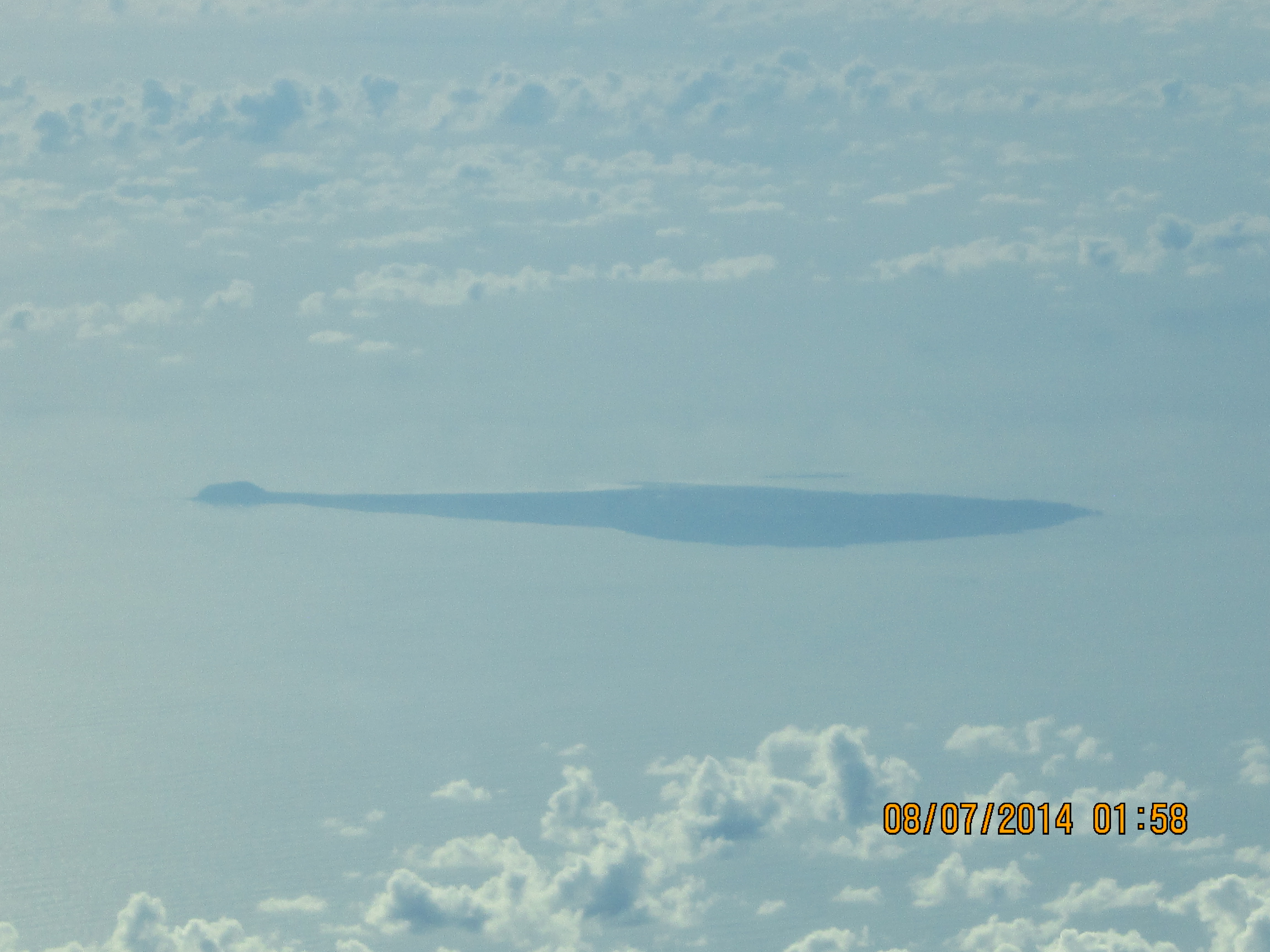
Naturally, because of the darkness, I had to wait until a daylight return to Japan to glimpse this hallowed island, and over the next several years, I flew past many times in both directions. Each time, I tried to snap a picture with my (ever-present) compact camera. More importantly, I would offer a silent prayer for all the young men (American and Japanese) whose last glimpse of this world was the volcanic rock of the isle I was gazing upon. Twenty-seven Congressional Medals of Honor were awarded following the battle, fourteen of them posthumously; prompting Admiral Chester Nimitz to utter his famous epitaph regarding the fighting, “On Iwo Island, uncommon valor was a common virtue.” I never flew past with nonchalance, but always with an overwhelming feeling of reverence.
(Iwo Jima. Passing northbound on the same route as mentioned in the previous picture. Mount Suribachi is visible on the left at the island’s southern tip.)
A few hours later, I was landing on Saipan, again, another of the infamous islands that had been bathed in blood and misery roughly a year before the battle for Iwo Jima. Slightly over a week after the Allies’ D-Day landings in Normandy, Marines (and Army units a few days later) landed on the island, and [as mentioned earlier] it would prove to be a seminal event in the war in the Pacific. I plan to pen a piece soon detailing my time spent exploring that infamous island.
After another restless night working through the jet lag of a fourteen-hour time zone change, I rented a moped scooter and drove to the General Aviation terminal at the airport. There, I inquired about how I could catch a flight to the island of Tinian. It lies just a few miles southwest of where I was standing, but in the summer of 1945, it was THE busiest airspace in the world, and (arguably) one of the more important locations on the planet.
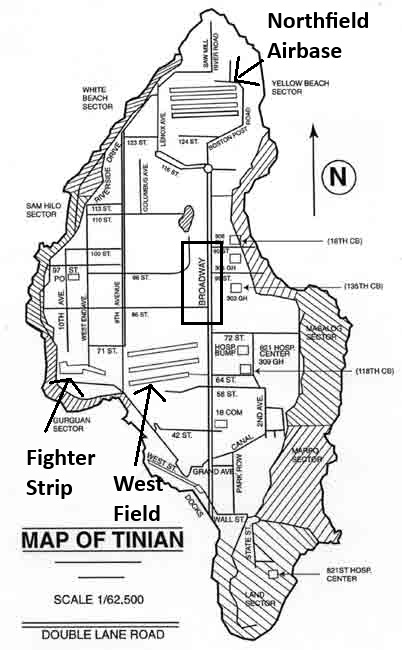
Fortune smiled my way, and after I asked about available flights (and showed the ticket agent my NWA company I.D. badge), she said the Piper Cherokee leaving in ten minutes was bound that way and that I could sign up for the “jumpseat” if I wished. I readily accepted her offer for a free ride, and roughly 30 minutes later I was stepping off the wing and onto the ramp of the small airport on the southern corner of the island. I rented another scooter and headed north on “Broadway Boulevard” (after the island was taken from the Japanese, the “Construction Battalions”, or CBs….or the more popular colloquial term; “SeeBees”… went to work constructing roads along with improving the runways at the North Field Airbase. They named the avenues after famous roadways in America.)
(The small commercial airport where the Piper landed lies approximately where the “West Field” was located. You can see a few of the other famous road names: Wall St., 42nd St., Columbus Ave., Canal St., etc. “Broadway” was the main thoroughfare leading toward the massive North Field Airbase.)
My destination was a place that few have heard of, and fewer still have visited. Regardless, this location was as significant to the history of America (and the world) as Plymouth Rock, Valley Forge, Gettysburg, or Tranquility Base. The men and women who occupied the northern tip of this desolate island would change mankind forever.
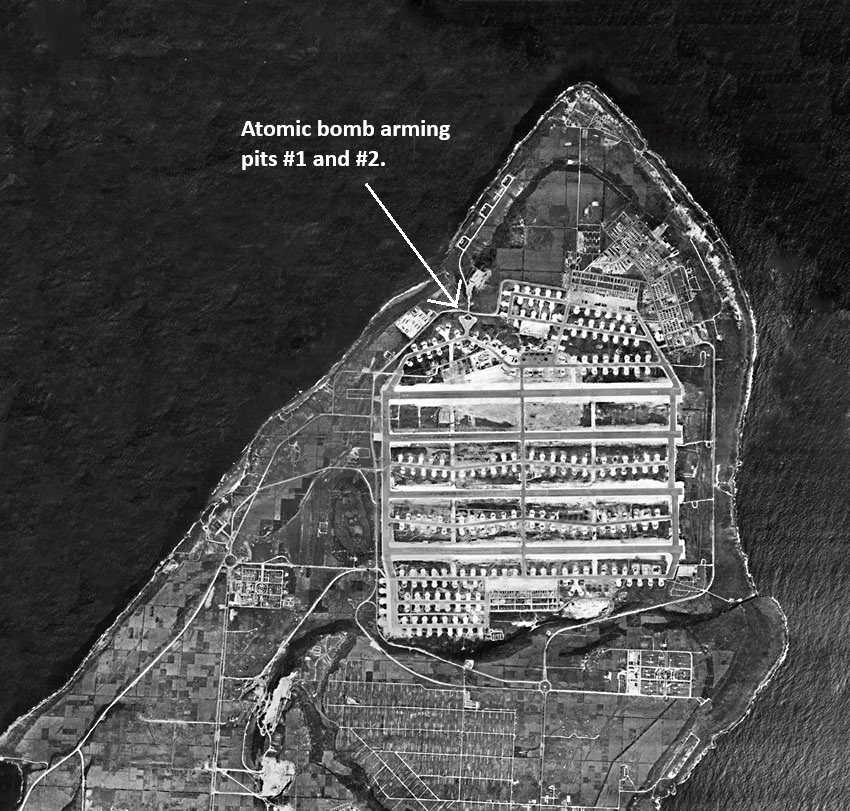
The farther north I rode, the more isolated I became from other humans, and I saw only two other vehicles: both small cars headed in the opposite direction. When I reached the North Field Base, I could instantly tell it didn’t resemble the pictures I had seen of the gigantic B-29 bomber base circa the summer of 1945. The two southern runways (named Runway C for “Charlie” and Runway D for “Dog”) were completely overgrown with a dense jungle of thousands of the dark-green, smallish trees. The two northern strips of crushed coral (Runways A for “Able” and B for “Baker”) were visible but (again) didn’t much resemble the old photos. Time heals all wounds; it also inevitably leaves wounds of its own.
(Satellite view of the massive North Field Airbase. When the Marines captured the airfield, there was but a single runway: the north one, and it was roughly 1/2 the length you see here).
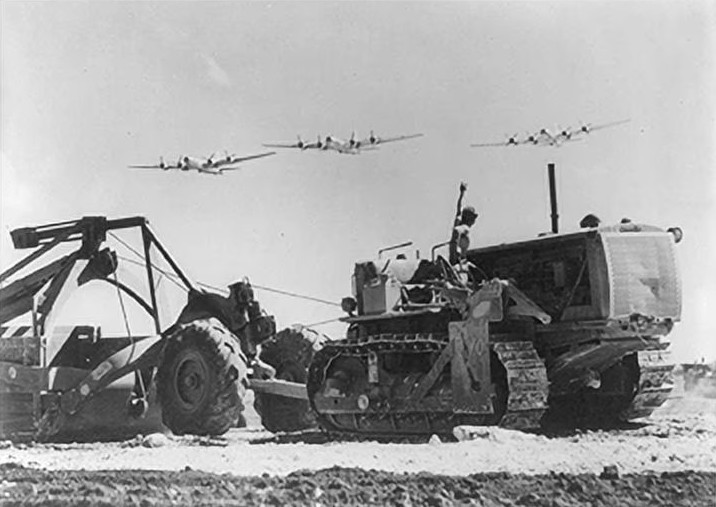
(It took roughly 45 days for the “SeeBees” to complete the runways, and during many of those days they were under enemy fire.)
I spent the next few hours riding, walking, and reading the few plaques left by those who knew that I (and those like me) would someday need to see their words. Mostly, though, I spent those hours sitting in the soft breeze, lost in thoughts of the gravity of where I was. Much like when I gazed at the multitude of white crosses on a bluff overlooking a beach called Omaha, or the ovens I stood next to (unable to comprehend what I was seeing) as a 10-year-old in town by the name of Dachau…my thoughts, my feelings, and the ghosts that sat with me on that morning were overwhelming.
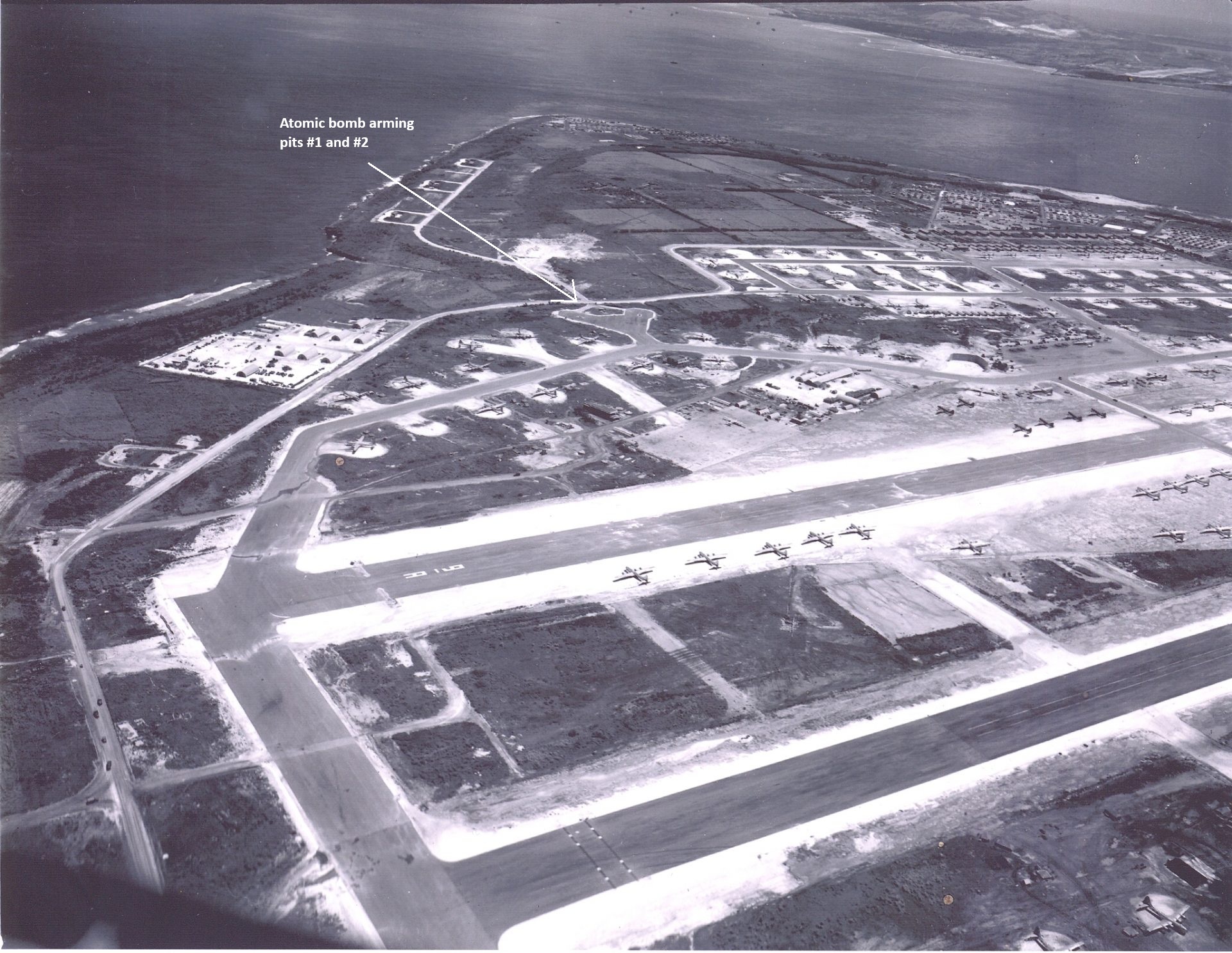
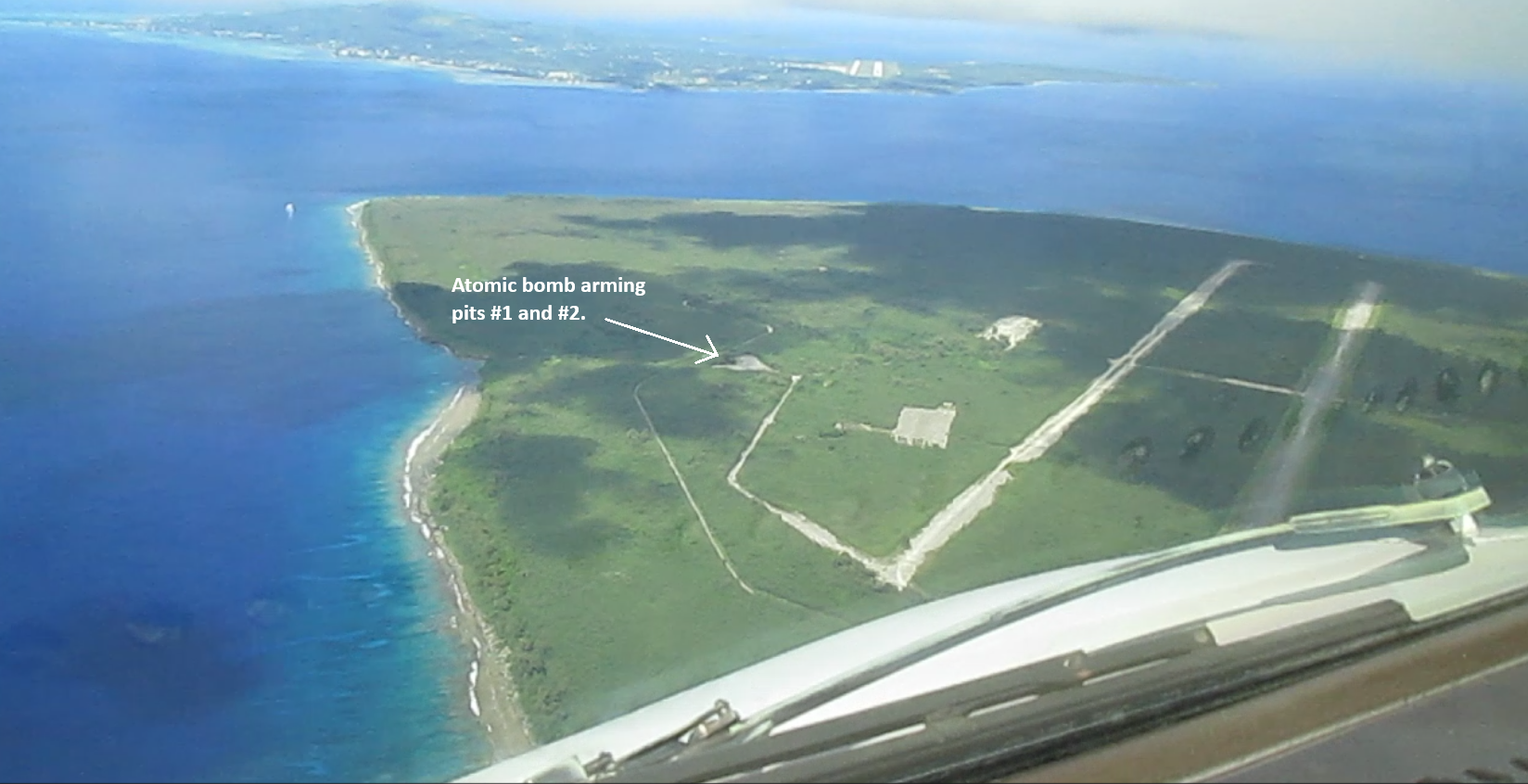
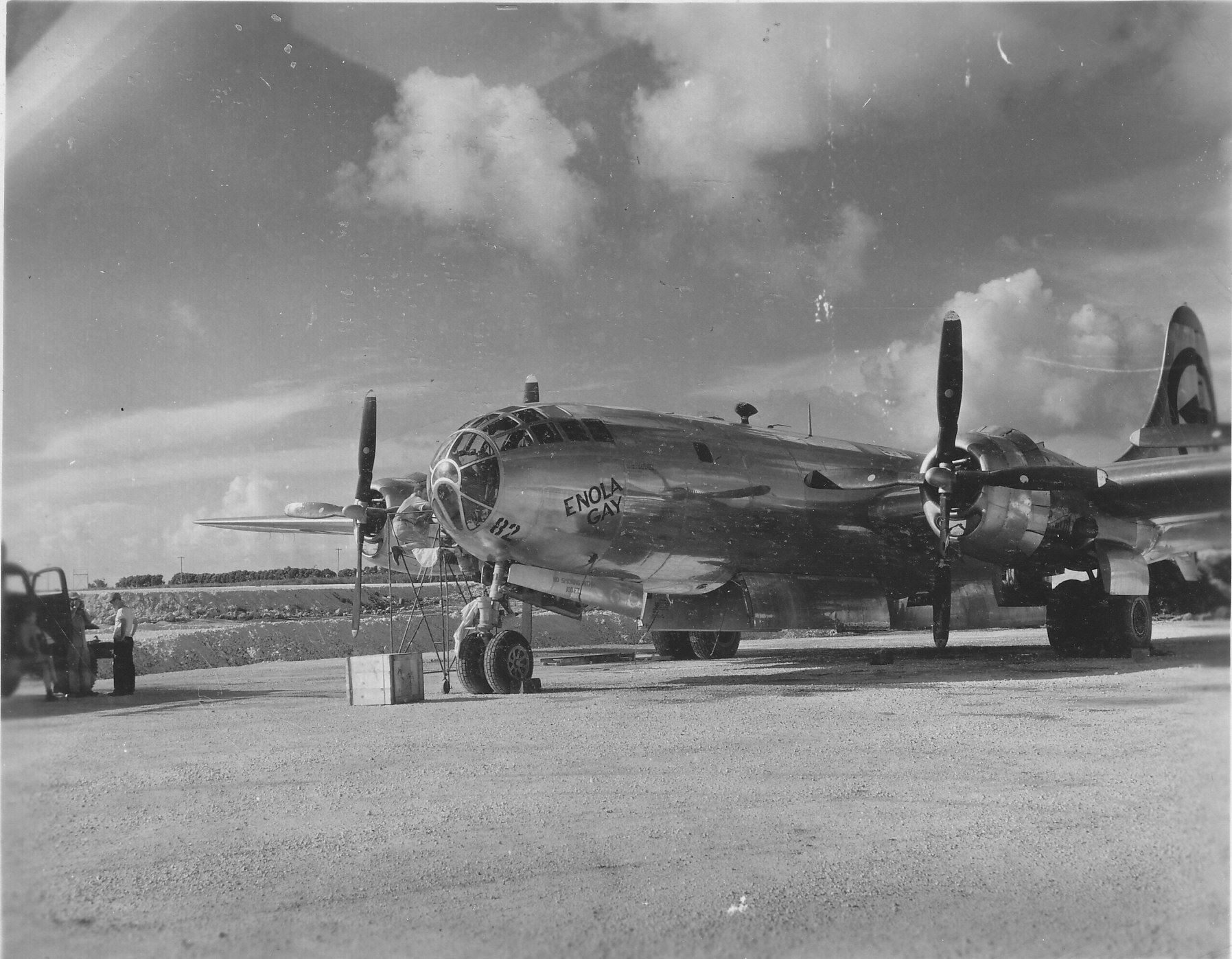
(During its heyday, the North Field Airbase was home to almost 300 of the massive B-29 Superfortresses. As I stood next to the arming pits, I was lost in a feeling that I was standing on hallowed ground.)
The thousands of sorties that lifted from these runways during the months of 1945, flown by men barely old enough to shave, have mostly been forgotten; overshadowed by the two missions that left in the middle of two steamy August nights. Hours after they took off, they would light up the morning skies over Hiroshima and Nagasaki with weapons so terrifying that words are wholly inadequate. Through the prism of time, I felt what those men did not/could not, for they had no way of knowing what history would ask of them. Through THEIR prism of time, however, they would learn what I knew; they would learn of the consequences of those flights. Some would see their graves as men filled with shame and regret; others would face their final hours feeling they were a catalyst to ending the pain and suffering of an already severely injured world. I refuse to judge; I leave that to the grace of God.
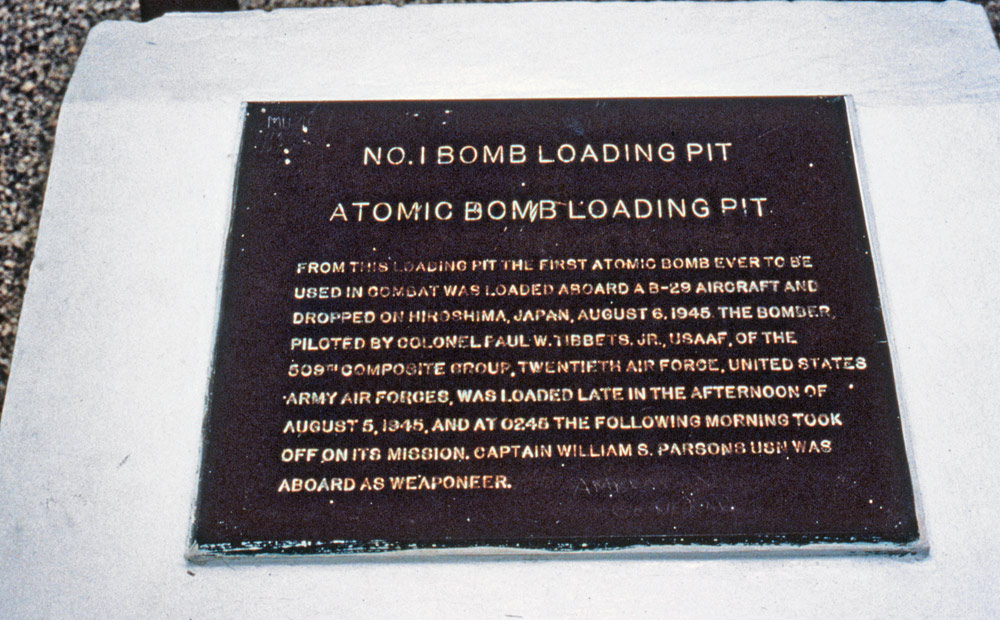
One thing is clear: on a peaceful November morning 18 years ago, I sat by a glass-enclosed “arming pit” on the tip of a small, isolated island in the Central Pacific. The plaque on the stone pillar was titled, “No 1 Bomb Loading Pit – Atomic Bomb Loading Pit”, and the next seventy-six words read like an ad in the classifieds. Matter-of-fact statements, devoid of opinion, empty of any hint of emotion. I was dumbstruck as I read the words; they mentioned nothing of the pain, the untold horror, or the suffering. It left me numb, then it dawned on me: it must be written that way; the plaque was there to refer simply to the mission, not the obvious ramifications. Was it moral to kill thousands so that millions may live, destroy a city so the rebuilding of the world could begin, make horrific war so there could be heavenly peace? Again, in my opinion, only the infinite wisdom of the good Lord can answer such a question.
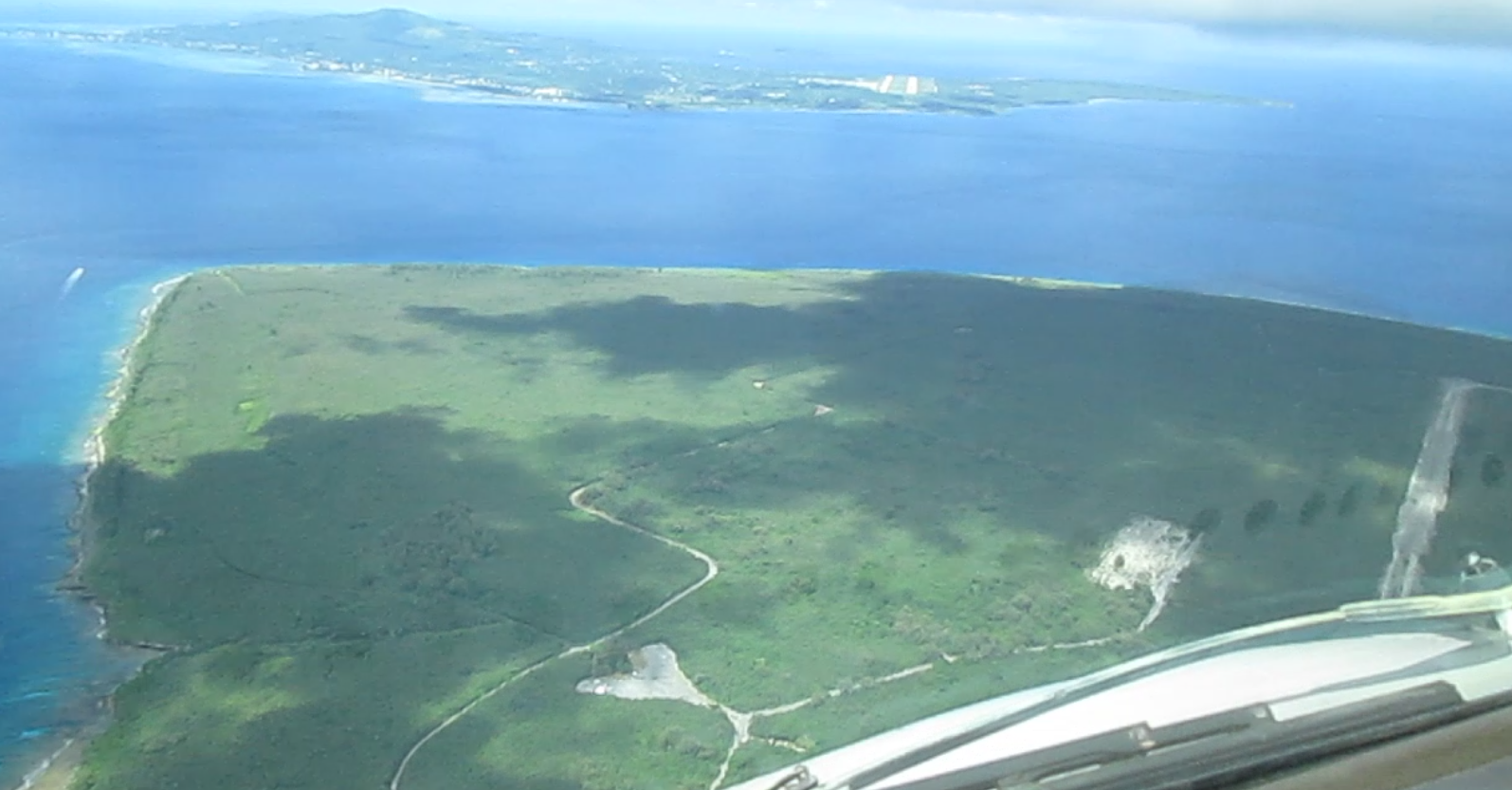
(One of the arming pits as it looks today.)
I sat for a long time. Eyes closed, “listening” to the sounds…not the soft breeze in the trees, but the sounds of the world’s busiest airbase in the summer of 1945. I heard the drumbeat of untold jeeps and trucks of all shapes and sizes; all going about the business of a huge military airfield at war. I listened to the paradox of the joyful laughter of men and women too young to know much about life, and the strained tones of the worry and anxiety of what lay ahead of them. Some would die; many would live. The ebb and flow of noise on an island [roughly the size of Lakeland, Florida] suddenly inhabited by roughly 50,000 people.
And then there were the roars. The unmistakable, throaty roars of hundreds of huge Wright-Cyclone R3350 engines straining to convince the world’s biggest, most deadly flying machine to defy gravity. One by one, they taxied past me in an extended “conga-line” of winged silver machines toward the long white runways.
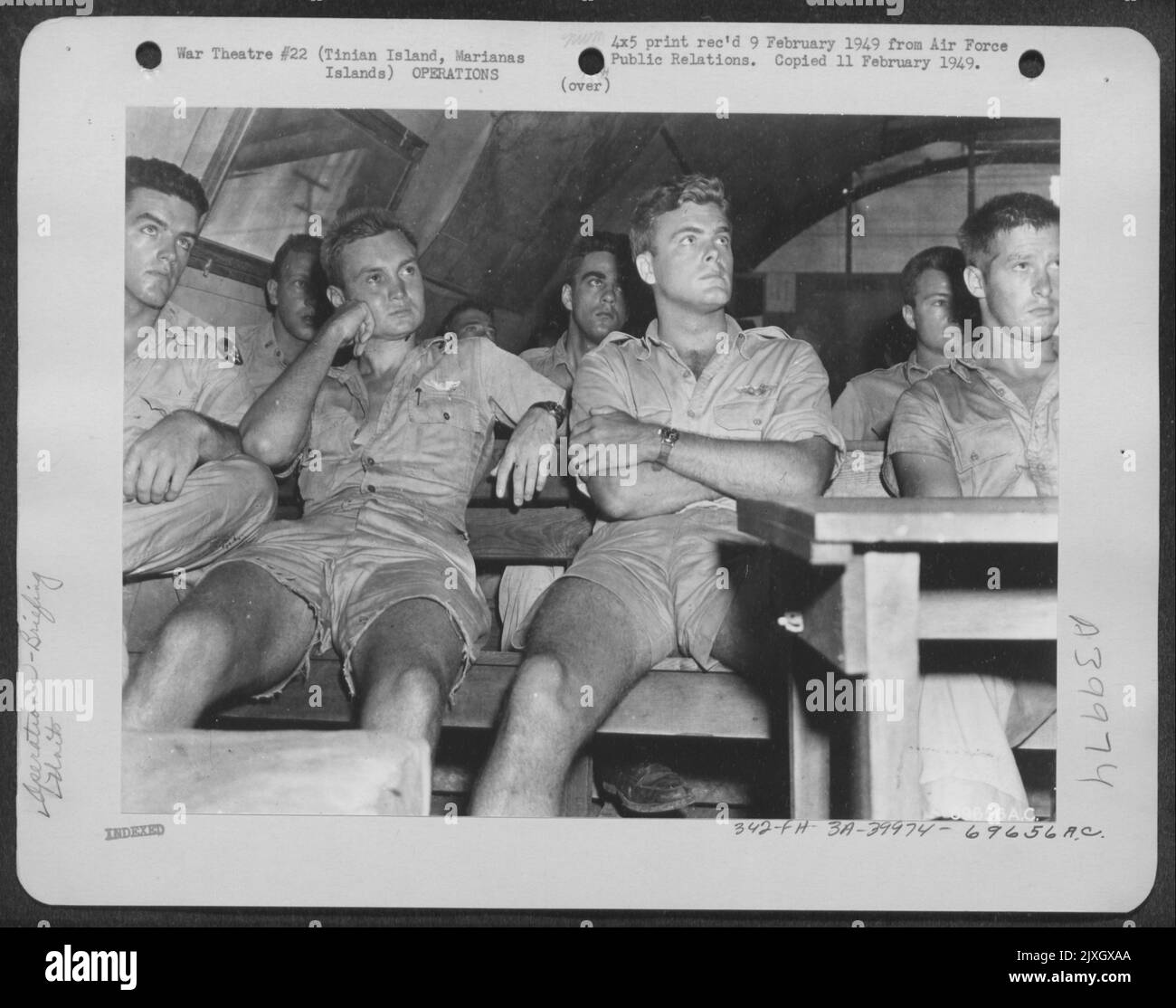
On board, each of the 11-man crew sat alone with his thoughts. Squadron and Flight commanders wishing the Briefing Officer’s cryptic quips of “unknown” to the questions of flak and fighters would cease playing in their ears. In the cockpits, pilots concentrated to stay in an orderly, sequenced line and keep the brakes from becoming red-hot from overuse. Behind them, Flight Engineers frantically worked the cowl flaps and intercoolers to keep the big engines from overheating in the sweltering, heavy Pacific air. The Navigators and Bombardiers sat chain-smoking at their small desks, checking and rechecking their calculations. Farther back through the pressurized tunnel, the half a dozen gunners silently prepared their tools of war. The long, slow march continued, and every man in every machine (unsuccessfully) tried not to remember the aircraft that crashed on takeoff two nights ago, killing all onboard. It was not the only one to crash…just the latest.
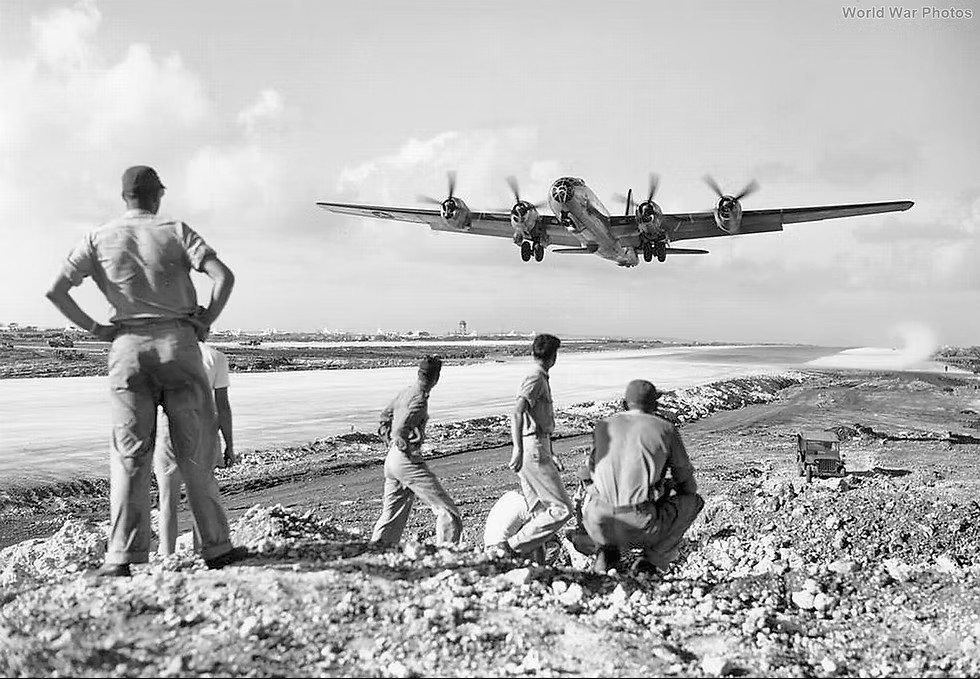
(If it looks like they were very young, it is because they were. I’ve asked it many times before, “Could the twenty-somethings of today do what these young men and women were asked to do?” I pray they will never have to find out.)
I “listened” as the huge, silver machines rumbled by in a seemingly endless line toward the four runways. Reaching the end, they turned onto the long, coral-paved strip, and 30 seconds apart, they roared to life, slowly picking up speed and lifting into a darkening crimson sunset. After the landing gear and flaps were retracted, they would slowly, gingerly turn the heavy bombers north toward Japan and their fate. Soft prayers from the ground crews followed those young men in the big silver birds, and I said one silently for their lives of service and sacrifice.
(The SeeBees paused only to watch the giant machines roar by.)
Slowly, I opened my eyes and was, once again, utterly alone. The legion of ghosts who silently walked, and sat with me, were my bridge to the past on that day. They were young, and I was not, and I wished that I knew their names. They (and the millions of others who saved the world back then) had drifted into the bin of history; a destination we all will inevitably share. They were ordinary young men and women living during extraordinary times, and writing the epic pages of history with each tick of the clock. On this day, for a precious few tics of that clock, they allowed me into their world, and I was in a time and a place that would change mankind forever. I obviously never knew them in this life, but on that November morning I was allowed a glimpse into the lives they led during that summer, on that small island in the Central Pacific. During my hours with them, they were companions of the highest order, and I was honored to be there with them.
What they did altered history for all eternity, and a small part of me envied them. All of me, however, sat in reverence for them.
(Two shots on approach to Runway 07 on Saipan.)
It was a morning and afternoon that I shall never forget.
God bless the young men and women of a generation that gave of themselves to save the world.
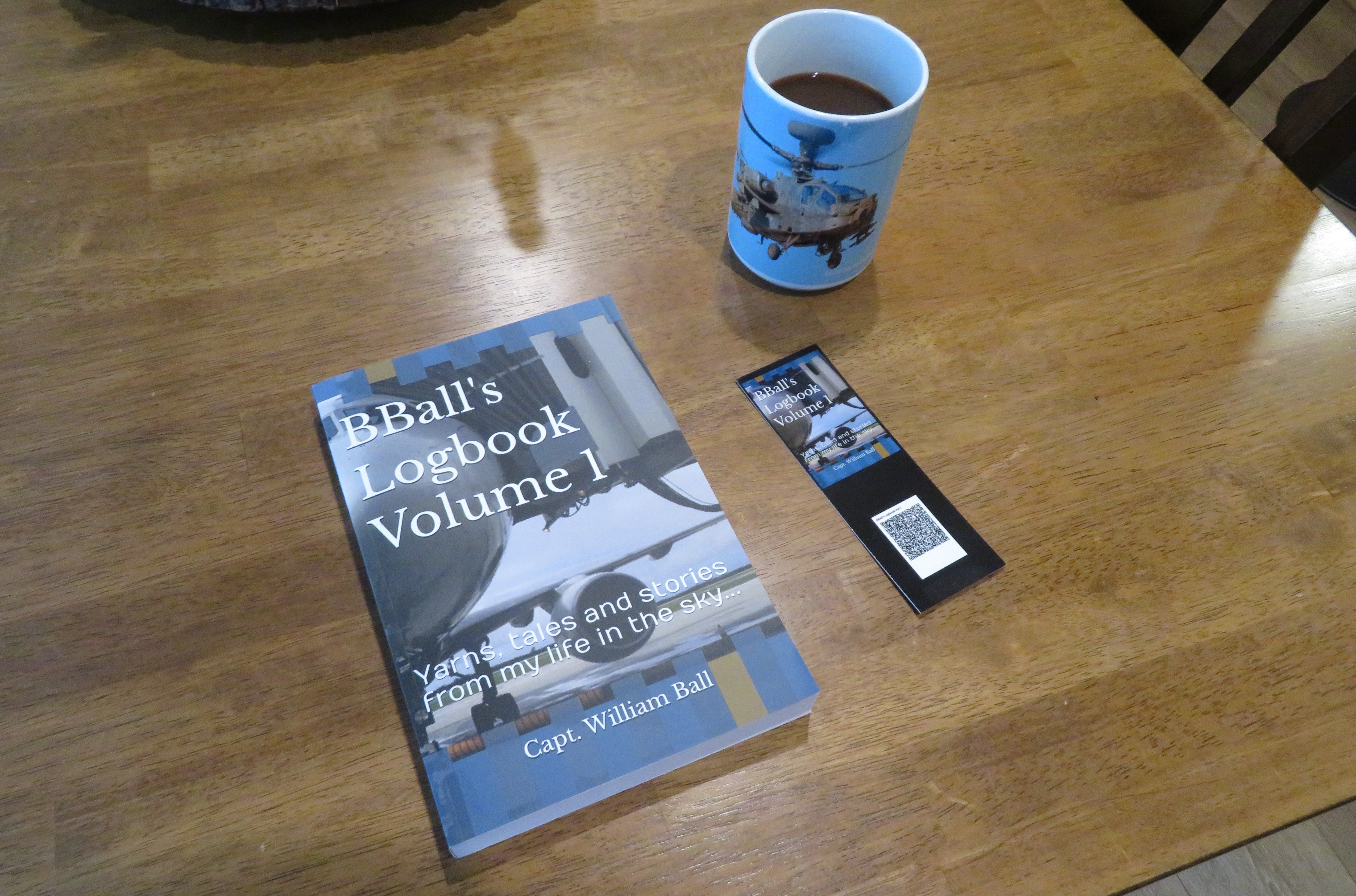
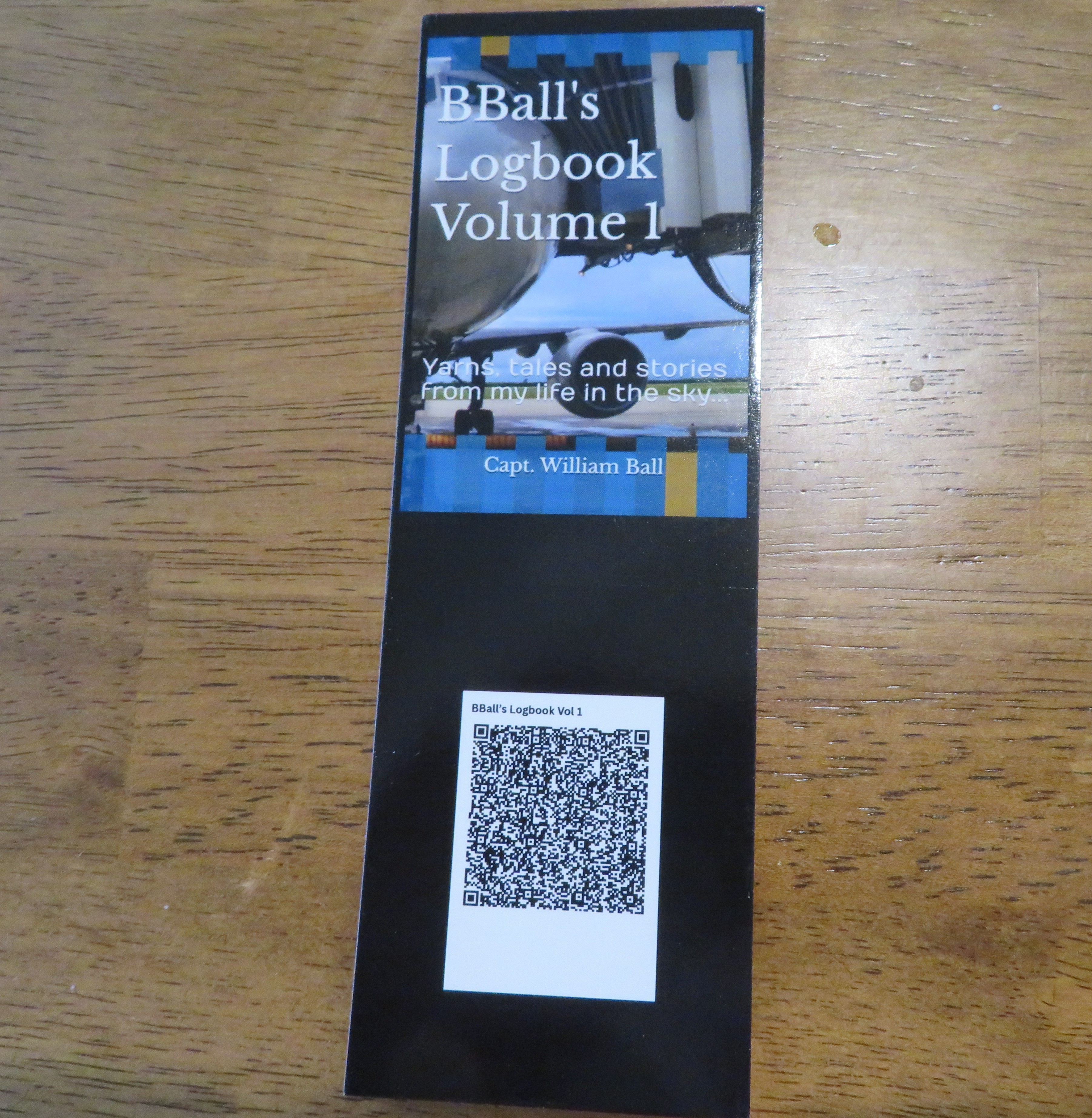
Just a short note to say that I FINALLY pulled the trigger and published my first book of stories and yarns from this blog site. Its title: “BBall’s Logbook Volume 1.”
Was it easy? Not really. I used Amazon’s self-publishing service, but the learning curve regarding the “work” of formatting, etc., was a bit steep. In the end, copious use of their instruction pages and plenty of YouTube videos (sprinkled with a few exclamations at the screen of “WHAT? I don’t even have that button on my version of MS Word!”) finally left me with a version that looked nice and read easily.
I was ably assisted by my loving wife, Debora, who served as chief editor, content aide-de-camp, visuals expert, and advertising guru. Frankly, without her help, I would probably still be working on this… she was indispensable. I strongly suggest that if you are harboring aspirations to publish, find a trusted advisor/confidant to assist you. They will be of immeasurable help, and possibly aid in keeping one’s sanity intact. Just sayin…
Speaking of advertising, her excellent suggestion was to have snazzy bookmarks printed with a QR code to help with ordering. They have been sent into the universe and beyond.
Volume 1 contains 12 of my tales, and I have recently begun work on Volume 2. Much like a parent corralling a house full of children, I have dozens upon dozens of these stories, but no real favorites. Each one holds a special place in my psyche. Some are full of joy and laughter, and some contain the opposite…but in the end, they are all from the heart.
As I glean them from the pages of this site and deposit them in the book, they will exist only in the Volume in which they are inserted. Rest assured, I have begun work on more… for my multiple Logbooks are brimming with lots of amazing tales from the sky.
If you choose to purchase Volume 1, I sincerely thank you. I hope you enjoy it.
It happens each month like clockwork. Nope, I’m not talking about the normal ills of being a (greying) whisker shy of seven decades of sunrises. Nor am I speaking of “old friends” like the aches and pains that come with moving too fast, or midnight bladder runs, since that thing called “middle age” hit like a tsunami. No, I am speaking of something that comes with the regularity of the tax man; the monthly publication of my union magazine (yes, even retired pelicans continue to receive it). The “Air Line Pilot” magazine’s ability to track one is legendary, almost mystical, for after several cross-country moves with no effort to update my address, it still inhabits my mailbox on a regular basis. I am quite certain that after the wizards at the Witness Protection Program erase you from all memory, the ALPA gnomes will locate you, and the magazine will show up just as it did the month before (when you were an actual person).
Regardless, it magically appears and is mostly filled with articles regarding airline safety, various FAA issues, new technology on the horizon, and information regarding the various ongoing contract negotiations within the industry. All those are fine and dandy, and mildly interesting to a retired pilot. Still, within the slick, glossy pages of this periodical, there remains one section that I (and most of my contemporaries) thumb to immediately.
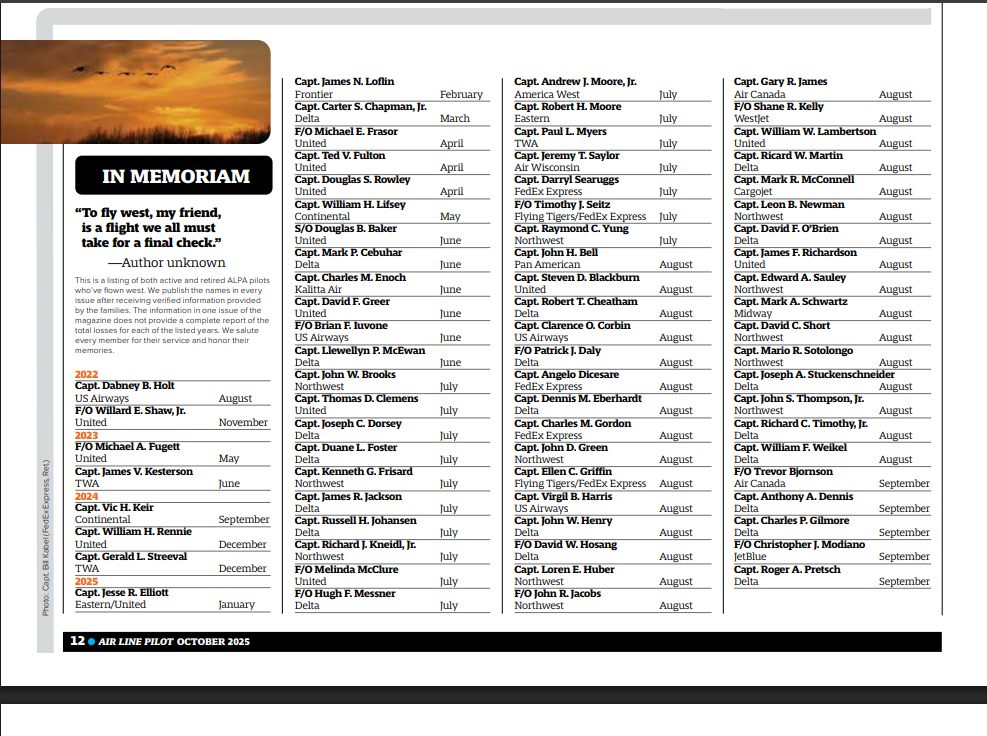
It is called “In Memoriam.”
In aviation, we have a saying when one of our brothers (or sisters) passes from this Earth into the next realm… we say they’ve “flown west.” Within this section lies a hallowed list of aviators that reads like a roster from the dusty book of line pilots who have taken that journey “west”. Under the title sits a short poem/mantra that is as familiar to most pilots as their Pre-Start Checklist. It reads:
“-Author Unknown”: “To fly west, my friend, is a flight we all must take for a final check.”
To those of us who have shared our world among the clouds, sitting but a few feet from a person for hours (even days) on end, there exists a bond that is as sacred as it is unexplainable to those who have lived within the restraints of gravity. Each month, as I page through the names, the list seems to be longer than the last. As the months pass, I recognize more of the names as those of brothers (and sisters) with whom I have had the privilege of logging flight time. They have all departed “west” to their eternal layover, and not surprisingly, some of the names spark the memory cells in my brain. Many of the names evoke wonderful memories (occasionally one that conjures the opposite), and I’ve either written about many of them or (in some cases) intend to pen a yarn about them in the future.
(The “In Memoriam” page from a recent ALPA magazine.)
It was a pleasure and an honor to fly with these folks, the ones who groomed me as a young “birdman”, and those who had my back as a new Captain. In later years, as my experience and comfort level in the Commander’s seat took on the “old shoe” style comfort, I endeavored to mentor the younger crewmembers and (at times) take on the role as a trusted advisor and marvel at their talent. They all (the wrinkled and the young) were amazing pilots, skilled in their profession, and they were a joy to work with (and for). The following link is a yarn penned many years ago of one of my all-time favorites when I was a new-hire at Northwest Orient Airlines:
Before my 37-year career at Northwest began, I was fortunate to fly with the most incredible group of pilots I had ever been a part of. We all worked for a small airline called Scheduled Skyways, based in Fayetteville, Arkansas. There were fewer than 100 pilots at this line. The following list reads like a “who’s who” of the gifted Captains at Skyways in the 1980s: Jim H., Jay T., Ron R., Wendall L., Gil M., Bill L., and Pat B. After a year, when I moved to the left seat and took command of the small “airliner” for the first time, the list of trusted First Officers was as hallowed as the list of four-stripers: Steve “Buzz” B., Cortney K., Pete C., Strawn F., Will H, Sinotra O., Ted J. Al M., Matt S., Don P., Stu B., Greg W., John A., Buddy A., Mike C., Scott E., Grady W., Paul B., and Mike D. Every name from those lists were (are) excellent pilots, and I was extremely fortunate to have them in the cockpit with me. Not every pilot at this line was mentioned; some were inadvertently left off (my apologies), some not so inadvertently.
The names mentioned are the men who helped shape me as a professional pilot, and many became friends (some to this day), and I was blessed to spend four years in my mid-twenties with them. Although we never shared the crucible of flying bullets and flag-draped coffins, we shared many a rain-swept, lightning-filled sky, more than our share of trials with difficult flying machines, and lots of bad days with difficult airline management. Pain spares no man, and we were no exception. We helped each other through death, divorce, and illness. When my beloved oldest sibling tragically took her own life in 1982, a dear friend and colleague made a suggestion that has become a lifelong outlet for my thoughts and feelings. He suggested that I begin a journal (“blogs” did not exist back before a guy named Gates hooked a keyboard to a screen). He explained that many years removed from the event, I would recall the event itself, but the details, and especially my feelings/emotions, could easily be skewed. He was spot on, and thousands of hours, ten calloused fingertips, and gigabytes of X’s and O’s (and one novel) later, I would be remiss if I failed to thank him profusely.
“Thank you, Peter, your suggestion has left many with sore eyes and bruised brains, but it has saved what little sanity I ever had… many times over. God bless you, brother.”
During those days in and out of the loud, cramped cockpits, we laughed, we bitched, and we bonded. Thank you, gentlemen, you will never know just how much I cherish those days.
Then there was Mark Detrixhe.
I first met Mark on a clear, pre-dawn September Sunday in 1979. I had been in the employ of the small “hometown” airline in Fayetteville for one month and one day. This was to be my fifth day of flying as a new First Officer on the Swearingen Metroliner in the livery of Scheduled Skyway. The initial training was “interesting” to be sure; it was flown in the middle of the night (the machines were far too busy to use during daylight hours), and under the intense tutelage of the Chief Pilot Ted B. The one other pilot in my “new hire class of two” (Howard S., who became a good friend and ended his career with FedEx) and I felt like we were taking a sip from a gushing fire hydrant. It was a huge amount of information for two young pilots (me, from the world of night freight in the Piper Navajo, and he, from the SoCal world of flight instructing). Still, we studied hard, flew to the best of our ability, and completed the program. I recall my first impressions of the machine was that it was very loud (we wore “noise cancelling” headsets…they did not cancel much of anything but a nice haircut), was much larger and heavier than anything I had piloted before (it had a 12,500 pounds gross take-off weight…by comparison the Navajo tipped the scales at just over 6000 pounds), and was rather over-engineered… a fancy way to say it was a complicated airplane (it was my first experience with things like “bleed switches”, “start locks” and “current limiters”).
(A typical Piper PA-31 Navajo cockpit.)
———
(A typical Swearingen Metroliner cockpit.)
The previous four days of this, my “virgin” week, were a blur. For the first two days, the weather was characteristically ugly for late summer in the Ozarks. Thunderstorms across the entire route structure (to include a missed approach at one of the smaller stations, Harrison, Arkansas), with lots of turbulence, heavy rain, and winds. After the front had passed, the next two days were a daze of dense, hazy skies and hot, humid flights. The four Captains for these first days were either the oldest guy I had ever flown with (Ray Y., … in his 70’s!), silent and surly (Art K.), or just rather “different” (Ed F. and David R.)…nice guys each one, but not the kind of commanders that might put me at ease (and thus relaxed) enough to truly glean anything useful about operating this beast in the 14-hour day, 10+ leg world of the commuter airline flying. I hung on by my fingernails, did exactly what they told me to do, mostly just watched them fly the aircraft (they were all “old heads” with lots of time in the machine), and finished each day wrung out and exhausted. Day five with Mark would be completely different.
Northwest Arkansas, in the Fall, can be a stunning place to live. Endless forests filled with vibrant hues that leave nothing of the color spectrum to the imagination. Cool mornings, warm afternoons, and gentle winds. This was what I expected on the first four days of my fledgling airline career; luckily, this was what I was presented with on day five. After meeting this man (roughly my age) whose smile was eclipsed by his easy manner and friendliness, we departed Drake Field as the eastern horizon began to brighten with the approaching sunrise and settled into our day of hauling posteriors through the clear blue skies of the deep south. We motored through Ft Smith, Memphis, Harrison, and Fayetteville, back to Memphis, and finally returned to our home base of Fayetteville as the clock was a few hours north of noon. Where the previous four days were long, intense, exhausting hours in the cockpit, this day was exactly the opposite.
(Scheduled Skyways ship number N501SS on the ramp at Drake Field.)
My most vivid memory was that we laughed. A lot. He told (and showed) me things with the machine that no one had mentioned (admonishing me to “don’t try this until you have hundreds of hours in this piece of sh*t”). He did it all in such a way that as I walked to my car at the end of the day, I felt as if I had just flown with a “guru,” a pilot who had been doing something very difficult long enough to make it look easy. He had, in effect, given me a “master class” on flying a machine that was most assuredly NOT easy to fly. And he did this all the while keeping the cockpit atmosphere relaxed and fun. I would not crew with Mark again for two months (flying almost every day), and when I did, the weather that day was characterized by rain, fog, low clouds, and wind. It was decidedly more challenging than our first day as a crew, but did the pressure of a day of ugly weather change this “easy-going” pilot in the command of our machine (and me)? Nope, same relaxed manner, same fun “banter,” same practiced “wizardry” at the controls of a difficult steed, and same feeling for me at the completion of (another) long day in the Metroliner. The “master class” continued, and I looked forward to seeing his name next to mine again on the schedule.
For the next few years, we crewed many more flights through many more beautiful (and at times angry) skies, and I learned a great deal from him. He became a friend, and I can still see his smile, hear his funny yarns, and recognize his influence on me as a new “airline birdman” as real and positive. He was a “Captain’s Captain,” and it was a pleasure to fly with him so early in my airline career. Like the rest of us brothers at this line, we all went our separate ways (I being hired by Northwest Orient in November of 1983). For some of us, our journeys would cross at regular intervals; for some, we would never see each other again.
Sadly, Mark “flew west” a few days ago, and although the years saw us drift apart and our lives move in different directions, I knew my aviation brother was still an integral (read important) part of my flying journey. Our last “conversation” was in a group text, and it breaks my heart to say it was not as “easy” as our early days in those noisy, cramped cockpits. Though we might have parted as polar opposites regarding things of this Earth, I pray that he knew I respected him as a man, an exemplary aviator, and loved him as a cherished friend. Several from our little group have journeyed before Mark, and in the end, we all will pass that invisible barrier between here and what awaits us. He will be missed by everyone who knew him.
I sat in my office a few nights ago and raised a glass of spirits to Mark. I prayed that he found his “paradise” and that he knows that we miss him.
“Fly west, Mark, on your journey that we all must take for a final check. I wish you only following winds and calm skies, my friend. Buy Buzz a beer for me, oh, and grab one for yourself… put it on my tab, brother.”
Not actual tears falling from the ducts, but emotionally weeping. This is not new to my world, for since a bright-blue Tuesday morning in September twenty-four years ago, as each late summer approaches, I am left with a torn and bruised soul. The month of September is bittersweet; it is a time full of joy and sorrow. The first few days are full of delight and love as the next anniversary of the blessed birth of my youngest child dawns early in the month, and then a spiritual funk inevitably begins to take over. Each year, as we approach the eleventh day, my thoughts and emotions drift back to that day when a dastardly evil crawled out of its corner of Hell and came to the shores of my beloved America. On that morning, the world watched as thousands of innocent people were murdered at the hands of demons using peaceful, graceful machines of the air as their heinous tools. Over the years, I have written about it several times, attempting to find answers and some sense of closure to that unspeakable madness…sadly, mostly to little or no avail.
This year, after north of eight thousand sunrises, I am sad to say that my soul weeps more than ever. The sage advice that “time heals all wounds” can be accurate, but those words fall short in the context of this human tragedy. This year, the pain of what has become known as the “9-11 Anniversary” was made worse by more evidence that whatever lessons mankind may have learned from that painful morning seem to have faded. Evil continues to have an address within the human heart and thus the source of my words.
People have always used language to influence others. Words are powerful, very powerful. They have changed the course of countries, populations, and even mankind. They can be beautiful, uplifting, and steer the human heart toward greatness. The likes of “We hold these truths to be self-evident,” “Four score and seven years ago,” “Ask not what your country can do for you,” “I have a dream,” and “Give peace a chance” will live through time as some of our finest linguistic moments. Sadly, we have seen the opposite; Stalin uttered, “The death of one man is tragic, the death of thousands is a statistic,” Mao hissed, “Morality begins at the point of a gun.” Himmler warned, “The best political weapon is the weapon of terror.” Yes, words can be beautiful, and they can be worse than horrible.
But why the bruised soul? Why the internal weeping?
Again, this past week, we as a collection of humans witnessed more of the depravity that “9-11” displayed to us all those years ago. Our “advancements” in technology now allow for millions to watch death and suffering as never before. In past weeks, a video surfaced that depicted a man being repeatedly shot in the back as he walked down a New York sidewalk. Early last week, we saw an innocent young woman be savagely murdered on a subway train as others appeared to be uninterested, and a few days ago, the world witnessed a man being killed by an assassin while debating his thoughts in the public square. All three of these humans woke that morning, went about their day as planned with no inkling that they had seen their final sunrise and that they would all horribly die as the rest of us watched on screens small and large. They were tragic events that displayed the very worst that an evil heart can conjure, but the story grows worse. In at least two of these tragic stories, sick, twisted, hate-infected people found these acts not only justified but a reason for rejoicing. Yes, I used the word rejoice. Not recoil in horror, not wince in moral repugnance, but somehow felt it was time to descend and devolve into something I am not sure my humanity can comprehend. They danced with evil, and it sickens me.
Sadly, history is rife with such actions. The murder at Ford’s Theater was celebrated by those few still loyal to the Southern cause, horrible people far from Dealey Plaza smiled as a nation lay stunned, and horrific bigots grinned and shook hands as a great man bled to death on a Memphis balcony. Again, my heart is shattered to think that “motivated murderers” are celebrated as death came to a man on the cold pavement of a city sidewalk and under a warm canvas tent in Utah. What is so broken within these people that it would allow them to feel such things? What can possibly live in their heart to think that taking the life of someone you have a social disagreement with (political or otherwise) is somehow “O.K,” or “justified,” or even…I shudder to think… “noble?”
I am certain I do not possess the insight or intellect to answer.
This begs the question, “Why?” Why would a group of our fellow humans do something so dark? Not the murdering of another person, that is the subject of another piece altogether, but how could someone that we may know and consider a “normal” person find a place in their heart to find joy in such a disgustingly non-normal event?
The only answer that continues to rattle within this head is one thing: “Words.”
As mentioned above, words are powerful. Words do matter.
We are continually fed a diet of horrific monikers spewed toward a group (or groups) that we do not share the identical worldview with. Terms like: “Fascist,” “Bigot,” “White Supremist,” “Homophobe,” “Hate Monger,” “Existential threat to our Democracy,” and of course, the grandaddy of them all…. comparing an individual to history’s most infamous person; “he is like Hitler.”
These words are intended to, and will spark powerful emotions in the purest of hearts, and using them to describe another person or linking them to an “idea” is at least horrific and at most deadly. Hearing these words directed at one person, organization, or idea ad nauseam for year after year has consequences, and we have recently (graphically) witnessed what those consequences look like. DO NOT for a moment muse that I exist in a “Pollyanna” world where I consider every person, every political leader, every corporation, every ideal to be wonderful and above reproach. Quite the opposite. I have scoured the “Warren Commission Report” and the “Pentagon Papers,” and have lived through the “It all depends on what IS…is” butchering of the truth. Free societies are messy, and our Republic is certainly not exempt. One of my historical heroes, Sir Winston Churchill (an imperfect human being, but perfect for his moment in time) said it best: “…democracy is the worst form of government except for all the others that have been tried.”
Which brings me back to that one thing: language.
Yes, words do matter; they can stir humans to greatness, and they can stir humans to hatred, but make no mistake, there are things that words cannot do. They cannot perform violent acts. Words are NOT violence; violence is violence. The wound from a knife blade, a 9mm pistol round or a 30 caliber rifle bullet are the violence, not words. But again, while words may not cause the wound, they can absolutely influence another person to cause it. Repeatedly referring to a certain group with disgusting invectives serves one thing; it dehumanizes that collection of humans, and in the end, invariably targets them for violence. National Socialism used words to convince millions that members of an ancient religion were dirty, horrible, disgusting, dishonest people (their term was “Untermensch” or “subhuman”). Their businesses and houses of worship were destroyed; they were shunned, physically assaulted, and within a decade were being herded onto boxcars to be systematically murdered. Why? Because of words.
Where do we find ourselves today? Have we in America spiraled into what some are referring to as an “assassination culture”? I will refrain from listing a “scorecard” of which political group physically attacks the other group more than the former, and vice versa. That is a fool’s errand, and although I do have an opinion regarding the ideology of which group leads in the macabre tally of hatred, destruction, and assault (to include killing), I will save that for another time and another discussion. I ask one simple thing…have we fallen so far from our humanity that we cannot ALL use our words to say it is WRONG, it is IMMORAL, and it must STOP?
Can we?
Sadly, I am not sure. A few days ago, I posed a similar question to a group of friends from my aviation past, and I was sadly left wondering if we can. Truth be told, these men were part of my early days in commercial aviation, and we cut our “pilot baby teeth” in the same cockpits of the crucible of “low altitude, bad weather, dangerous airplanes, onerous Company management”. A comradeship developed that years of shared difficult situations will invariably produce. We leaned on each other in those days, and although I knew our lives diverged over the years, I assumed our values and “inner mettles” remained mostly constant. It seems I may have been wrong; I sincerely hope that I have not. When I posed the above question after the recent spate of violence (and a link to a video denouncing the sickness of killing as a means of disagreement), the response was something I did not expect. Either silence or polite refusal to offer an opinion. I pressed on (maybe unwisely).
I added: “If I ask the question, “can we all agree that murdering someone because their world views differ from another is a horrific thing…and that our Republic is better than that? Does that proffer an answer, or are we gonna take a pass on that too…” I added the word “Respect” and included a “saluting” image.
Again, most remained silent, a few declined to comment, and after pointing out that none responded to my question and offered that I believe we should all find the “core agreements on our humanity,” one became markedly upset and erupted with an angry, invective-infused response. Truth be told, the furious response did not wound as much as the deafening silence. It seems that the lack of words carries as much weight as the words themselves. I was immediately reminded of quotes from two very wise men,
“The only way for evil to flourish is for good men to do nothing.” Sir Edmund Burke
and
“Indifference to me is the epitome of all evil.” ― Elie Wiesel
Ironically, the man who was publicly murdered while talking to students on a college campus has said, “When people stop talking, that’s when you get violence.” Disgustingly, almost before his corpse had cooled, the chant began that his words carried “hate,” for they did not align with a particular world set of viewpoints; fine, have your opinions, debate those opinions. I ask, however, did this now qualify him to fall into the category of “he got what he deserved”? Each person must peer into their heart and answer that question. If your answer is “NO,” then we agree that language is the tool to use when we disagree, not bullets. But, again, WE MUST not use the words that are designed to foster hate. Simply because a person disagrees with you does not mean they are a “Fascist”, or a “Homophobe”, or a “Hate Monger”…it only means they disagree with you. State your views sans hatred and listen to the response. The words this man spoke did not draw blood and stop a life, but the words used to inspire the man with the rifle most certainly did. If your answer is “YES, he did deserve what he got,” then we fundamentally disagree on the definition of what “humanity” and “moral” mean within your heart.
I will also add that the darkness of your avenue on the journey of life we are all taking should give you pause.
I love my country. I love the uniqueness of the ideals on which we were founded, and I thank God every day that I live in this amazing collection of states. When I need a reminder of our special uniqueness, I reach into my pocket, retrieve a coin and read the inscriptions;
“In God We Trust”
“E Pluribus Unum” (“From Many One”)
And,
“Liberty”
Soon, we will be approaching our two-and-a-half-century birthdate, and I pray each day that we can find a way to debate our ideas around the dinner table, in the “town square” (virtual and actual), and do so without using words that influence one human to visit violence and death upon another. I find the longer I witness human behavior, that while it is easy to love people, it can be difficult to not detest humanity as a whole. I pray that someday I may find reasons to alter those thoughts about humanity as a whole.
We need our words; it is one of the things that separates us from other life forms on this wonderful planet.
I offer these nine beautiful words in closing. If we might all pause and put them in our hearts, things might be different. They were spoken two centuries past, and they are as relevant today as the moment they left this man’s lips;
“I am the way, the truth, and the life”
God bless you all.
Love each other and let us live and let live (and keep talking).
So, another trip around the sun is complete. It should look good on a resume someday, right? Well, maybe not. The last 12 months of my existence have been full of life’s usual “sine wave roller coaster” in terms of ups and downs, and I won’t bore anyone with any details; suffice to say that family and friends came through it (mostly) unscathed. Another one down…? many more to go.
If the last 68 rings around the ol’ Sol have taught me anything, it is that this day (the “O-oneth of January”) is perennially full of competing ideas for personal promises and declarations. For the record, I have NEVER been a fan of dragging my ass outta bed at noon on this day, swearing off the act of imbibing in alcohol and staying up all night howling at the moon, and then spending the next version of consciousness (read wakeful sobriety) telling myself (and the universe) that the world will now be witnessing a “new and improved” version of a human being by rattling off a laundry list of “New Year’s Resolutions.”
It’s a fool’s errand, period.
On that front, nothing has changed as this day dawned. However, IF…and it’s a big IF…. I was ever to complete said list of things that I was swearing would happen (or not happen) during the next 364 days to mold myself into a more “perfect” human being; it might look something like this:
My (fantasy) list of 2025 New Year’s Resolutions.
I resolve to:
1). Sleep 8 hours a day and internally consume only from the Rober F. Kennedy, Jr. daily menu (side note #1: this DOES NOT include the Donald J. Trump “Mickey D’s” presidential menu recommendations as served on all “Trumpforce One” flights).
2). Drag my ass onto the treadmill (and weight bench) every third (or fourth) day of each week to keep this “Earth suit” from atrophying at a rate not considered “normal.”
3). Keep my sanity in terms of my hobby regarding “flying” within the computer world. I promise to refrain from the required rants following each software update of Digital Combat Simulations (that inevitably breaks more in the simulation than it “fixes”). This includes refraining from my usual response of ordering 157 Pizza Hut pepperoni pizzas to be delivered to the residence of the Senior Producer for said flight simulation (the infamous Watt Magner).
4). During online flights of said flight simulation, I will vehemently aspire to accomplish the unrealistic goal of ensuring that all my landings equal all my take-offs. This to include heeding Commander bitboy’s sage advice to “be wary” when attempting to comprehend his information-filled pre-mission briefings.
5). I will refrain from “taking a piss” (what my bro’s from “Ol’ Blighty” say when they are giving someone a massive amount of crap) out of my online flying partners, Commanders TBob and FALKAN, and endeavor to spend the flight complimenting their obvious prowess as simulation pilots and overall excellent human beings.
6). Finally completing the delivery process for the 15-mission AH-64 campaign (“Apache Dawn”) that began two years prior and has proven to be a very long and painful gestation period (see comment above concerning DCS software updates and the resulting rants).
7). Complete writing the novel I began last Spring (but have been “writing in my head” for the last several decades). Currently sitting at 29 Chapters, 79+ thousand words and 205 pages.
8). Become a “kinder, gentler” version of a grumpy old curmudgeon (this includes refraining from the standard refrain of “GET OFF MY LAWN” at the neighborhood urchins).
9). And finally, to treat everyone with respect and love (to include all infants and puppies). This may include providing hugs and/or balloons to all who are suffering from a case of “the sads.”
So that’s about it. My resolutions for the coming year.(Side note #2. After revealing the above list to the bookmakers haunting the halls of the Las Vegas casinos…the highly-respected team of oddsmakers from the brains of “Bushkin and Bushkin Speculators, Inc.” they’ve concluded that there exists a:
“0 %” chance of completing resolutions #’s: 1, 2, 3 and 5.
“50%” chance of completing resolution # 4.
“23%” chance of completing resolution # 6.
“66.9” chance of completing resolution # 7.
“0%” chance of completing resolution #8.
LESS THAN “0%” chance of EVER completing resolution #9.
The date was the 9th of December, 1980, and I awoke to a rain-soaked Tuesday morning in Springdale, Arkansas; I was to fly later that morning. As the clock radio came to life, I lay dumbfounded, and a sick feeling washed over me. As the reporter spoke, I realized that I was experiencing another of life’s inevitable gut punches …” Last night, December 8th, 1980, John Lennon was killed outside his brownstone apartment in New York…”. The rain against the bedroom window felt like the tears of a world suffering a newly broken heart. In a few hours, I would be looking down on the forests and fields of middle America, but now they would look different. The world had changed, and I wondered if we, as humans, would ever “give peace a chance?”
I was a first-grader at the Evergreen Elementary school on the massive Ft. Lewis Army base when the speaker came to life to announce to 35 rowdy kids that our president, John F. Kennedy, was dead. The teachers all recoiled in shock, cried, and hugged each other; school was canceled, and we all went home to a mom glued to the black and white television hanging on Walter Cronkite’s every word. My father left Ft. Lewis later that day to sit on alert somewhere on the southern coast of America, awaiting a foreign attack that never came. He was to be gone for many weeks, and I, as a crew-cut, G.I.-Joe playing, sling-shot-carrying six-year-old, did not realize it, but the world was now a radically different place.
I was sweeping the hangar floor on an “Okahoma-hot” August day a few weeks before the start of my junior year in college. Suddenly, another of the airport line crew workers rushed into the hangar to ask if I had heard the news. I had no idea what he was referring to. “Elvis, did you hear about Elvis?” He informed me that Elvis had “left the building,” only this time for good. He was found dead earlier that day at his mansion in Memphis. “The King” was dead, and his court (the world) would mourn for decades. Could this be the actual day that Don McLean spoke of when he lamented about “the day the music died?” The world of entertainment had changed forever.
The shivering cold that January morning in 1986 helped cool the hot brakes on the big Boeing 727 as it sat in the chocks at the Cleveland Hopkins International Airport. We had landed from Detroit less than thirty minutes earlier, and I was signing the dispatch release for our return flight. The wall-mounted television in gate A4 held the focused attention of our three dozen or so passengers, and I looked up to see a beautiful Florida morning and a gleaming white orbital vehicle roaring to life with monstrous flames and billowing smoke. Seconds later, with the glow of a thousand sunrises, it lifted into a clear, cold sky, and one minute and thirteen seconds, and 46000’ later, it was gone…a bright flash, with twin plumes extending like twisted fingers into the cobalt blue sky. Seven Americans died, and the world was in shock. It would be almost three years before humans would slip from gravity once more. We had changed, and the world changed with us.
And the granddaddy of all “gut punches” …what history would name “9-11”. I have written about that “day of days” many times; suffice it to say, it was a day that changed my world of aviation forever. In the heat of battle, I failed to comprehend just how fundamental that change would become. More importantly, it changed the entire human race for eternity.
My personal worst gut punch came courtesy of a blinking telephone “message” light in my room at the Sonesta Hotel in Amsterdam. I awoke at noon from my post-all-night flight from Boston, noticed the light, and called home. I sat stunned and broke down, weeping at what I had been told. Suddenly, and without warning, a giant piece of my world was gone, and I was left with a hole in my heart that took several years and many more tears to soothe. The date was February 4th, 1993, and I had just learned through the phone receiver that my dear father had died during the night. He was my mentor, one of the two “rocks” of our family (I was to lose the other…my dear mother…three months later), and was the driving force behind my career in the sky. I suddenly felt that I was now “flying without a compass,” and in many ways, I most certainly was. I must now find a way to live my life without his loving guidance, and attempt to be the kind of man that he showed me I must become. In some ways, I have utterly failed, but hopefully, in some other ways, I will have made him proud. The world did not change that day, but my world most certainly did.
I offer these “signposts” in history (global and personal) because a few months ago, I was feeling many of the same emotions that I felt from those events. I apologize for the delay in putting them to pen. Suffice it to say that the death of one’s beloved nation is not an easy thing to vocalize…another “gut punch.”
Politics suck.
I despise political seasons, for lots of reasons. They are too long, too over-the-top, and too…well, everything. The current one, however, is the worst my 60+ years have witnessed.
I will not mention names or political parties but simply say that during the current political season, one party (and their candidate/s) seems bent on obtaining the Seat of Power in America by destroying the other candidate. Students of history (the greatest teacher of all) know that this is a page from the playbook of every despot through time immemorial. The empire of Rome was destroyed from within by this perversion of power, and in recent times, we have many examples of evil doing what evil does. Mao jailed and murdered his opponents, Hitler destroyed the German Chancellery, and his opponents mysteriously disappeared. Lenin and Stalin murdered the Czar (and his family), then jailed and executed what was left of the ruling class to gain power. In every case, the “crimes” were fabricated, the courts and its cast of useful idiots were aligned, and the light of choice and freedom was snuffed out. Most importantly, the misguided people who despised or hated those being removed celebrated joyously in the streets. Until the darkness came for them… and it did…it always does. Simply ask the current head of local municipal power in New York City; the wolves he has aligned himself with are currently knocking at his door.
In this season of the body politic, things have gone from their normal bad to the horribly surreal.
A candidate for the highest office in the land had been crucified, both legally, personally, and almost physically.
He has been legally crucified for the last many months, all intending to remove him from the political scene. You may not be overly enamored with the person who was accused and/or convicted of a bizarre set of “crimes,” but a wise person will see past the man. A democracy (or, to be more precise, our Representative Republic) cannot survive in an atmosphere of tit-for-tat politically motivated revenge court proceedings. Lady Justice is wearing a blindfold for a reason… she is intended to be, in fact, “blind,” and, most importantly, her scales are designed to tip in both directions. In these proceedings, the blindfold seems to have been angrily torn off, and her scales have been weaponized. This will not work in our America; this type of justice, if continued, will certainly devolve into violence…it always does.
Rule to live by: Do not love politicians. Love (or hate) their policies.
I learned a supremely valuable lesson years ago, and it was the following: politicians are flawed… all of them, with the possibility of one notable exception. This was a person whose pure heart was only matched by his incredible vision for all Americans, and his name was Lincoln. Hatred and evil took him before his time, but the brief years that he steered our country were some of the brightest the world has ever seen. Sadly, they were also some of the darkest our country had ever lived through. Politics can ruin nations, and it nearly ruined ours.
Politics can also save nations.
I recently wrote the check to pay for my democracy by logging several minutes in a local voting booth. With my research behind me and my “vote for the policies, NOT the person” rules in place, I worked to divorce feelings from that sacred cubicle. Failing to do this is a huge error (THAT MANY AMONG US MAKE) that has enormously far-reaching consequences. An endearing life lesson from my lovely parents was to “think with your head, feel with your heart,” and although difficult at times, it is supremely worth the effort. When I hold a precious grandchild in my arms, my heart bursts with feeling; when I am picking a leader, my head hurts with thinking. If I like or admire the person in question, great…., but it dare not be an integral part of the equation. I do not aspire to become best friends with them; I do not want to play golf with them or invite them into my home for Thanksgiving dinner. I’m not looking for them to be my “life coach” or “spiritual advisor”, or even a member of my book club (I actually don’t belong to a book club), but I do expect them to fulfill certain requirements for my vote.
To represent me in our sacred halls of power, I require but a few things from them: keep my country safe, attempt to keep peace in the world, keep the lion’s share of my money in my pocket (not theirs), and try to stay out of my life as much as possible. It’s actually very simple. They should never lose sight of two very important facts: 1). it is a privilege to serve the people of this country, and, 2). they serve at the pleasure of the citizens who gave them the power they wield. Never forget those two facts, and they and I will get along just fine.
Side note: If one is looking for a “nice” or “perfect” person to sit at the controls of the country (meaning, your life), then you may be looking at the wrong occupational group of people. Again, probably the last truly “morally good” person who occupied 1200 Pennsylvania Avenue was over 250 years ago. Let’s take a moment to look at some of the personality traits of a few of our country’s past leaders.
-Washington was prone to brooding.
-Madison had a world-class temper.
-Jefferson never met a mirror he did not fall in love with.
-Grant drank to excess and was prone to fits of depression.
-Andrew Jackson was a hot-headed bully who killed a man in a duel after he insulted his wife.
-Teddy Roosevelt would kick your ass (and had no problem telling you so).
-Eisenhower smoked like a chimney and kept a mistress as his driver.
-Kennedy was a world-class philanderer.
-Lyndon Johnson was a rude jerk and had a profane vocabulary that was not only immense but often used.
-Nixon could be rude and loved to dominate every conversation.
-Clinton made Kennedy look like a choir boy, placed his hand on the Bible, and openly lied to the American people (not the first or the last politician to do so I might add).
-Bush’s patriotism allowed advice from warmongers against his better judgment.
-Trump “embellishes” facts and is prone to hyperbole (what man isn’t guilty of both…ever listened to a fishing tale?)
My point is that all of them are/were flawed human beings, but all had some good (even great) leadership abilities and policies.
Again, suppose you do not like the person who has been the target of the current “Stalinist” persecution (a person continually maligned in the media that has had attempts on their life… possibly stoked from hatred fueled by said media coverage). That feeling is certainly your choice as a citizen of this country, but I ask you to do one thing. Take a moment away from your disgust/hatred and/or glee to ponder the fact that if an arm of the United States government and the power of the media (social or print/television) can squash a world-famous billionaire (who happens to be the leading candidate for the opposition party), then they can certainly squash you, too. The wolves of power are never satiated, there is always the “next threat” that must be dealt with. Will that be you?
Love the person in question, or hate the person in question. That is not the issue. The issue is this: where do you stand on freedom and democracy and the “power of the people?” In our current America, do we decide our collective fates with crazed rhetoric, disturbed people with “John Wilkes Booth”-like hatred in their hearts, or an army of attorneys? Or do we determine our fates with a ballot?
I implore you to do two things in the next few days.
Vote… hundreds of thousands of Americans have died since that first “shot heard round the world” to secure your right to do just that. Don’t waste their blood…VOTE.
Make your decisions with your brain and not your heart. Go home and use your heart to hug your kids, or pet your dog, but don’t vote with your “feelings”…the act is far too important for that.
The tattoo on my left arm reads: “WE THE PEOPLE est. 1776”
Where do YOU stand? One thing is certain: there will be no bench warmers on this issue…. The fate of our/YOUR country will not allow it. It is time to take a stand. DO SOMETHING. Talk, write, donate, put a sign in your yard. This is not a time to do nothing…to appease the storm. Spending your time hoping the storm will not touch your world is a fool’s errand.
Churchill once famously proclaimed, “An appeaser is one who feeds a crocodile, hoping it will eat him last.” The crocodile does not care about your feelings…nor does history or the universe…it only cares about your actions.
Decide where you stand and act. History will be written in the next few days.
“Nancy, do you read me? Nancy, can you hear me?” Nothing but silence. I could clearly see her in the tiny blue and white Cessna, for the Fall evening sky (in the closing months of 1977), was a soft blue, with calm winds giving way to unlimited visibility. She was in a left turn, rolling wings level on what looked to be a perfect heading for a downwind leg in the traffic pattern at our home airfield. Her altitude seemed good, her airspeed looked spot on; everything seemed to be normal, save one rather important thing. This landing approach would be her third, with the first two ending in an “abort”, with her climbing away from the ground at the last second.
A ”go-around”, as it’s known in the aviation world, is not an uncommon occurrence. I’ve done them in everything from small planes (like the Cessna 150 trainer that Nancy was piloting), to widebody behemoths like the Boeing 747 and the McDonnell Douglas DC-10. I’ve done hundreds over the years, and on every airline simulator check-ride, I’ve had to demonstrate proficiency in the art of abandoning a landing attempt (safely) and maneuvering yourself for another one. It’s a skill that every pilot must have in their bag of tricks.
A Northwest Airlines Boeing 757.
But this was something far different than just a “go around” (or two in a row in her case), for she was alone in an airplane for the first time. A few minutes earlier, after several circuits of the airport doing “touch and go’s”, I deemed that she was ready to fly this machine by herself, and no longer needed the jaundiced eye of her flight instructor. She had landed, and after exiting the runway at the mid-field taxiway, I told her to set the parking brake (quizzical look on her face). I announced that I felt she was “ready to solo”, instructed her to do 3 take-offs and landings, and after the third arrival, taxi to the ramp fueling station, shut down the engine, and I would meet her there.
Her wide-eyed grin met my best nod of “you’re ready, you can do it” look as I exited the airplane. She taxied to the departure runway, and I ran to an inert machine, flipped the battery switch to “ON”, and brought the #1 Comm radio to life just in time to hear her announce her departure as per our “no control tower” procedures dictated. Off she went (literally) into the wild blue yonder, flew a picture-perfect traffic pattern, and made all the required radio transmissions…she was doing great. It all seemed to be progressing normally until on short final approach, she executed a “go around”. I could hear her push the throttle forward, as I watched her raise the nose, and climb away from the runway pavement. “OK”, I thought to myself, it looked fine, but clearly there was something she didn’t like, and she decided to abort that landing and try again. No harm, no foul.
Again, great looking traffic pattern, good radio calls, and again, on short final, she abandoned the approach and climbed away. That’s when the waves of thoughts began to crash against the shores of my brain. Was she having some sort of mechanical issue? Was she so nervous that she had forgotten her training? Had she become so afraid of crashing that she may end up doing exactly that? All of these thoughts were racing through my mind as I attempted to contact her on the radio of the parked Cessna trainer I was sitting in.
The date was October 13th, 1977, and I had been a CFI (Certified Flight Instructor) for a grand total of two and a half months. I was in my junior year at the aviation university where I was studying to obtain my Bachelor of Science degree, majoring in Aerospace Technology. I knew that my path to an airline cockpit would travel through such an institution, and that journey would include more than a few hurdles. One such “fence to clear” would be to become a flight instructor; preferably employed by the university itself. This would allow me to turn the corner in my flying world in two very significant ways.
My college aviation “center of the universe”.
First, I would go from the “I’m paying for the plane/fuel/instructor” mode to the “I’m getting paid” to be here mode, and second, the more students I could log time in a cockpit with, the more flight time I would accumulate, and the closer I would get to that “magic number” of 1500 flight hours (the number needed to obtain the pinnacle of all aviation licenses…the coveted Airline Transport Pilot License…don’t even think about applying to a major airline until you had one). It would truly be a “win/win” situation for me.
One of the most time-honored responsibilities that a CFI shoulders, is to determine at what point in a fledgling pilots training, they are ready to fly the airplane by themselves. Again, it’s known as flying “solo”, and as everyone that’s ever piloted an airship by themselves will attest to, the first time you do it by yourself, it’s a special day indeed (it’s a memory that you’ll take to your grave). It’s a weight that no flight instructor takes lightly, for the consequences of using bad judgment when the matter is literally life or death, can obviously be rather dire indeed.
A Cessna “152”…the next generation version of our college “150s”.
After what seemed like an eternity, Nancy acknowledged my radio transmissions with a rather calm, almost cheerful, “Yes Bill, I hear you, go ahead.” I immediately asked her if she was O.K., and if anything was wrong with the airplane. She nonchalantly replied, “No, everything is fine.” I was more than just a bit perplexed (and curious), and offered her what seemed to be the obvious question, “So why have you done two go-arounds?” Her answer was as simple as it was perfect, “Well, you always said that if I didn’t like what I was seeing on short final, or just didn’t feel comfortable with the approach, to just “go around” and try it again…so I did.”
I chuckled a little, relaxed more than a little, and replied something to the effect of, “Well, have fun and I’ll see you when you taxi in.” Within the next half hour, we were standing in front of the little trainer, as I listened to her (excitement and adrenaline-infused) tale of just how it all went. She mentioned just how light the airplane felt as it seemed to literally jump into the sky on takeoff (I distinctly remember that being one of the first things I noticed four years earlier when I had soloed for the first time), and how hard it was to get it to descend at that much lighter weight. She rambled on and on, and I just listened and smiled as the light began to fade into dusk. She was on cloud 9, I was on cloud 10.
We were now faced with a dilemma of epic proportions. In the world of aviation, when a student completes their initial solo flight, a time-honored event takes place. The instructor “clips” a piece of the student’s shirt tail, inscribes it with the date of the solo flight, and then proudly displays it somewhere in the Operations area of the flight school. Eventually, the student takes possession of said clipped garment and attaches it to their logbook (as I did…see picture). We, however, had an ”issue”, for Nancy wasn’t wearing a shirt (or blouse as it were). Her attire for the day consisted of a pair of shorts and a halter top (it was, after all, the 1970s). As I stood in the office pondering the situation, she arrived at the answer, smiled, and excused herself for a few minutes. The next day as the Operations Office for the Southeastern Oklahoma State University flight school opened, on the “Solo Board”, amongst all the shirt-tail clippings, was pinned a pair of rather frilly “unmentionables” with her name, date, and “First Solo” printed across the derriere. Problem solved.
Apparently, I was wearing a blue-jean shirt the day I soloed…
Two addendums to this tale. One involves Nancy, and the other concerns yours truly.
Cessna on short final approach.
Nancy was to continue in her flight training, and eventually work for one of the premier airlines in the United States. Braniff International was a force to be reckoned with after the Airline Deregulation Act of 1978, for it grew from a rather small “Mom and Pop” hometown Dallas airline to a worldwide jewel in the airline crown (a terrific book titled “Flying Colors” chronicles it’s rise, and unfortunately, it’s fall into bankruptcy). Sadly, Nancy would not live more than a few years past her college days, and truth be told, I know very little about her demise, other than its occurrence.
The last piece of this puzzle concerns the fact that on that calm, peaceful October evening, those many years ago, a young woman in her early twenties flew an air machine by herself for the very first time, while a young Flight Instructor (also in his early twenties) was suffering through more than a few anxious moments. You see, he was watching the first student he had ever “signed off” to solo prove that his judgment of her abilities was correct. She made five circuits around an Oklahoma airport that ended in three landings, and by doing so, became a life-long member of a rather exclusive club. She also produced a few dozen (future) grey hairs on this young man’s head.
I would go on to send dozens of other young men and women into the sky for their initial solo flights, but their stories are blurred in my memory while her story remains crystal clear.
So, what does that tale have to do with the moronic nonsense of “wokeness” that we find ourselves being force-fed daily? Exactly everything. I give you the titles of two recent “news” pieces that may “feel” all warm and wonderful to a certain segment of humanity, but in reality, they display monumental idiocy and a complete lack of knowledge with regard to aviation:
New York Times article: “The End of the All-Male, All-White Cockpit”.
From United Airlines: “50% of our pilots will be women of color over the next decade.”
One of these is patently false, and the other is patently stupid.
Since the infant days of my personal aviation journey, I’ve had the pleasure of sharing cockpits with pilots of all shapes and sizes….AND RACES AND SEXES. The vast majority of those pilots have not only been amazing aviators, but they’ve also been just downright good people.
Let me start by making the following comment on the first of the above “woke” statements… there is no such thing as an “All-Male, All-White Cockpit” …. let me say that again, there is no such thing as an “All-Male, All-White Cockpit”.
I’ll concede the fact that in the years following that fateful morning, in the third year of an infant century, when two bicycle mechanics coaxed a powered aircraft a few hundred feet into the air (and the world began this crazy experiment known as “aviation”), the majority of cockpits were populated with 1) men and 2) Caucasian men…but so what? I’ll say it again…so what?
Not what one would call a “long haul flight”.
If we are to comment on a by-gone slice of history, then we owe it to that very history to use a thing called “perspective”. The world of the early 20th century was (mostly) owned, operated, governed, and ruled by men. It’s not a political statement, it’s most certainly not a “judgment”, it is simply just a truth.
So, the fact that a scant 8 years later, Harriet Quimby became the first licensed woman pilot in the United States, was nothing short of amazing. The very accomplishment was as unusual as it was important. A year later, she continued to shock the world when she successfully crossed the English Channel from Dover to Hardolot, France. Did she fight to overcome the prejudices of her time? Of course, she did. However, using that horrible thing known as “perspective” (again, required when gazing into the rear-view mirror of time), we would find ourselves in a world we simply would not recognize. This place would be so radically different than our current existence, that I’m sure few of us would have the power to comprehend it. Measuring that parcel of time with the yardstick of our current world, displays a gross lack of intellectual honesty, and is a fool’s errand to be sure.
As noted, women have contributed to the success of aviation almost since its inception. After Ms. Quimby, history gives us many examples of women altering the course of human flight. Amelia Earhart is clearly the most famous, but the list goes on…a scant two dozen are listed here:
The legend herself: Amelia Earhart.America’s first black female pilot: Willa Brown, an inspiring story to be sure.
One notable name that caught my eye on that list, is indeed a legend in American aviation. I would hazard a guess that 90% of the pilots of my generation (I soloed in 1973) are familiar with her and her incredible accomplishments. In the year 1929, (before she became the first woman to break the sound barrier …and throughout her flying career, shatter almost every altitude, speed, and distance record), Jacqueline “Jackie” Cochran and 98 other female pilots formed a group that is as strong today, as they’ve ever been. They are called “The 99’s”, and most of the women I’ve flown with throughout my life as a pilot have belonged to this amazing organization. To quote their website ( https://www.ninety-nines.org/ ): “Today Ninety-Nines are professional pilots for airlines, industry and government; we are pilots who teach and pilots who fly for pleasure; we are pilots who are technicians and mechanics. But first and foremost, we are women who love to fly!”
The amazing “Jackie Cochran”.
A few years after forming the “99’s”, Ms. Cochranhelped form a group of women pilots that history paints with immense importance. Most scholars of the Second World War agree that without this group, our victory, and hence, the future of the free world, would have been in dire jeopardy. They came from all corners of the country and banded together to form a collection of women pilots that specialized in ferrying, training, and testing the most advanced war-fighting aircraft the world had ever seen. They became known as the “Women Airforce Service Pilots” (or simply “WASPs”), and they were nothing short of incredible.
They sacrificed their worldly life for a life in the clouds. They worked long hours in the blazing-hot skies over Texas, training to fly those complicated and (in some cases) dangerous machines, and become proficient enough to teach others to fly them. When their training was complete, they would log many long hours flying them to distant corners of the world, and when stateside, they would teach their male counterparts to safely operate those very types of machines.
Four members of the WASPs after a flight in the Boeing B-17. These ladies were incredible aviators. Ever try just taxiing a four-engined tail-wheel airplane? It’s a difficult thing to do I assure you.The Germans called the P-38 Lightning the “Gabelschwanz-Teufel” which means Fork Tailed Devil, the Japanese said it was “two airplanes, one pilot”, and they feared them greatly. It was a radically new design and when it was first put into service, more than a few pilots perished flying it. Here we see “Jackie” Cochran reading for a flight in a “recon” model of the P-38L.
From the cover of a July 1943 LIFE magazine. Shirley Slade as a WASP trainee.
Between the years 1942 to 1944, the 1,078 members of the “WASPs” substantially contributed to the war effort by ferrying more than 12,000 aircraft over 1 million miles. Sadly, thirty-eight of these incredible young women did not survive to see the victory that they had dedicated their lives to achieve. They perished on dark stormy nights, and they died under bright blue skies; they risked everything because they loved their country and because they simply loved to fly.
History was to finally give them the status they so richly deserved, for, in 1977, Public Law 95-202 bestowed them official “veteran” status. Thirty-two years later they were awarded Congressional Gold Medals, one of the highest civilian honors that can be awarded by Congress. Without question, they blazed a path that many young women have followed, not only in the world of civilian aviation but in the cockpits of military aircraft of all branches.
President Obama signs the document bestowing the Congressional Gold Medal to the ladies of the Women’s Airforce Service Pilots.The official caption for the photo: “Capt. Danielle Parton, a pilot in the 123rd Airlift Wing, shares flying stories with Florence Shutsy Reynolds on the flight deck of a C-130 aircraft at the Kentucky Air National Guard Base in Louisville, Ky., March 22, 2014. Reynolds, a former pilot in the Women Airforce Service Pilots corps during World War II, was visiting the base as part of National Women’s History Month.” (U.S. Air National Guard photo by Staff Sgt. Vicky Spesard)
Thankfully, their accomplishments have been etched permanently into the cloth of history with the 2005 opening of the “National WASP WWII Museum” in Sweetwater, Texas. I’ve been a contributor since its early days, and someday I hope to cross it off my “bucket list” of places to stand in reverence and feebly attempt to connect with the past and understand what it must’ve been like to be that brave.
So, the absurd title, “The End of the All Male, All White Cockpit”, is pure nonsense to be sure. The “woke” are nothing if they’re not full of ignorance of the past. And, shamefully, they are chock full of insults toward people undeserving of their misbegotten ignorance.
As for the second example of “wokeness”, I shuddered when it was flashed across my television screen.
From United Airlines: “50% of our pilots will be women of color over the next decade.”
Sounds wonderful, right? It’s malfeasance, bordering on criminality…let me explain.
The level of idiocy with regards to this statement, (almost) left me speechless. A litany of reasons caused this feeling of shock, not least of which is that it was uttered by people that absolutely should know better. They are executive leaders in the very industry I spent 37 years of my life attempting to excel within, and to make such a blatantly stupid statement is almost beyond belief. Do they feel the pressure of bending the knee to the woke crowd of morons so intently, that they can readily sacrifice their integrity to placate a group bent on social engineering? Has their pledge of safety to the customer been subjugated to a fear of being canceled? If so, then hell has a very special place for that ilk of executive. If they are indeed serious about that nonsense, then remind me to never ride on that line again…ever. Several of my good friends at the regional airline took a job with that (once) proud airline, and I can assure you that they recoiled as much as I did when they heard of this nonsense.
Why not utter, “50% of our pilots will be left-handed, red haired, near-sighted, professional bowlers over the next decade.” It makes just as much sense as their nonsensical drivel …
As mentioned earlier, I’ve shared cockpits of countless air machines with folks of virtually ALL racial and ethnic backgrounds; both women and men. I’ve had the pleasure to know them as both aviators, and also, as just plain people. They’ve run the gamut of skill with an air vehicle from excellent to lacking, and they’ve been folks that I considered a joy and an honor to know, and a scant few were just not my cup of tea. The one constant among all of them was one thing…they were human. They came with all the strengths (and weaknesses) that we as a species possess. A very important (in this context, THE most important) sub-sect of that human constant was the following: their skill as a pilot had nothing…I’ll say it again…nothing to do with their gender and/or their race. Nadda, zip, zilch…they could either fly the machine competently, or they could not…it’s really that simple.
In 1981, the little “mom and pop” airline I worked for, gained national fame on the cover of “Professional Pilot” magazine.
Sinatra O.
One of my favorite First Officers at the regional airline (and a stellar aviator to boot) was a young man from the southside of Chicago. He grew up in poverty but realized that to succeed in life, he needed to educate himself, so he made sacrifices in his personal life, studied hard, became a member of the Chicago Police Department; and eventually, he became a pilot. When his name would appear with mine on the day’s crew assignment sheet, I knew two things were about to happen. One, we would have a great day together, for our personalities fit as a hand and glove, and two, I would be sharing the cockpit with a very accomplished aviator. The airplane didn’t care that he and I had skin colors that were not the same…and neither did I. He became a personal friend, and we spent time together living life as two young, single men would do. Shortly before I left for a job with Northwest Orient Airlines, he left the regional airline to take a job flying large jets for a competitor. Our paths diverged at that point, and I sincerely hope he went on to have a happy life and a long and wonderful career at his chosen airline.
Debbie H.
She was short of stature but tall in character, and I liked flying with her very much. The skill in which she flew the big Boeings was fun to watch, and her “large and in charge” (when needed) personality was just as enjoyable to witness. One story stands out among many.
On this particular morning, we had a gentleman from the FAA riding our cockpit jump-seat giving us a Line Check from Anchorage back to our home base of Minneapolis/St. Paul. Some pilots bristle when having the “Feds” peer over your shoulder, hawking your every move while flying a segment, but truth be told, I can’t recall ever having an issue when they were in my cockpit. The fact that they did possess the power to clip your wings and ground you, intimidated some, but I just saw them as a person doing their job, and I tried to be as cordial to them as I could, and fly the machine exactly like I did every other day at the airline.
When “Mr. FAA” entered the cockpit and introduced himself (displaying his credentials and FAA badge), I gladly shook his hand and gave him my version of a proper salutation. She, however, possessed a different opinion of his chosen profession, and refused to shake his hand with the statement, “I’m sorry, but I don’t like the FAA…it’s not personal, but I won’t shake your hand.” LOL! She turned back to immerse herself in her pre-takeoff duties, and his look toward me was a mixture of shock and disbelief. I simply smiled, shrugged my shoulders, and turned back to the duties that needed my attention before we left the gate.
“O’dark thirty” in the morning as we readied the big bird to leave Palau bound for Tokyo’s Narita Airport.
Later in the flight, when he was out of the cockpit (in the restroom), she looked at me and asked, “Are you mad at me because I wouldn’t shake his hand?” I assured her that I could care less if she shook his hand or not, as long as she did her job as she was trained to do (which she did very well I might add). Her retort was, “I just don’t like the FAA.” I offered that this was America, and she could dislike anything she chose…I for one disliked peaches. No slight against the peach industry, I just don’t care for them. Within a few minutes, he returned to the cockpit, and we had an uneventful (albeit a bit quiet) flight into the Twin Cities.
We would go on to crew many flights together over the next several years (mostly in Asia). Side note: she was raised in Japan to missionary parents and spoke fluent Japanese. Thus, I always felt like I had a personal interpreter as my cockpit contemporary. This came in quite handy many times explaining an issue to a ticket agent or one of our maintenance staff. More than once, when we were having a problem with one of the systems on the Boeing, I would explain the problem in detail to the mechanic and they would acknowledge with a rather stern nod, but I could tell they were not truly grasping the issue. She would step in, launch into a litany of her best Japanese, and smiles would break out all around. The (now smiling) vigorous head nodding would begin, and we would ALL be back in our happy place. The “language of aviation” is absolute, the ability to communicate it across verbal barriers is most certainly not.
We logged time in sunny skies over vast oceans and on dark, stormy nights amongst the many typhoons that live in Asia during the late summer and Fall months. She will stand out as one of the best pilots I’ve had the joy to share a cockpit with, but I will offer this: I never heard (nor did I ask) about what may have happened in her piloting career that soured her on the FAA. I guess some things are best left unsaid.
One last tale.
Many years ago, I shared a cockpit with a young lady named Tammy. She had graduated from the Air Force Academy, and flown transport aircraft in the military. We had a great four-day trip together, but it began, on a rather interesting note.
Tammy was blessed with lots of hair, and I mean lots. Not sure if she let it loose because in the Air Force, she was required to pin it back, or tie it in a ponytail…I have no idea, and quite frankly, I didn’t care. Picture the 80’s big hair band “Vixen”, OK, maybe somewhere just shy of that was Tammy. While sitting at the gate in Minneapolis making the jet ready for our first departure on the first day of the trip, we had a visitor to the cockpit. It seems a lady boarded the jet, looked into the cockpit, and became quite excited. After getting permission from the Purser, she entered the cockpit, and proceeded to shake Tammy’s hand profusely, and congratulate her on being a pilot…you’d have thought Tammy had just invented the longer-lasting light bulb or something.
The 80s band “Vixen”, complete with the big-haired look. Tammy was not quite on par with them, but not far from it…lol.
As the lady left the cockpit, I could tell that Tammy was miffed…well, more than miffed, she was genuinely pissed off. Paint me confused. When I inquired as to why she was so upset, Tammy let loose with a tirade of “I’m sick and tired of people only seeing a woman pilot in the cockpit…I’m a PILOT damn it…. not a WOMAN pilot.” She ranted and raved a bit more, and when she was done, I gave her my .02 cents worth of opinion. I offered that the lady genuinely meant all the praise thrown her way and that she was indeed a semi-rare species; being a woman in a predominantly male thought of profession. But mostly that she should take the lady’s comments and praise in the flavor in which they were offered.
I guess I actually didn’t give Tammy’s concerns too much thought, but through the prism of time, I’ve grown to agree with her 100%. Are women a rare thing in aviation? To a certain extent, yes…but not nearly as rare as most that are not aviators believe, for as mentioned above, I’ve flown with literally hundreds of women in my career.
A proud moment for Captain Wendy R. to be sure…a “mother and daughter” day to the extreme. I had the pleasure to share a cockpit with Wendy (before she upgraded to Captain), and if her daughter is 1/2 the aviator that she is, then her future passengers are in very good hands.
So, in retrospect, Tammy was spot on, we need to stop looking at the folks in the pointy-end with gender/race tinted goggles, and start seeing them as the one thing that they see themselves as: a pilot. From my own experience, I will promise you that in every single case, each one of them has sacrificed thousands of hours working, studying, training, staying in shape (we take an FAA physical every 6 months), and dedicating their lives to (hopefully) one day occupy that seat in the front end of the jet.
The point of the above yarns is this; (again) the air vehicle could care less what race or gender, or any other category the person hanging on to the controls might be pigeon-holed into…that matters NOT ONE SINGLE IOTA. What matters is that the person is competent to safely operate the machine. Tall, short, large, small, left-handed, blond, brunette, brown-eyed, black, white, man, woman, …it simply does not matter, and any sane person understands such.
I’ll say it one last time, the ONLY THING that matters is this: can the person do the job? I’ll offer you this; you better hope they can. If I’m sitting in seat 22A as a passenger on that proverbial dark, stormy night, as the pilots are struggling to land a crippled jet on a snow-covered runway, in the mountains with a blistering crosswind, I assure you I will not give a rat’s ass if United has lived up to their nonsensical claim that “50% of our pilots will be women of color over the next decade”, but I WILL BE VERY CONCERNED if the folks they have hired are competent aviators. I’m going to hazard a guess, that if you’re sitting in seat 22B on that jet, YOU will be too.
So, let’s all wake up and end this woke idiocy…it only makes you look foolish and sound even worse. Granted, you may feel all warm and fuzzy when you’re talking about gender/race quotas with respect to your accountant, or baker, or barista, but in the life and death world of aviation, there’s no room for this insanity. If, however, you continue to cling to the importance of gender and race when it comes to piloting flying machines, then I’m afraid the miracle of aviation is lost on you. The next time you need to get from New York to Paris, I humbly suggest you take an Uber…it’s probably more your gig.
Today is the 11th day of the month of September, and virtually every person on the planet acknowledges this particular day as an anniversary.
We’ve now taken the big circle around the Sun twenty times since THAT DAY…a day that literally changed the world. It hardly seems…wait that’s not the correct word….it hardly FEELS like it can be true. Was it really two decades ago that we all found ourselves recoiling in horror? We sat motionless as we watched thousands of fellow humans perish in real time before our very eyes, and we were shocked to the depth of our souls. Yes, it’s been that long. Has the march of time lessened the pain?
No, it most certainly has not.
We all have those large “signposts” in our personal histories, where you can instantly tell someone where you were and what you were doing when ………… (fill in the blank). Mine include the following events: the day JFK was assassinated, the moment Neil Armstrong stepped onto the Moon, the day Elvis died, and the day John Lennon was killed. They all come under the heading of “earth shattering”, and even “shocking”, and excel in not only importance, but in some cases even excitement and/or certainly sadness. But that second Tuesday, in the month of September those two decades ago was different…it was all of those things, but infused with a massive dose of steroids (obviously, sans the excitement).
I’m ashamed to say that on each anniversary of this horrific event, I hear those that utter nonsense to the effect of, “How long are we going to do this? How many more years are we going to “memorialize” this? Should we even be doing this? Is it healthy to keep re-living this each year?” To them I offer the simple answer…” We should remember the horror and bravery of this day until evil crawls back into its hole, and leaves innocents to live their lives.” Each year, as we remember this event, we acknowledge the horror of this evil act, but (more importantly) in our remembrance, we CELEBRATE the lives of those so tragically taken on that day.
We celebrate the bravery, the selflessness, the sacrifice, and the love we saw beating back the horror and the evil. The television screen brutally showed it to each of us, and in those horrible hours of confusion and pain, the world changed. In the months that followed, we all became one huge, humanity-linked “family”. The horror, the pain and the anguish changed us. We left our differences, our prejudices, and our pettiness aside, and people actually became something I had not seen in many years…they became kind. I saw it at the airport, I lived it on the airplane, and I felt it in my soul. When we finally took to the skies again, as each and every passenger I flew deplaned, they looked me deep in the eyes, said “thank you”, and I knew they meant it. We airline crews were NOT the incredibly brave firefighters, or the police or the EMTs, but it took a certain level of “bravery” to step back onto those flying machines and do our jobs. We pilot-types sat behind newly hardened doors, but our incredible cabin crews had no such “armor”. They had their professionalism, the love of their work, they had each other, and they had the (in some cases) newfound respect and gratitude of the folks they were there to serve. That morning changed the airline world forever…in some ways long overdue. Aviation has a time-honored saying, “All big changes in aviation are written in blood.” It’s was true with Orville and Wilbur, and it remains true today.
We were ALL of one tribe on that day.
My “day of days” was special only in the realm of a five-year-old. We had celebrated her fifth birthday just over a week prior, and that Tuesday morning was her second day of school. I had dropped her off, and moments after I had walked through my front door, a friend (non-pilot) called to ask if I knew anything about the “plane crash in New York”. My first question was concerning the weather in the Big Apple, for my initial thought was an IFR day with low clouds, poor visibility, and an errant private jet accidentally impacting one of the many towering structures of Manhattan. I switched on the television moments before the second big Boeing slammed into the South Tower of the World Trade Center. I saw it happen, I recoiled in horror, and moments later, my “pilot brain” kicked into gear.
Heroism took many forms that day.
I was holding the phone, and spoke something to the effect of, “Olie, this is not accidental, this is terrorism, I’ll call you back…”. I hung up and almost immediately my dear wife called from a business training conference. We spoke briefly, I offered her the same thoughts I had given my friend, along with the comment…”I think this is the work of a guy named Osama bin Laden”. Our recurrent training at the airline always spent time on “security issues”, and this monster’s name had been discussed many times. I spent the rest of the day glued to the television (like most of humanity), on and off the phone with concerned friends and relatives, doing the “Dad thing” with my three wonderful kids (two of which were old enough to grasp most of what all this meant), and living in the dull ache of a worldly nightmare. The nightmare continued for what seemed like weeks.
As an airline pilot, I was living in a daze as the government grounding of the entire United States civilian aviation fleet began to effect my very professional existence. It was a whirlwind of emotions, to include the collective realization that evil had once again, heinously killed a vast amount of innocent people (to include many children). As I’ve mentioned before, this event caused a tsunami of changes in our airline cockpits. As the days progressed, we received emails from the company and/or the pilot’s union on an (almost) hourly basis. It was a paradigm shift of epic proportions. We weren’t actually making it up as we went along, but we weren’t far from it. How do we “harden” the cockpit door? How do we change our communications with the cabin crew? If an attack occurs, do we do things like aggressively maneuver the jet to bounce the attackers off the ceiling? What about weapons in the cockpit? Where 99% of the threats against the machine used to come from the outside of the jet (thunderstorms, windshear, ice, crosswinds, mid-air collisions, etc), we were now facing the prospect of deadly threats from WITHIN our vessel. Hijackings had occurred in aviation prior to 9-11, but those were of the “take me to _____________ (fill in the blank)” type occurrences. This was something far deadlier, this was unprecedented.
About a month later, as I began to recover from the shock of this horrific day, I looked to the keyboard to express myself. My dear parents had been gone for over 8 years (and a sibling roughly ten years before that), and inwardly I yearned for their thoughts, their love and their guidance. I penned a piece in the form of a letter to my father, it helped immensely, and I posted it up to the website I was writing for a the time. Fourteen years later, after another series of disgusting, gruesome, abhorrent acts of terror (the Paris and the San Bernadino attacks in late 2015), where hundreds of innocent people woke up not knowing that day would be their last on this Earth, I re-blogged my original piece here with a rather lengthy pre-amble.
In my humble opinion, they are both relevant on this anniversary date, so I decided to re-blog it in its entirety.
I (once again, with a pre-amble) give you, “Dear Dad”…
(this originally posted in December of 2015)
The sun remains an hour below the eastern horizon, and I should be sound asleep, but I’m not. I’m wide awake, and in front of this lousy keyboard.
That’s actually quite a statement from me, for one of the better traits that the good Lord has bestowed upon this body, is (was) the ability to sleep soundly in almost any time zone. Unfortunately, that seems to have changed in recent times, and it’s less than great. So the question becomes why? Why the insomnia of the last few months? Truly, it’s been a puzzle that was as troubling as it was annoying; however, a few hours ago (lying in the dark), the answer finally came. You see I, my soul, my heart, my “humanity” is in mourning. I have the feeling of being in the long, dark hallway that we’ve all seen in our childhood nightmares, but worse than that, I know that I’ve been here before, and I know not where it will end.
The following piece I penned shortly after the horrific attacks of September 11, 2001. It was in the form of a letter to my most trusted advisor, my mentor and a dear departed friend. I’m speaking, of course, of my father (hence the title “Dear Dad”). Like most of the world, I was still in a state of shock by the recent events, and I felt like I had to talk to him. It was as if I had to get the words out or I would burst. He and I shared a lifetime of love and joy with our flying machines, and these monsters had used their graceful beauty to kill and maim innocent people on a scale previously unheard of.
I now find myself at that same place. My soul and the very essence of what it is to be a human being, is greatly troubled…sickened really. Not for me, but for my children, their children and what lies ahead for my wonderful country (and the world). Birds must fly, fish must swim, and writers must write. Hence my insomnia coupled to a keyboard.
The world has seen Islamic terror for years, but recently on a scale of horror that’s almost unimaginable. A few weeks ago, it spread death on the streets of Paris, and less than forty-eight hours ago, it once again came to the shores of America, and it came hard. In Paris, it left several hundred murdered and maimed, and in California, over a dozen innocent people dead, almost two dozen wounded, and truth be told, we were lucky. The demons (in this case, a radicalized man and his equally demented wife), were of the “sleeper” category, and only their ineptitude with explosive devices kept the carnage from being much worse.
At the risk of being labeled a political piece, I offer you the following thought. These innocent Americans were killed as much by the current culture in my homeland, as they were by Islamic jihadist. There exists a faction of the population of my country that simply cannot (WILL NOT is more accurate) acknowledge that true evil exits. This segment of our citizenry shares a view of the world that is so out of touch with reality, so “childlike” in their view of the world, that they exist in a bubble that is not only foolish, but also very dangerous. The true evil that I speak of is, of course, radical Islamic terror, and its wish to kill those of us that don’t believe as they do. Part of America simply refuses to see this, and crimson pools of blood run cold because of it.
The simple fact that days after the attack here, with EVERY shred of evidence pointing to Islamic terror, many in our government (and media) simply refuse to call this heinous act by its true name. This is shameful beyond words, for it cheapens the bravery and heroism of the men and women that rushed toward it and killed this evil. It’s like watching famed journalist Edward R. Murrow sheltering in the London subway during the Blitz of 1940, and hearing him say, “Well, we can see and feel the bombs falling, and Herr Hitler has indeed declared war on England, but since its dark, we can’t FOR CERTAIN tell if it’s the Luftwaffe doing the bombing.” What in the world has become of journalistic integrity? Has truth and honor given way to agenda and politics? Wake up America! The wolf is at the door, and it’s OK to call it a wolf, just as it was OK to call them Nazis and Fascists.
What makes YOU so smart Mr. BBall? How do YOU have all the answers? Simply put, I don’t. I will offer however, that even though six decades of heartbeats has taken its toll on this body, it has also given me (and many of my age) one thing in return…and that is clarity. Clarity in thought and deed. That we may no longer be young is offset by the fact that we are blessed with the knowing of certain things. We know that the majority of the world wants peace, prosperity, and to be simply left alone to live and love our children as God intended us to. But we know something else. We know that, beyond a shadow of a doubt, real evil lives and walks among us. We know that there exits an evil so horrible that we shudder at its thought…and it takes many forms. The form it took a few days ago cannot be ignored, cannot be wished away, and no form of “political correctness” will stop it from coming back.
Just as important as this knowledge, is this difficult truth; we know that we must face it, that we must fight it, and that we must prevail. This simple thought is the ideological crossroads where the aforementioned segment of my culture and I diverge. They are simply wrong, and the consequences of their folly are dire. Their most erroneous (read dangerous) construct is the following: since they refuse to face TRUE evil, they manufacture their own version of a Boogey man… a “straw man of evil” if you will. This begs the question…why do they do this? It’s actually very simple, and it’s where history will paint them with a cruel brush. If they acknowledge evil, then by their own human sense of morality, they are obliged to fight against it.
But this cannot be for them, for they believe that ANY type of fighting or war is worse than a war to vanquish evil. They believe that global warming (or “climate change”…or whatever the “nom du jour” currently might be for this) is THE BIGGEST THREAT to humanity. I have offered to those of this ilk, the following question. What do you think our climate would look like if these demons detonate a nuclear device in New York, London and Tel Aviv simultaneously? In my opinion, that monumental change in the atmospherics of this planet, would do far more harm than the carbon footprint of my F-150. Strangely, they never seem to have an answer to this query. Usually at this point in the conversation, the focused shifts to how horrible a person I must be…and again, the question that begs an answer (deserves one really), is left an orphan.
They also believe that second-hand smoke is evil, that sugared “big gulp” soft drinks pose a huge threat, that income and gender “inequality” is a horror beyond words, and that legally owning a firearm is worse than wrong. But, in my opinion, the most damaging idea of all, is that they believe that I, myself, must be somehow horrible, bad, even evil, because I don’t believe that these things are. Where I believe that they are wrong, mis-guided and foolish; they believe I’m the worst kind of despicable human one can imagine. Remember the word “clarity”? The collective conscious of the free world had it 70 plus years ago on the beaches of Normandy, the jungles of New Guinea, and on the streets of America, London and Paris, but unfortunately, many of us seem to have lost it. I fear that radical Islamic terror will force us to pay for our lack of this clarity…and that scares the hell out of me.
A certain leader of this country had it in spades a few years ago, but I was in my 20s/30s and mostly ignored him (and politics in general), to my shame. He once spoke these insightful words:
“Freedom is never more than one generation away from extinction. We didn’t pass it to our children in the bloodstream. It must be fought for, protected, and handed on for them to do the same, or one day we will spend our sunset years telling our children and our children’s children what it was once like in the United States where men were free.”
His name was Ronald Reagan, and he was beyond right. EVERY generation faces it’s own existential threat and is tested. My parents generation was tested in the fields of Europe, and on the seas (and islands) of the Pacific. Mine in the jungles of Vietnam and the sands of the Middle East. My children now find themselves in the midst of their test, and it will be in the cities and towns of America (and Paris, and London, and Sydney), and on every street corner where freedom and liberty call home.
A certain group of people have been fighting this evil monster for years…long before they were an actual country. The people that surround them, that hate them, and wish their demise have slogans such as, “We love death more than the Jews love life.” They live with this horror daily, and have for generations. So now we must do the same. My heart weeps for them, it weeps for us, and it weeps for the world.
In a few days, my wonderful wife (my dearest friend and confidant) and I will take that next step in this war against actual evil. We will engage in weapons training (over the years, I’ve had many hours of formal weapons training, this will be her first time), and enter the world of the “sheepdog”. After becoming licensed, we will be legally armed while in public (truth be told, at home, I’m never more than just a few feet from a weapon). The circumstances that now have us thinking, acting and LIVING tactically sadden me, but the thought that evil Islamic terror lives in my beloved (free) America angers me past that sadness. America is at war…in the streets, the workplaces, the malls, the playgrounds, and yes, even our houses of worship. Regardless of the fact that the leaders of this country (and a certain segment of the population) can’t see it, simply doesn’t change the truth. I once had a person in my cockpit from the “other side” of the political isle than myself, speak these troubling words, “the truth is relative”. I recoiled at the comment, but he believed it to his soul. The blood of history has left this gory message; the truth is most certainly NOT relative. The unsettling truth is that we are in a fight for our very lives.
Several years ago, while in training to carry a firearm in the cockpit, my training class and I were subjected to a talk from a gentleman that lived his life amongst this evil. His former job was in the service of the IDF (Israeli Defense Force), and he was currently acting as an advisor to our group. He told us that America must suffer two more 9-11’s “before you will wake up to the kind of evil you are facing”. We all were a bit shocked, but his words ring true. Was the most recent attack by Islamic radical monsters our second “9-11”? I honestly don’t know. Do we need to “wake up” as a country, look this monster squarely in its bloodshot eyes, and send it back to the hell it most surely came from? The answer is obvious…at least to me. Maybe a few days ago, on a bright sunny day in California stained with the blood of innocent people, was the day everyone in America became an IDF fighter.
Do I love life (and liberty) more than the Islamic terrorists love death? Ask that question to the Jewish nation, then ask me again. I fear the next few decades will test America and the free world. I only hope and pray we have the clarity, courage and faith of our brothers and sisters across the globe from us. God bless them, and God bless the free people of the world
With that, I give you…
“Dear Dad”
(originally penned in October, 2011)
Dear Dad,
I know it’s been several years since I’ve written, but surely know that I think about you every day. How are you doing? I have many, many questions to ask you. Someday I hope that we can meander some distant golf course together under sunny skies, and just chat like we used to. How are Mom and Teresa? Please tell them that I am doing O.K., and that I love and miss them very much.
You must be wondering why I’m writing. I know that you received word about my health experiences of the last couple of years. Yeah, at times it was pretty rough. I was subjected to some rather ugly stuff, but through it all, I somehow knew that I would be strong enough to weather it. I watched you very closely as a young man, and when times got tough in your life, you did just what I hoped I could do. You toughed it out, and you shifted the focus away from you and directed it toward others. Last winter, I lay awake many nights and “talked” to you (and the Big Guy) while times were at their worst, and it helped immensely. Just the thought that you might be listening really eased my mind…you were right, there are truly no atheists in a foxhole.
The reason that I’m writing is to open my heart to you. You see, a cancer has returned, and I need your help. To be clear, it’s not my personal cancer cells trying to kill only me; it’s something far bigger, and far more evil. Please don’t be shocked, for you’ve seen it before, and you showed me how to handle it then, as I’m sure you will now. There is but one cure for this type of disease, and I’m not sure that I won’t see the cure without many, many days of pain and suffering.
Right now my heart is heavy, and I get by with thinking of the wonderful things in my life. I’ve been truly blessed with a loving wife and family. They are my pillars of strength, and my anchors in every storm. Plus, I’ve also been given the gift of many really wonderful people that I can call “friend”, and they too are what keeps me going. They’ve seen me through many bad times in my life, and I know they will be there for me again. And then, of course I have my airplanes.
I’ll never forget the morning that I made that momentous decision (as momentous as any 17 year old can make) that I wished to become a professional pilot like you. We were working on one of the many cars in our life at the time, and when I broached you with the subject, your response was, “you better go talk to your Mom about that” (I’m pretty sure I could see you grin as I walked into the house). Her answer was a roll of the eyes, and something on the order of, “oh great, another pilot”.
You and I began that wonderful journey together many years before that day, when you would take me with you out to the Army airfields. You were planting the seeds then, and now those seeds are towering oaks. I remember the time I asked you about taking the night freight job flying the Piper Navajo out of Albuquerque. This was to be my first “real” flying job out of college, and I needed your expert guidance. Your response was, “it’ll be great experience if you live through it, and if you don’t, it won’t matter will it?” (hehe, I loved the pragmatism) It was the perfect answer. Since that first “command”, I’ve had many wonderful experiences. The last 18 years with Northwest have given me so many wonderful aviating memories, that sometimes I feel a bit guilty. The flying machine in my life now is truly an incredible combination of grace, beauty, and raw power. I wish you could feel her in your grasp just once…you’d fall in love in an instant…just like I did.
But Dad, something terrible has happened. Something so incredibly bad that I can hardly understand it even now, many days later. I know you don’t get the news where you are, but you’d better sit down, this is truly a sad story. It’s almost impossible for me to understand this, but unspeakable evil has seeped into our daily lives. Evil that almost none of us can comprehend. The mongers of this curse, just a few days ago, unleashed death on such an unspeakable scale that it tears my soul just to think about it…and Dad, they used our beautiful, peaceful flying machines to do it. I know you’ve seen death on the battlefield, honorable death. But that was not this. This was no Gettysburg, no Normandy, no Dien Bien Phu…it was in the skies, and on the streets of America.
An armed group of terrorists hijacked four airliners (I can’t even use the word hijacked, for that speaks of commandeering an airplane to go to a different destination…what they did was murder the crews and take command of the jets), and then plunged three of them into prominent structures in New York and Washington D.C. In the process, they took many, many innocent civilian lives. Apparently, on the fourth jet, the passengers knew their fate and fought back. They died in their attempt to re-capture the machine, but they did what I know you (and I) would have done…they fought the bastards. They fought like their lives depended on it, as well they did. No matter what the outcome, they won…just by fighting back, they won.
I cringe when I imagine what happened on those jets…I just can’t understand it. I will NEVER be able to look to the skies, at one of those lovely machines again, and not think of those brave people. In a very real sense, something died in all of us that fateful day. Was it our sense of security in our respective worlds? I don’t know, but I do know that humanity lost something; something very precious. I remember writing in my journal about how, after losing you and Mom, I now viewed the world as if through a veil of tears. Maybe we all do now.
This is my new cancer Dad, and it’s spread throughout the world. ALL of humanity has it, and ALL of us will have to find a way to fight it. It’s a disease of hate, death and destruction. We are in for a very long fight, one that I’m afraid will take some of the best of us from this world, but I know what you would say to that. You would say, “Anything in life that’s worth having, is worth fighting for”, and you would be very, very right. Our peace and freedom most certainly fit into that category, right?
I know that you would tell me that this kind of scum has risen its ugly head before, and descent, peace-loving people of the world have fought it back to the hell it surely comes from. They fought it from the shelters of London, the streets of Stalingrad, and the caves of Okinawa, and they won. They won with the cost of much blood, pain and heartache…but in the end they prevailed. I know that you understand why we must do what will be done, and not just as Americans, but as a collective group of people sharing the same rock in space. We want only to live our lives and raise our families, in a world that doesn’t include in-discriminant killing of innocent men, women and children in the name of (religion, government, land, etc) ___________ (fill in the blank). The cancer of hate and vileness that these people spread, just simply can’t be stronger than our love for peace and freedom. It can’t be, it WON’T be.
I know you understand where my heart is now. The pain, the confusion, and the anguish I’m feeling…I’m sure you would be feeling it too. You are in a place that knows not of such things…and for this I am truly thankful. You live in a world were peace and love are the only things that prosper, where cancer under any name is unheard of. Someday, maybe we can have that here too.
Please take care of Mom, Teresa, yourself, and all of our loved ones. Also, please know that we here are trying our best day in and day out to be what you (and the other wonderful parents) have taught us to be. When you feel the gentle wind blow, and feel the warm sun on your face, please send some of that peace our way. Oh, and Dad, you’ve probably seen a lot of new faces about since a few days ago. Give them a hug, hold their hands, show them around, and realize that they’ve been through a very, very tough time.
A couple of days ago, I was reconnecting with a flight simulation website where I had been rather active for the last few years, but due to the cross-country move, etc, I had become a stranger to their pages. The folks that frequent this site are helicopter enthusiasts, and concentrate on “virtually” flying the famous Bell UH-1H Iroquois…more affectionately known as simply “the Huey”. Anyone with any knowledge of the war in Vietnam, knows that it was termed “the helicopter war”; and rightly so. The military had pioneered the concept of “vertical assault” just a few years before America’s involvement in S.E. Asia, and my father’s helicopter unit was one of the first to be tasked by President Kennedy to deploy to the rice paddies and jungles of Vietnam.
(In the early days of the war, the Army aviation units primarily shuttled South Vietnam troops in [and out] of combat. They used the early version of the Huey…the UH-1B pictured above, and the H-21 “Shawnee” [the machine my father flew during the conflict] pictured below.)
I originally penned this in August of 2013 after a conversation I had with a good friend while flying online. I titled it: “Mom, Dad, A Huey Followed Me Home…Can I Keep It?”
A few nights ago, while totally engrossed in an online flight with my good compadre’ and fellow flight sim enthusiast Griff, he offered a question that stopped me in my tracks…
“What do you think your Dad would’ve thought of this?”
Simple enough question, not at all a simple answer. First a bit of background.
For those of you that know me, you know I was blessed with being raised by a man that was not only my hero, but also the driving force behind my career in aviation (November 2013 marks my 30th anniversary flying for a major U.S. airline). He was fun (and funny), intelligent, handsome, caring, an incredible parent, but one of the coolest things I loved (and could “cash in on” in my little boy world), was the fact that he was a career Army Warrant Officer, and a veteran combat helicopter pilot. He truly rocked as a Dad!
(My dear father in the deadly skies over Vietnam…circa 1963.)
He joined the military at a very young age, struggled through Korea as a medic, and entered Army Aviation back in the days when flying helicopters was more of a fringe idea than a career path. He went to Vietnam early in the conflict in the cockpit of the CH-21 Shawnee, came home and transitioned to the OH-13 for a few years. Two years later, he hauled us off to Germany (for the second time) to fly the CH-34, and after two years of that, received orders to check out on a machine that was definitely on his “wish list”…the CH-47 Chinook. The only proviso was that when his training at Ft. Rucker, Alabama was finished, his next destination would be back in the hell of Vietnam. The year was 1968, he had his “20 in” toward his pension requirements, so he declined and decided to retire.
Although he never “officially” checked out on the UH-1 Huey, he did indeed log time in that wonderful machine from the amazing folks at Bell Helicopter. It was brought into the Army inventory about the time he was landing in the rice paddies of S.E. Asia in his Shawnee, so he missed a formal transition into it. Regardless of that fact, he was fortunate enough to fly it many times before he retired.
(A flight of Hueys touching down in the “PZ”…or pickup zone in Vietnam.)
After retirement from the Army, good news followed with a job as a civilian flight instructor training new Warrant Officer Candidates (or WOCs ) at the Army’s Primary Helicopter Training Center in Ft. Wolters, Texas. His love for being a “fling wing pilot”, his penchant for teaching, and his “gift of gab” served him well as an I.P. He loved the job, and it loved him. One awesome by-product of this new occupation, was that yours truly was allowed to accompany him to work on many occasions. I sat in on the lesson briefings, and was allowed to follow him to the flight line to observe the preflight inspections of the little TH-55 trainers. I would then hop in a pickup truck and bounce across the North Texas dirt roads (with one of the non-flying Instructor Pilots) enroute to one of the dozens of “Stage Fields” where the actual training took place.
They had cool names like, Sundance, Mustang, Rawhide, and Pinto, but then as Vietnam spooled up to it’s horrific crescendo, names like Da Nang, Phu Loi and Soc Trang became part of the Ft. Wolters lexicon. Being your typical 13 year old boy in the late ’60s, I was interested (but not too concerned) with the Vietnam War, the “hippie movement”, and the social unrest and protesting, but to say that it dominated my thoughts would not have been accurate. I was far more enthralled with sports, dirt bikes, and girls, but with that said, there was that one OTHER thing that most teen boys never gave two hoots about. Flying in general, and helicopters in particular.
Although my first lesson in a cockpit wouldn’t happen for another three years, I was being weened on the language of my passion. Words like rotor blades, tail rotors, hovering, pedal turns, retreating blade stalls, pinnacle landings, nap of the Earth flying, auto-rotations, vortex ring state, the cyclic, the collective and pedal controls were working their way into my speech. It was a new language, and it stoked the flames of my aviation passion.
(A scene from a “Vietnam era” mission that I built in the DCS flight simulation. This particular mission features flying the UH-1H ferrying troops into a hot LZ (landing zone)…I named the mission “Charlie Don’t Surf” from the famous line in the movie “Apocalypse Now”.)
When at the various Stage Fields, my place was to function as their de facto “mascot”. I was accepted by these brave men, and I would be tasked with getting coffee, running errands, passing messages and anything else those “six foot a million”, square jawed, broad smiled heroes might ask me to do. In return I was gifted with story after story of flying heroics (complete with the pilot habit of “flying your hand”), lots of “chin music” toward each other, and tons of tidbits about how to fly a helicopter…the right AND the wrong way. All of the I.P.s had been to Vietnam, most had been shot down at least once (my Dad was in that unenviable club), they all had medals to wear, and I’m sure they all had scars to hide. I cherish those days from many years ago, and marvel even today about how I was allowed a glimpse of their incredible world.
I lost this wonderful man (and his beloved wife and my beautiful Mother) back in 1993, and truth be told, nary a day goes by that I don’t have many thoughts of them both. In the latter stages of his life, his boyish charm and love of fun with gadgets got the best of him, and he bought his first Mattel Game-boy (of many I might add). He loved that little plastic device; his favorite game being a golfing experience . After his work day was done, he would spend hours sitting in his easy chair, thinning grey hair, glasses covering those wonderful “aviator” crows feet in the corner of his blue eyes, lost in his make-believe world of long drives and six-foot putts. Inevitably, a big smile would spread across his face and his dancing fingers would be putting it there. Unfortunately, he passed before my first computer purchase, but fortunately for me, that little Gateway system came complete with a flight simulation by the name of “Aces Over Europe”. It was my first exposure to flying in the virtual world, and I was hooked for life.
Over the years, my little Gateway joystick (suction cupped, trigger and one red button on top), has morphed into a TM Warthog HOTAS (top of the line joystick and throttle setup), with Saitek rudder pedals, all complete with a wooden stand constructed by a person without a modicum of skill with saw, hammer and nails (yours truly), but it somehow suffices. I cannot begin to account for all the expenditures in money and precious time that virtual flying has taken from me, and with the advent of online flying, the latter (time) has increased ten fold. The good news, of course, is that I’ve been blessed to meet and become fast friends with lots of folks through this 21st century medium. Most don’t hold any sort of FAA certificate, but in my eyes, that doesn’t diminish the fact that they share a passion for flying machines. They’re all pilots to me.
(I’m departing the airfield inbound to the PZ, then off to a remote mountain top, that will serve as our LZ for this flight. This mission can be flown by yourself in the “single player world”, or with friends online.)
This brings me back to Griff’s original question. How WOULD my father have liked virtual flying, specifically our newest venture…a machine he fell in love with almost 50 years ago. I knew that when DCS World released the UH-1H “Huey”, I would be drawn back to those days of my youth when I watched heroes laughing, smoking, drinking coffee and making fascinating flying machines dance a most difficult ballet. The smell of sweat, leather, coffee, cigarettes and Old Spice, complete with the summer Texas heat (mixed with the roar of dozens of Lycoming engines) was where I would be transported as I fired up that beautiful piece of software for the first time.
(Departing during a mortar attack by “Charlie”.)
To answer the question, I’ll simply say this… I’m fairly sure our first phone conversation after he flew it would be something on the order of the following:
“Hey son…what’s up?”
“Not much Pop…have you fired up that newest module from DCS? You know, the UH-1H Huey?”
“Yeah….wow! Flying that brings back a lot of great memories! That was a great helicopter, fun to fly and this is damn close to what it was like!”
“Really, it’s that good?”
“Yep…it’s that good! Oh… and your Mother has a bone to pick with you!”
“Uh oh….”
“Yeah, she said to tell you that the new monitor, new Warthog joystick and throttles, new pedals, TWO new video cards, new computer chip, extra RAM, and those SSD hard drives I just ordered are coming out of YOUR inheritance!”
“LOL….thanks Dad. Tell her I love her, and that all this started back with your FIRST Gameboy in 1991…so it’s not really my fault! Oh, and can we expect you in TeamSpeak tonight at the regular time?”
“Damn right I’ll be there….SOMEBODY has to show you noobs how to really fly the Huey!”
(An hour…an many bullet holes in the Huey later…I’m landing back at the helicopter base.)
(August 2020)
Needless to say, I’m thinking my Dad would’ve loved all this. I can hardly imagine his reaction after donning my Oculus “Rift S” Virtual Headset!
Side note: Another good friend of mine from the world of flight simulations, introduced me to “REAL” Huey pilot… his father-in-law Tom. He was a student at the Ft. Wolters Army helicopter school at the same time my Dad was a flight instructor there (no, they didn’t meet…of course I had to ask 🙂 ). During his long, accomplished career in the Army as a pilot, Tom logged more than 5000 flight hours in this amazing machine, and (according to him)…loved every minute of it. My mate Terry and I put Tom in front of a computer , and had him “fly” the virtual Huey around for a bit. What’s was his impression you ask? He described it as being VERY accurately depicted, and thought it was awesome. In fact, Tom has been gracious enough to meet online with another virtual pilot group I’m flying with, and hold “instructional classes” in the fine art of mastering this iconic bird.
“Dad, if you’re watching, know that each time I strap myself into the (virtual) Huey cockpit, YOU’RE right there with me. I know you are watching and me giving silent advice. I swear every now and then I can feel the gentle push of an anti-torque pedal, a slight nudge of the cyclic stick and occasionally the smallest of “helping” movements of the collective control. You’re sitting in that magic machine with me, and I’m damned glad you are…this “noob” needs all the help he can get.
I love you. I miss you. And I love flying with you in the Huey every chance I get.