“Get Off My Plane!”

Humans basically suck. But wait, that’s not exactly my opinion about such. I actually like people, I simply think humanity sucks. Why would I say such a thing?  One has to simply read the news (as it pertains to airline travel) to come to the same conclusion. What’s that you say, passengers acting like jack-asses on airplanes? Say it isn’t so! Sorry Alice, but I’m afraid it IS so. I’m afraid it’s been part of “the deal” of commercial aviation since Orville and Wilbur were cruising around with an extra body on the machine with them.  So what’s changed in the last 100 years? In my opinion, the following statement sums it up perfectly. I once heard a flight attendant (you know the people that have to put up with 99% of this nonsense) describe it to me like this: “Neiman Marcus taste on a Walmart budget.”

So how do I feel about a “passenger Bill of Rights”? You really have to ask? Here’s the basic deal according to my understanding of commercial air travel. For the fee you are paying my airline (and hence to me) I promise to: attempt to fly you from point A to point B without a scratch…period, end of sentence.  Does that mean you have a right to expect split-second, on-time service? Does that mean you are paying for a “fine dining experience”? Should you expect to enjoy more electronic gadgetry than your average teenage gamer owns? Truth be told, I wish ALL of these things on your next flight, but for the same airfare as decades ago (adjusted for inflation), if you get NONE of those things (other than the Point A to Point B thing), then you are still way ahead of the game.

Case in point; many years ago I had a lady in my face, screaming at me (yep, the spittle was flying) because I wouldn’t fly my little Beechcraft 99 (with her in it) through a line of thunderstorms. I calmly spoke to her about the limitations of bad weather flying, etc., but she was having none of it, and the spittle-bath continued.  I offered her the following alternative. “Mam, I mean no disrespect (well, maybe just a wee bit), but if you would like to travel from here (Knoxville, TN) through the length of Tennessee and most of Arkansas to Ft. Smith like they did in the last century, then be my guest.” She had the “huh?” look staring back at me; so I was forced to feed her a small dose of history. “You know Mam, bouncing along for a month in a Conestoga wagon, being chased by wild savages and cholera?” She neither got my point, nor appreciated my sense of humor. Mattered not, for on this evening, ol’ “Mr. Cumulonimbus” prevailed, and we rolled into Ft. Smith after midnight.
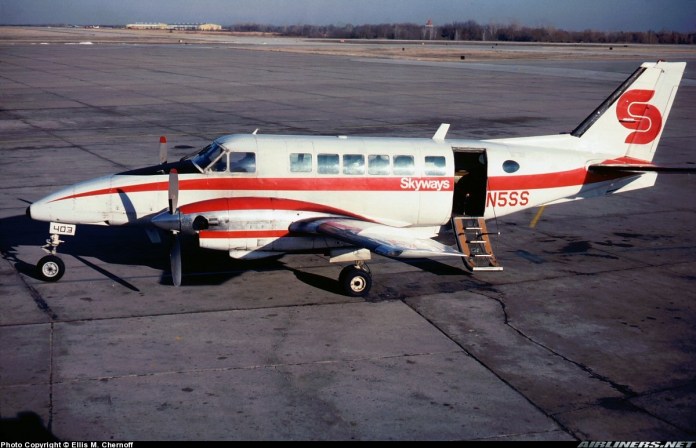
0759252

(A Scheduled Skyways Beechcraft Model 99 on the ramp at Tulsa, Oklahoma circa 1980.  Good old N5SS, I spent many an hour in her loving arms. Photograph courtesy of Ellis M. Chernoff.)

Trust me when I say that I’m fully aware that the experience of riding on airplanes can be worse than riding the bus. As us “baby boomers” will tell you, it didn’t used to be like that (even when I began as a professional pilot way back in 1979).  Back during those golden days of flying, the planes were usually about ½ full, thus allowing one to spread out and not be smashed into a jet cabin like sardines. Couple that with the fact that people seemed to simply act more civil toward each other back then, and you get a recipe for an enjoyable adventure. Although air travel for the masses is obviously a great thing economically, it can be a huge challenge when you jam hundreds of humans in a tight tubular beer can, and make them behave for several hours on end (all the while serving them liquor…lol).

As recent media coverage reveals, taking an airplane trip can sometimes become nightmarish. Are the airlines sometimes at fault? Of course they are! But in their defense, very few people have the slightest concept of the complexities of keeping the whole parade marching in the right direction! Try not to forget that when the airliner parade gets wonky in New York, it WILL affect your jet coming to LAX to whisk you off to Tampa. Remember the toy by the name of “Slinky”? What happens at one end of the snake, eventually makes its way to the other end. And no Belinda (contrary to popular belief), the airlines do not have “spare airplanes” just sitting around waiting to be used. Do restaurants cook “spare” T-bones to just sit around in case someone needs one? Of course not…that would be amazingly stupid. In the airline biz, if it’s not in the air, it’s not making money…in fact, it’s costing you money. Trust me, everyone from the CEO to the lowly ticket agent scanning your boarding pass, wants your jet out of the gate on time!

The bottom line is this: if you fly enough times, things WILL get pear-shaped! It’s just a fact of life. O.K., genius, with that amazing butt-load of wisdom spewed forth for all of humanity to marvel at, what would your sagely advice be after 40 years sitting at the pointy-end of this madness? How about…learn to relax, learn to breathe, chant your mantra, think of puppies and balloons…hell, I don’t know. Whatever lets you stay in your “happy place”, do that. 99.9% of the time, there is just no reason to act like a jack-ass.

Second case in point; one evening I was at the gate podium (looking regal, like my job dictates), and a nicely dressed passenger (obviously a businessman) was tearing the poor ticket agent a new orifice because she would not upgrade him from the cabin with the unwashed masses up to First Class. She had calmly explained to him (more than once) that First Class was full, that there simply wasn’t a seat available. He wasn’t hearing it, and was being a class-A knucklehead, I deemed it was time to use the “Captain’s voice” and step in. I put down the flight plan, stepped in front of him and asked if there was a problem, and could I help? He did his tirade at me for a moment, and then stopped as he saw that my “I don’t give a sh*te” expression had not changed. I offered this to Mr. Wonderful, “Sir, have you not heard this nice lady explain to you that there simply are no seats available in First Class? I suggest that you accept that fact, and sit in the seat this lady assigns to you. Or…the other option is for you to NOT go for an airplane ride tonight. Do I make myself clear?” He replied, “Yes”, and wandered off to crawl back under the rock in which he came from. Apparently he was far more deserving of the big seat in the front of the jet, than the person that he wanted the agent to pull out of said seat. Narcissism (and it’s evil twin bastard “entitlement”) has been perfected to a fine art form it seems these days. To quote someone that had a bit of an issue several years ago: “Can’t we all just get along?

I penned this piece several years ago, but since then I’ve had a few more “episodes” that I thought needed to be added. I titled it “Get Off My Plane” to share a few yarns about a few of the times that I’ve had to throw someone off my airplane (or been a part of this act). The level of stupidity that humanity can show on airplanes (and at the airport) is legendary. Thankfully, when things do go awry in the world of winged-transport, the vast majority of us do indeed act like normal people and NOT like morons…and for that I give a huge “thank you” to those that do. But there are times…


                        “Get Off My Plane!”

A locally famous news story told of an elderly woman in her vehicle about the time of the morning rush hour. As she was speeding down the freeway on-ramp, a disgruntled driver cut her off, swerved toward her, and forced her over to the grassy shoulder. He approached her open window, proceeded to reach in, and pummeled this poor old woman with his fists! Isn’t it just lovely what humanity is capable of doing? To make a horrible incident even worse, this person turned out to be a (wait for it)… physician on his way to work! Makes me wonder what happened to the oath of, “First, do no harm.”? Shortly after his episode of violence, he boarded an airplane and fled the country. Justice was served however, for when he returned to the United States, he was immediately brought up on criminal charges. He is now doing some sort of community service for his little “indiscretion”, thus paying his debt to society. Needless to say, it stands to reason that his poor victim will be scared by this until her end of days. One question…I wonder if his Mal-practice insurance covers this type of event?

The Psychiatrists call it “road rage”. We’ve all heard of it, some of us may even have been a victim (or perpetrator) in this collective insanity. Where did it start? It matters not. What’s causes such behavior? Who the hell knows? How about just being a member of the human (rat) race. For decades, this sort of anti-social behavior used to be confined to the earth-bound sect, but things have changed for those of us that do our life’s work in the sky. We seem to be privileged enough to have our own version of this nonsense; we call it “air rage” (I’m certain some highly paid bureaucrat came up with that one). Recent events got my juices flowing recalling the incidents of this flavor of “mis-behavior” that I’ve witnessed over the years on my aircraft. The following will be a (short) compilation of some of the ones that stand out. As the title suggests, many of these individuals were either pitched off the jet before launch, or arrested upon landing.

I grew up in the era when airline travel was something special. We dressed for the event, were on our best behavior, and felt like it was something to be enjoyed and cherished (not simply endured like nowadays). My first airline flight of memory was New York to Frankfurt in a TWA Constellation in the mid-1960s. My father was being transferred from Fort Lewis, Washington to whatever “kaserne” was used at the time by the U.S. Army in Nuremberg, (West) Germany. He was to pilot his helicopters around Europe (thus protecting us from the red horde poised to come pouring through the Fulda Gap), and my dear mother, four siblings and I were enroute to join him. Once seated on that beautiful red and white airliner, I was amazed at the world I had just entered. I distinctly remember the cushy red cloth seats, folded curtains on the windows, friendly stewardesses dressed in their tailored uniforms, and the sounds (and rumbles) of the four big Wright 3350 engines as they came to life that evening on the ramp in La Guardia. It was all so magnificent, and I was bathed in a sense of departing on some grand adventure.

Lockheed_L-049_Constellation,_Trans_World_Airlines_(TWA)_JP7293287

(The TWA L-1049 Constellation…grace and power in one package. Photograph courtesy of Jon Proctor.)

The story changes there, for an hour or so into the journey, the cabin crew settled into their routines and served us a meal in the little plastic cafeteria-type food trays. Being your average nine year old, I wolfed it down without pausing to taste what I was actually eating. I then guzzled my carton of milk, and settled back to listen to the engines drone, all the while straining in an attempt to eves drop on the adults having their post-supper cigarettes and cocktails. The twilight had given way to ink black darkness, and somewhere in the vicinity of our “coast out” point over Newfoundland, we entered a weather system. At this point, the flight became a night-long ride on the State Fair roller-coaster. We were enjoying a version of the ugly weather that the north Atlantic can dish up for ship and plane alike. Cruising at our (massive) altitude of 20,000’ or so, did not allow the Captain the option to climb above the turbulence. Nowadays, in the big Boeings, I routinely saunter up to FL390 (39000′) and watch the lightning dance its duel below me, all the while casually sipping a cup of hot coffee in smooth air. But that would not happen on this night, and we paid the price.  I spent the next few hours in the cabin of the big metal bird, bouncing along back and forth, all the while watching (and hearing, and smelling) the chubby kid to my left loudly depositing his dinner into a conga-line of sick sacks.

Obviously, things are a bit different these days. My first encounter with “air rage” was totally unexpected. I was a year into my commuter airline career, and as a brand new Captain was sitting in the left seat of the venerable Swearingen Metroliner boring holes in the skies over the southern USA. At 24 years old that “fourth stripe” was weighing pretty heavy on the ol’ shoulders with the realization that now “the buck REALLY does stop here” was somewhat of a shock, but I was getting used to it. In terms of folks acting like idiots on flying machines, simply stated, my naivety had me expecting all adults to act as such while in and around airplanes. Boy was the next 30+ years going to prove me wrong! Remember if you will, this sort of incident was a rare occurrence way back in 1980.

On this particular day, the First Officer and I found ourselves in the midst of a lengthy delay at our home airport in Fayetteville, Arkansas. It was a typical thunderstorm-encrusted Spring morning, but we had managed to fly a round trip to Tulsa and back. We now found ourselves mired in a lengthy delay for our departure to Little Rock. The weather had “unleashed the dogs of war”, and was playing havoc with any attempt at running our intended schedule on time. The obvious answer was to kick back in the baggage room behind the ticket counter, and get some R & R before our next bout with the cumulus monsters. That’s precisely when we heard the shouting begin.

METROLINER

(The venerable Swearengin SA226TC Metroliner. We liked to call it; the “trauma tube”.)

We looked at each other with the requisite “wtf” look on our faces, and immediately headed through the doorway toward the ticket counter. Planted at the opposite side of the counter, stood the biggest, ugliest, wild-eyed looking red-neck character I’ve ever seen. He was one of those guys that have two names…you know, like “Billy Bob”, or “Bubba Fred”…we all know the type. He could have easily been cast in the movie “Deliverance”, and NOT to play Ned Beatty’s character. His tattered overalls, huge beer gut, and 3 day old stubble were actually not that out of place in this neck of the woods, but it was his demeanor that stood him apart from the rest of us in the human race. He was as big as a house, and he was as mad as a hornet; never a good combination.

The young ticket agent trying to solve his scheduling problem was a friend of mine (it was a small airline, and we all knew each other), and she was one of my lines very best agents. The fact that she was attractive and very polite always served her well in these types of situations, and on a few occasions, I had witnessed her defuse an angry passenger with her bright smile and charming Southern self. But today, that wasn’t going to work. “Bobby Joe” wasn’t hearing a word she was saying, and things were beginning to escalate. She was calmly attempting to explain the complexities of what a mass of thunderstorms can do to her departures, but her smooth, soft demeanor simply wasn’t rubbing off on him. What he did next surprised the hell out of the F/O and me (and her too I might add).

In the mid-sentence, he snapped and started to physically come over the ticket counter! She recoiled with a look of shock and disbelief and the First Officer and I quickly stepped in. Being firm believers in chivalry (and all that rot), he and I quickly positioned ourselves between her and the angry Goliath. The fire in “Hayseed Harry’s” eyes was unmistakable, and when he suddenly focused on two uniformed males positioned in front of him, he rapidly slowed his pace to a halt. But that begs the question… what was his next maneuver going to entail? We had no idea; we braced ourselves for the expected assault, and accepted our fate. He suddenly snapped out of his fit of rage, and tried to compose himself. I’m sure that our shouts of: “wait a minute there mister!” (Or something like that, MAYBE mixed with a bit of profanity), might have helped him come back to reality. At this point, the agent became pale, and quickly excused herself to the back room. I can’t say as I blamed her; I was probably a bit pale myself. Just what “Booger Dan” had in mind is anyone’s guess, but there’s no question he could’ve snapped her in two without much effort (us too for that matter).

NEW CAPTAIN

(Sporting my brand-new Scheduled Skyways Captain stripes waaay back in 1980.)

If I recall correctly, “Deliverance Boy” didn’t make ANY schedule that day. For as we were doing the stare-down routine, another agent called the security folks and they quickly whisked his big (redneck) ass out of the terminal, and off to a local lock-up. I spent the remainder of that day trying to sort out what had happened. We, of course, had seen our share of pissed off customers while flying at this little airline, but none that had gone from zero to homicide in the snap of a finger! Would he have actually committed bodily harm? I guess I’ll never know, but that was indeed a first for me. I subsequently never heard what became of him. I sometimes wonder if he’s still tied to a stump somewhere in northwest Arkansas. Shudder.

The next is one of my favorites, for it has all the makings of a good “Funniest Home Videos” type story. This buffoon was a classic, and each time I recall his little display, I can’t help but chuckle a bit. The year was 1988, I had made it to “the show” and was flying for Northwest Orient Airlines as a Second Officer (or Flight Engineer if you will) on the magnificent time machine known as the Boeing 747. Although the job as the third pilot was mostly very boring, there were times when it was anything but. This was one of those times.

It was late August, and we were scheduled for a night departure from Tokyo’s Narita International Airport southwest bound for a short stop in Okinawa, then on to Manila for our layover. Our flight was under the command of Bob H., and he was one of my favorite “Whale” Captains to work with. He was rather short in stature, a bit rotund, looked a little like Capt. Kangaroo, and had the quiet, calm make-up of Mr. Rogers. He was definitely one of the nicest, most even-tempered gentlemen that I ever logged time with in a cockpit. On this night however, all that was about to change.

As we were nearing our departure time (roughly inside the 30 minute window), the Lead Flight Attendant came into the cockpit to speak to us about a passenger that she was having an issue with. The person in question had just climbed the boarding stairs, entered the jet, and proceeded to become a royal pain in her posterior (we were parked at a hard stand away from the terminal, so the passengers were bussed to the aircraft, and climbed up a covered set of boarding stairs…just like in the old days). He was a younger man, dressed in enlisted U.S. Navy “whites”, and was totally, completely “knee-walking, pie-eyed” drunk…I’m talking, “driving the porcelain bus, God’s own drunk”. Apparently he stumbled through the boarding door, disregarded his assigned seat, found the nearest chair that suited him, and plopped his big ass squarely into it. She was more than a little miffed that he was boarded in this condition (a violation of U.S. Federal Aviation Regulations), and was more than a bit upset that he wouldn’t take his assigned seat. Hence, she was now on the flight deck to enlist our assistance. Being the good-natured “fatherly” type, Capt. Bob informed her that he would come downstairs, and “have a little talk with him”. I expected him to completely diffuse the situation with his laid-back temper and impeccable manners, so I turned back to my Flight Engineers panel and continued with my pre-flight duties.

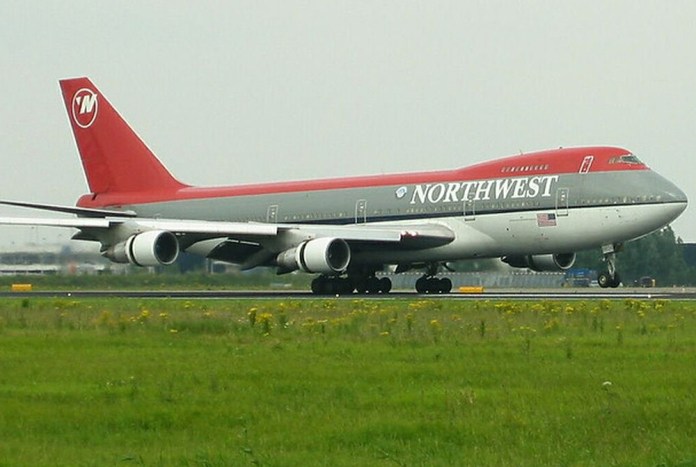
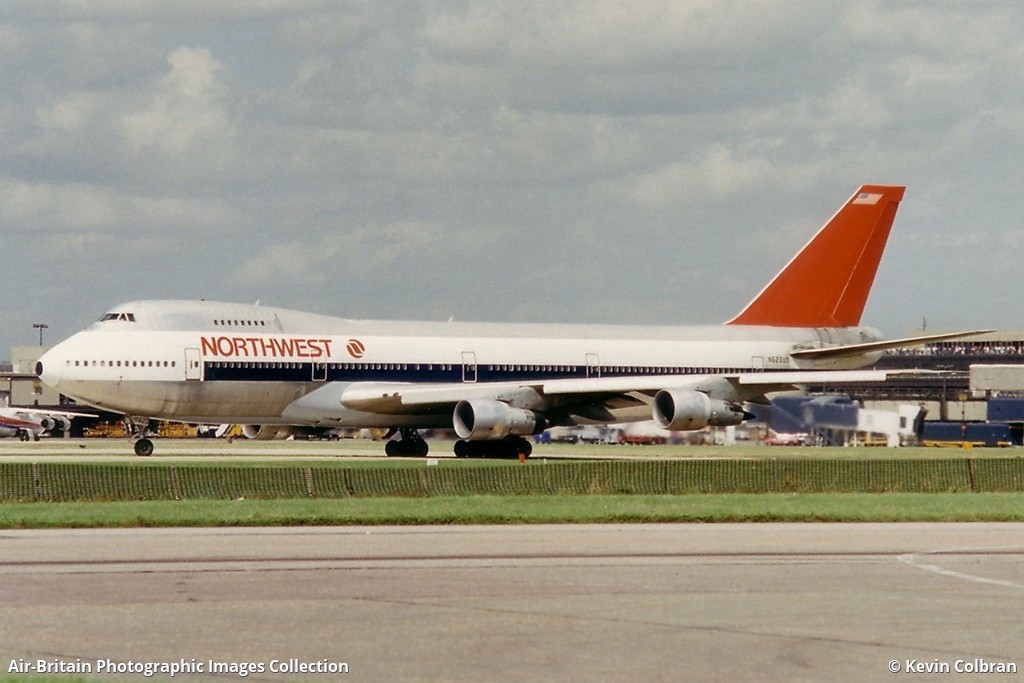
1085047-large

(A Northwest Boeing 747-200 taxiing for launch at London’s Gatwick Airport. Photograph courtesy of Kevin Colbran.)

Within a few short minutes, Bob stormed back into the cockpit, slammed the door, looked at me red-faced and growled, “Get Operations on the horn, and have them send Security to the airplane! I want that ass-hole off this jet now!” Eh…Bob…it must not have gone too well, am I right? As he was climbing back into his seat, he began to explain to the startled First Officer what had just transpired.  Apparently, as Bob approached him, the guy drunkenly looked up and asked “Who the hell are you… God?”  With that brilliant utterance complete, he promptly leaned over and vomited in the seat next to him! As if that wasn’t enough, he then calmly pulled the seat cushion up and turned it over so (apparently) no one would notice. (This would’ve earned him a ticket on the “GET OFF MY PLANE EXPRESS” with me nowadays, but Bob tried a bit more diplomacy). He asked the young man if he possibly had a bit too much to drink, and maybe he wouldn’t mind going back into the terminal and “resting” a little before the next departure (he was obviously bound for the U.S. Navy base at Subic Bay in the Philippines). His reply was too lean over, get very close to Bob’s face, and shout a rather terse, “F*ck you, you asshole!” Hehe; that sealed it…a one-way ticket on the “G.O.M.P. EXPRESS”.

As I was trying desperately to get the Japanese NWA Operations agents to understand that we wanted the actual “security forces” to come to the jet (“ah roger, Northwest 003, we send ticket agent to the airplane.” “Negative, negative, we are requesting the security forces to the jet immediately!” “Ah roger, we send ticket agent to the airplane”), and realizing that I wasn’t having much luck with it, Capt. Bob decided to take measures into his own hands. He called the Lead F/A on the interphone, and gave her the following instructions. “Tell that S.O.B. that someone on the boarding stairs wants to talk to him, and when he stumbles off the jet to see who it might be….close the door behind him!” It worked like a charm.

The moment he found himself outside of the airplane all by himself, he went rather nuts. He began to pound on the boarding door (we could actually hear it from upstairs in the cockpit), but he apparently couldn’t figure out how to actually open it. The Lead F/A came upstairs to ask Bob what she should do if he got it open, and he replied with, “Point him toward the cockpit and get the hell out of his way”. His next statement was to me, “Bill, get the crash axe out of the holder and position yourself behind the door. If he makes it in here, you crack him on the head with that thing!” Cool!

Within a few minutes he stopped pounding on the door, and began a new tactic. He started to run around the outside of the jet, looking up at us in the cockpit and shooting us the finger! Needless to say, we were watching him VERY closely, and I must admit, we (occasionally) shot it right back at him. By now it was beginning to rain very hard, and he took this as the signal to rip his shirt off and do the Tarzan thing (why do ALL pissed-off drunks end up shirtless?). We had just gone from the ridiculous to the sublime. I didn’t know whether to laugh or be very concerned, or maybe both. One of the funniest aspects to all of this is that he looked remarkably like the late actor Chris Farley (no disrespect Chris)! His blubbery, shirtless, drenched body, running around our aircraft, coupled with the sheer strangeness of it all, was more than a little surreal and unnerving. I continued my quest to get someone to the airplane other than a gate agent.

Finally after what seemed like an eternity with this madman loose under the jet, the REAL security forces showed up. They bounded out of their little pickup truck and began to chase him around the airplane! (I promise you this happened; you can’t make this stuff up) We watched like spectators at a rugby match (of course cheering for the guys with the billy-clubs), and within a few minutes they chased him up the covered boarding stairs. With three heads pressed to the left side cockpit window, we watched the stairs begin to rock back and forth rather violently (they must’ve been “disgruntled doctors” too, for I think they were pulling some Jackie Chan marshal arts moves on him). Eventually, with one on each leg and arm, they dragged him down the stairs unconscious, pitched him into the bed of their pickup truck, and off they drove. Japanese Security forces = 1, drunken Navy “Chris Farley” dude = 0.

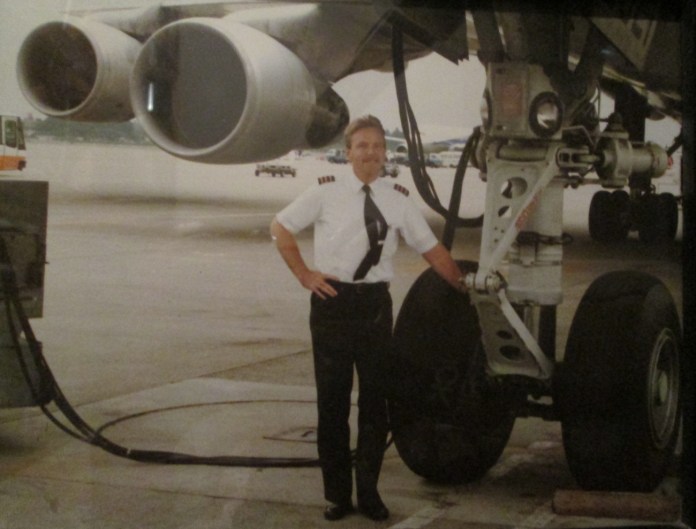
whale-so-2

(Before doing my preflight walk-around in Tokyo. It ALWAYS amazed me just how monstrous this machine actually was!)

The only addendum to this story concerns a bit of mischief on my part. An hour or so later, as we were winging our way toward Okinawa, Bob was busy filling out his report on all of this. I thought maybe a bit of fun was called for, so I pretended to be on the number two Comm radio with the NWA Tokyo personnel. I was playing it up well, with more than a few lines like, “Oh, oh. You gotta be kidding me. Really? That’s not good…not good at all! Of course I’ll inform the Captain. Roger Flt 003, out.” It was more than Bob could stand, so he turned and asked whom I was talking to. I couldn’t resist, “Well Bob, you know that moron we just had pitched UNDER the jail in Tokyo? Well, that was Operations saying they have a message from the State Department and that we screwed up big-time…seems he is the SON of the U.S. Ambassador to the Philippines!” You should’ve seen the look on Bob’s face. I probably took a couple of years off his life…sorry Bob, just kidding.

When, in 1994, I upgraded to my first command of a jetliner, I tried to emulate the manners and patience of the gentlemen like Bob that I had flown with over the years…but it wasn’t easy. My first experience with calling the authorities to meet the aircraft came one day as we were inbound to Miami in the Boeing 727. The Lead Cabin Attendant informed me somewhere around the halfway point of the journey that she had to “cut off” (stop serving liquor to) a passenger in the First Class cabin. Apparently, he was getting more than just a bit buzzed, and was becoming a first-class asshole. My reply was “Great, do what you have to do, and if he gives you any grief, you tell him it was MY decision to cut him off”. She left, and I turned back around to busy myself with the business of flying the jet.

As fate would have it, at our arrival time into the Miami area, a thunderstorm was directly overhead the airport. Since I have a distinct “no landings in the middle of thunderstorms” policy, we entered a holding pattern to let it move out of the approach corridor. I made the requisite announcement over the P.A. system informing everyone of our small delay. I also added that it was due to the fact that a thunderstorm was over the field, and that in about 15 minutes (or less) it would move out of our way, and we would proceed inbound to land without any problems. I hung up the P.A. mic, and settled back to watch the offending cumulonimbus with my usual awe and amazement.

Very shortly after my announcement, the cockpit door opened, and in came the (now pretty upset) Lead F/A. She informed me that the disgruntled passenger had informed her that: A) he was a Doctor, was extermely afraid to fly into thunderstorms,  and was going to prescribe himself alcohol for his “condition”, and B) would SUE ME if she refused to comply with his “prescription”. Good heavens, now I’ve seen it all! I calmly turned to address her (thinking of how Bob would’ve handled it I’m sure). I remember telling her to say something like this, “The Captain wanted me to tell you that you are the SECOND most afraid person to fly into thunderstorms on this airplane…no one gets to be more afraid than him. He also wants you to provide him with your name, your address, and your “Dr. License number” (I didn’t know if they actually were issued one or not…but thought the bluff wouldn’t hurt), so he can have them available when he gets in touch with the American Medical Association. He says that he’s sure that the AMA will be VERY interested in a doctor that is prescribing alcohol to himself to cure his fear of flying.” I will have to admit that I gave him a high grade for being creative with the booze-prescription thing…lol.

After he relayed my message to “Herr Doktor”, he became even more adamant about his “prescription”. He now began to call the Lead F/A and myself a few choice names and the threats continued…sorry, still no booze. With this, I directed the Second Officer to call Miami Operations, and have them stand by to meet the jet with the security folks. He seemed to by highly pissed-off when we reached the gate (I remember he wouldn’t look me in the eye), and when the big guys with the “badges” met him upon deplaning, life changed for the good doctor. The authorities weren’t going to buy his “prescription” excuse for interfering with a crewmember in the performance of their duties (a federal offense); they just thought that he was being a prized asshole. They promptly arrested him, and escorted him off to the “cross-bar motel”. Later I began to think, “Hey wait a minute, I’ve used alcohol to cure lots of “problems” in my life, maybe he was on to something there”….just kidding of course.

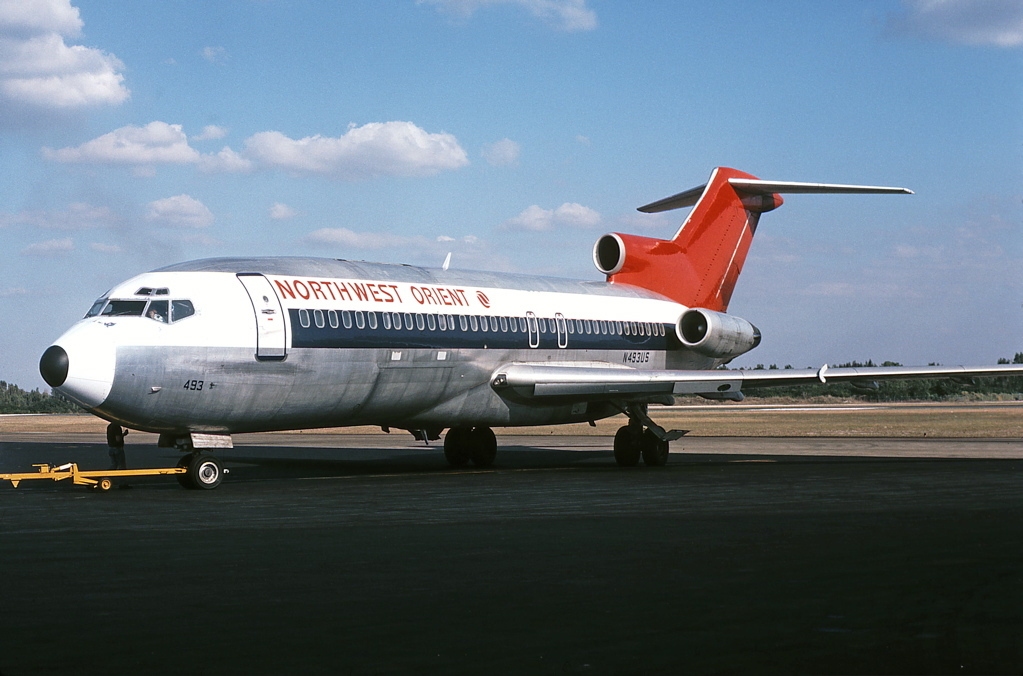
Boeing_727-51C,_Northwest_Orient_Airlines_JP6399046

(A rare sighting…a Boeing 727-100…when I was a new hire at Northwest Orient we referred to them as “the Stubby”.  Within a few years of my joining the line, they were all sold. Photograph courtesy of Jon Proctor.)

Redeyes…oh gross! I’m not talking about what my baby-blue peepers tend to look like at the end of an all-night flight-sim/beer drinking binge…nope, I’m talking about those airline flights that leave at midnight, and arrive at roughly the time the sun is peeking over the eastern horizon. One might ask, “Who in their right mind would want to go to the jet-port at that un-Godly hour and sit next to a fat guy snoring for five hours?” You’d be surprised; these flights are almost always full to the gunnels (I would guess it has something to do with cheaper fares). And since my jet is the “super-star du jour” for hauling lots of bodies out of metropolitan airports (relatively) quietly at midnight, then I get to enjoy these types of missions during the majority of my domestic trips.

One night a few years ago, we launched out of “Sin City” (Las Vegas) long after sunset, with our destination being my home domicile of Minneapolis/St. Paul.  This leg would be the end of our four day 757 trip, and except for the “night owl” thing at the end, it had been a very enjoyable time spent on the road (read, little or no hassles during the trip).  Needless to say, many times leaving Vegas, customer issues on the jet seem to come as fast and furious as the bells ringing on the slot machines! Inbound you have happy drunks, outbound you have broke/tired/dehydrated/(at times) pissed-off drunks….I prefer the happy ones. I’ve thrown lots of folks off the jet in KLAS, and needless to say, it’s not one of my favorite destinations in our domestic system.

On this night however, all things seemed to be in harmony.  We boarded the folks without incident, taxied for a runway 25R RNAV departure, and with a very quiet ATC shift in progress, we began to feel like we were the only jet in the sky. McCarren Departure Control handed us off to L.A. Center, and without asking for it, the nice lady at the big, glowing “Pong” screen, cleared us direct to KMSP!  For all the bitching about redeye flying, sometimes the middle of the night is the best time for flying. [This coming from an ex-teenage paperboy that delivered the news at 0400 every morning, and a former night-freight hauler that would launch my Piper Navajo over the Scandia Mountains east of Albuquerque at midnight every night bound for Lubbock, Texas.]

NAVAJO

(A PA-31 Piper Navajo. It was my first actual pilot job after college. Single pilot, night freight over the mountains was “interesting” to say the least.)

When things at 2 a.m. are working with my karma, the weather is smooth and clear (with the ground lights and stars like two blazing fields of diamonds), the ATC folks are silent and loving it half as much as I am, the customers are all a slumber, the steady purring of the two big Pratt and Whitneys is music to this old pelican’s ears, and the required cup of “Joe” is like something from the porcelain vase of the nectar of the Gods. In other words, all is right with the world.

That is exactly how this night would begin, but not how it would end. Somewhere over the sleeping plains of Nebraska, the chime in the cockpit announced that one of the cabin attendants wanted to speak to us. I naturally assumed it was something to the order of…”Captain, a passenger wants to know what the name of that little town is…” (like I would know? And, like I would care? Lol). This time, it was a bit different. After answering the inter-phone, one of the young men (cabin attendants) requested to come onto the flight deck to talk to me. Sure…come on up.  He came into the cockpit, quickly took a seat in the jumpseat immediately behind my “throne”, and began to regale me with his tale of woe.
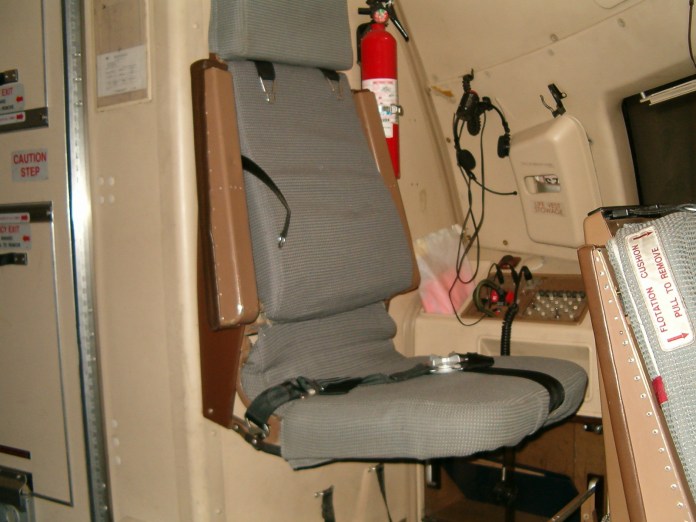
jumpseat

(The Boeing 757 jump-seat. Definitely NOT the most comfortable seat in the house.)

It seems that not all was right in his world, for on this flight there was on particular passenger that did not like him. My answer was something like, “OooooKay, and how is that playing out with the service you guys are doing, etc?” He informed me that the service was finished, but this man didn’t like him, and he knew this because of all of the dirty, hateful looks this person was sending toward him. By now, of course, the First Officer was giving me the proverbial “side-long” glances coupled with a smirk or three. I knew exactly what was going through his 71/4 hat size…”Well, oh exalted great Captain, my Captain! Just how are you going to deal with this little “emergency”? He hates me Captain…boo hoo!” I shot him a dirty/hateful look, and turned back to “Billy” (not his real name) and continued with the “counseling session”. “And how does this make you FEEL Billy?”

“Well Billy, I’m sorry the guy in 15D doesn’t like you…but we ALL can’t be liked by EVERYONE, right? I know it makes your job uncomfortable, but how about this…how about you just stay away from the guy, get one of the other guys on the crew to serve him, you just “play in your corner of the playground”, and he can play in his “corner”. How does that sound?” I asked him to describe his nemesis, and as it turned out, I distinctly remember seeing this person as he boarded the jet. He was one of the last folks to board, and (in my humble opinion) he was very distinctive looking for many reasons.

To begin with, he was wearing dark sunglasses (and it was indeed midnight when he walked onto the jet). Now I know that means you are one super cool, bad-ass vaquero. And I also know that my personal uber-bright personality means I get to “wear my sunglasses at night” (they should make a song about that…lol), but I’m not sure his did. Also, he was sporting some of the coolest looking fingerless, leather driving gloves I’ve ever seen! O.K., again, I get to wear those in the cockpit because I’m actually “driving” this big-bad mama-jamma at 500 knots and cool enough to own it…I’m just not sure he was. I will say, the awesome gloves did match his black leather pants…word up dude. And lastly, to round out his ensemble, over his thug T-shirt, he was proudly displaying the requisite “Mr. T. Starter Set” gaggle of gold chains! There truly must’ve been at least 50 chains on that young dude’s neck! Made my own neck sore just looking at him! So, needless to say, the guy was feathered out in his best “gangsta wannabe” regalia, but for some reason, he and “Billy” just were not groovin’ on the same cosmic plain. Just lovely. I really need to chat to whoever is in charge of dishing out MY karma…
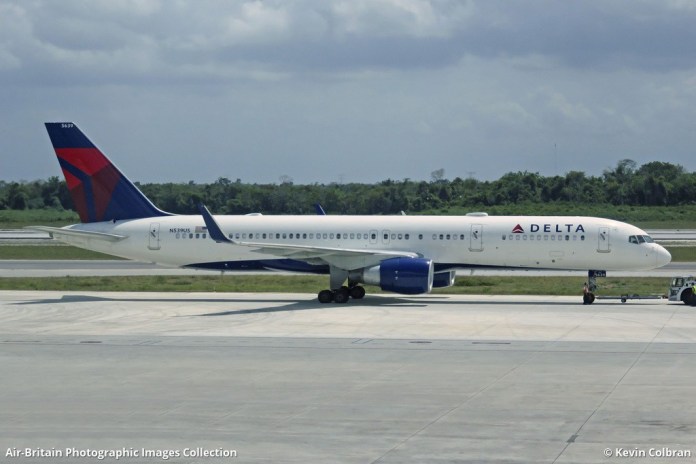
1527670-large

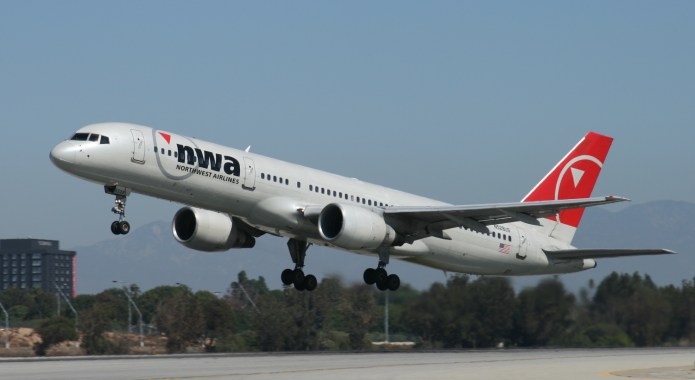
(The current queen of “grace and power”…the Boeing 757. The jet I’ve called home for the last 20 years [with her big sister, the 767]…thank you Mr. Boeing. Photograph courtesy of Kevin Colbran.)

Things seemed to be “all quiet on the western front” for the next hour or so, but shortly after the end of their last service, and about 15 minutes from us beginning our re-entry maneuver, I once again get the “Bing-bong” (and blue light) on the overhead Alert Panel telling me that (most probably) “Billy” and “Mr. T” were not sharing recipes over a cup of chamomile tea. Sure enough it was “Billy”, and upon letting him into the cockpit, I noticed that his uniform had taken on a strange new color. It seems that square in the middle of his white shirt, a very large, very dark, very wet brown spot had suddenly appeared. “Billy” was almost in tears, and through the anger (and some sobs) I finally gleaned what had transpired.  Apparently he had approached “Mr. T” to talk peace terms (or something), and had been rewarded with a full cup of coffee (NOT from the porcelain vase of the nectar of the God’s mind you) smack dab “on time/on target” into the middle of “Billy’s” starched white shirt! “SHACK!”

“Billy” of course wanted him arrested upon landing, and truth be told, I was beginning to lean in that direction myself. Its one thing to interfere with a crewmember in the performance of their duty (again, a federal offense), but this was not the “he won’t turn off his cell phone” type of issue. This fell under the actual “assault” of a crewmember category, and we had now squarely escalated to “DEF-CON 2” territory. Of course, dousing “Billy” with Folgers is hardly the same as coming at him with a battle-axe, but it’s still assault, and the die had been cast. This moronic “gangsta wannabe”, with his butt in MY seat 15D, was about to feel some love courtesy of the Minneapolis/St. Paul Airport Police Department! I’ve seen them in action, and when it gets to “DEF-CON 1” with these guys, it can get ugly in a heartbeat. Their sense of humor gauge does not exist.

Of course, protocol has changed since 9-11, and I won’t go into all of our procedures (for obvious reasons), but one thing hasn’t changed…getting in touch with the “Mother Ship” and getting them in the loop is still an important step in the process.  Within a few minutes, I was on the horn with our Dispatch Office, giving them the scoop (incident, name, seat number, etc.), and the “scales of Justice” were about to begin their tilt toward our beloved “Billy”.  A few minutes later, Dispatch hailed us on the radio with a juicy little tid-bit of information concerning our perp. It seems that “Mr. T” was the 20-something son of one of the airlines employees! He was a “pass rider” as it were, and the only reason he was on the jet was because the dear lady that gave birth to his worthless behind had (as part of her compensation package) pass travel benefits. Needless to say, when you travel as an employee of the airline (or as a dependent of an employee), your behavior is closely scrutinized. Our company employee handbook lists all the things you CANNOT (read DARE NOT) do while riding on a pass, and while throwing a full cup of steaming hot java on one of the flight attendants isn’t listed…it’s damn sure implied!!!

LMAO! Oh my God! The moron is the child of an employee? I requested two things from the Dispatcher. First, to indeed have the airport security forces ready to meet the jet, but secondly, to please give his dear mother a phone call (I never met the woman, but I’ll lovingly refer to her as “Big Momma”) and inform her of the antics of the “pride of her ovaries”. Also, please ask her if she’d be interested in driving to the airport to meet us at Gate 2 in roughly 45 minutes. He told me to stand by, and within about 3 minutes came back with an “affirmative” on both accounts. It seems that “Big Momma” was an early riser, and would LOVE to be standing by at sunrise when we dock.
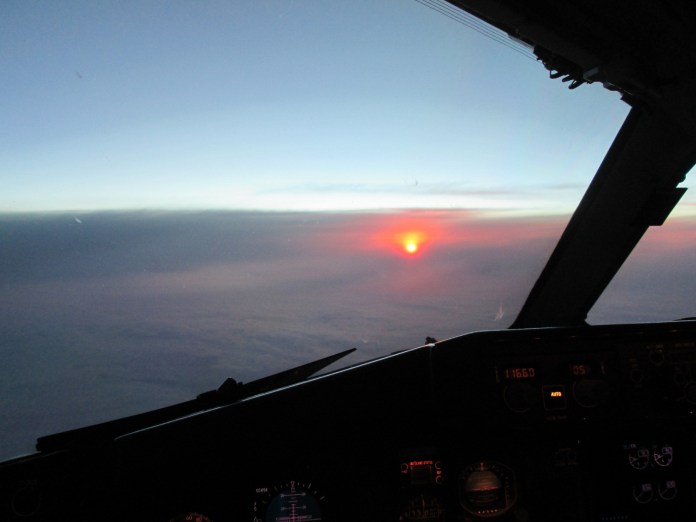
SUNRISE

(If I had a dollar for every sunrise these old eyes have seen from altitude, I’d make Bill Gates look like he lived under an overpass.)

The Lead Flight Attendant informed the genius in seat 15D that the Captain required him to remain in his seat until all of the other passengers have deplaned, and only then would he be allowed to depart the jet (I wanted to be sure and not miss the “festivities” that were sure to take place in the gate…lol). We began our descent as the smooth air and faint glow on the horizon gave way to an “accidental” giggle or two from the two aviators up in the pointy end. Lots of shaking of the heads, and comments like “what the hell was he thinking…his Mother could be fired, or at the very least lose her pass benefits over this!” With calm winds, clear skies and no traffic, MSP TRACON cleared us for a straight-in visual approach to Runway 12R, and with long practiced effort, we gracefully landed and exited the runway.

More giggles on the way to Gate 2, and when parked and all of the checklist complete, the F/O and I hurried the task of gathering our wares for a hasty exit to witness the show! As I stepped from the jetway into the (now mostly deserted) gate area, the first thing I saw were the two officers of “Minneapolis’ Finest” dispatched to the gate. They were standing against the wall, arms folded and grinning from ear to ear. Apparently their special skills were not to be needed this fine morning. That’s when I saw her; she, of the “Big Momma” clan.  Standing about 5 feet tall, roughly 200 “on the hoof”, and with legs, torso and arms that would make Dick Butkus jealous.  She had her “baby” pinned up against the wall, with one massive mitt around his neck, and was giving him a profanity-laced version of the “what for” that made my little virgin ears burn! All I could think of was: gloves, pants, Ray-Bans, gold chains and attitude…$2000! Look of shock and terror on an idiots face as his Momma whoops his ass….priceless!

As I strolled away with thoughts of another trip firmly in the books, and the pending days in the loving world of my wife and children, she stopped her “attitude adjustment” long enough to glance at me. We shared a moment, a look, a hint of a grin, and a knowing that only those that have “righted a wrong” can know. I quietly muttered, “You GO Big Momma…you GO!” And then I thought of how my karma was indeed back in its happy place. But what of HIS karma, and “Billys”….oh well, one out of three ain’t bad…right?


So those are some of the “best of the best”, but just for grins I’ll throw a couple more at you before I’m finished.

We had a guy bounce his “hockey-puck” airline sandwich off the back of a Flight Attendant’s head the other day while yelling, “We got better food than this IN PRISON!”  The worst thing about it is he was probably right. As mentioned above, nowhere on the ticket does it say “fine dining experience”…does it?

I had to pitch a lady off the jet going to L.A. the other night (“pie-eyed” drunk), and she literally threw herself down to the jet-way floor immediately outside the boarding door. She then proceeded to kick, scream, and call me every “mofo” name in the book. Funny, I thought I knew all of those fancy curse words! I guess now I have a few new ones…lol.


One final snippet of airborne nastiness.

A passenger boarded the jet in LAX the other morning at 1 a.m. (another “redeye” bound for Minneapolis/ St. Paul), and promptly shoved a passenger that wasn’t getting down the aisle fast enough for him. The Flight Attendant informed me of his behavior; I called the gate agent, and guess what?  A “GOMP” award for you, ass-hat…off the jet you go! Within a few minutes the gate agent came into the cockpit to ask if I was too busy to come out in the gate and talk to the buffoon that did the shoving. I told him that A) I was actually quite busy loading data into the Flight Management Computer, and B) to tell the guy that he knew the “rules of the playground”, and if he couldn’t play by the rules, then he doesn’t get to go for an airplane ride…simple as that. A few minutes later, the agent came back into the cockpit to hand me the close-out paperwork, and to inform me that he relayed my message to the dude that I threw off the jet. And what was his response? “He called you an a**-hole”. Funny, even after heaping such worthy praise on me, he still didn’t get an airplane ride that night.

I guess my reasoning behind illuminating some of humanities “darker” moments around airplanes is to say one thing. The next time you march onto an aircraft, don’t feel like the rules have changed…they haven’t. I was told many times growing up to “act as if your Mother were watching”. In fact I’ve dearly wanted to ask some of these people over the years (I would’ve LOVED to have said it to the doctor that beat the snot out of the old lady on the freeway), “what would your mother say, if she saw you doing that?” I’d be willing to bet that for most of them, having a flashback to their version of “Big Momma” kicking their butt for mis-behaving, would’ve resolved the incident post haste.

’till next time…

Standard

Time Machine

Seems like it’s been a few days since my last entry…actually it has been.  As of today (22 February), that gap can be measured by exactly 262 sunrises and sunsets. Time has a way of slipping away from all of us, and if you ask anyone (up to and including old “Al Einstein” himself), they would offer that time is a commodity; a very precious one in fact.  We get scant little of it on our journey from cradle to grave, and when that fateful day comes as your personal hour glass runs out of sand, a King’s ransom will make no difference.

This entry is about time, but not the moments that you and I are spending now, or those that we are sure to pilfer away tomorrow or next month. This story is about days that have come and gone. We humans call it “history” (wonder what dogs call it…), and for a bloke like me, it’s as fascinating as it gets. If I were ever to construct a Time Machine, I would care not about traveling into the future, but I would ache to go backwards. Imagine being on/at the likes of: Calvary Hill, Hastings in 1066, Plymouth Rock, Independence Hall, Waterloo, Ford’s Theater, Kitty Hawk, Promontory Peak, the Little Big Horn, Times Square on V.J. Day…the list is almost endless.

On my last trip a few days ago, the F/O and I began to muse about things historical, and I relayed a story about a magical afternoon that I was allowed to spend many years ago. I give you the following piece penned originally in 1998 concerning that day…


“When Time Stood Still”

The agent at gate D2 looked more than just a little pissed-off, “what time does your ACARS read now?” She was referring to our datalink screen on the center pedestal; this is our version of a “dog leash” to all things that are company related. It would show that Northwest flight # 845 was already past the point of an on-time departure toward Anchorage this evening. We were being held at the gate as a “weight critical” flight, and I (by FAA law) could not release the brakes until I received the datalink message from our Load Control folks in Memphis. It would tell me if we were going to be heavier than our 228,500 pound maximum ramp weight.

b757-ramp-saipan

(Boeing 757-251 on the ramp in Saipan)

I knew it was going to be very close, and we weren’t going anywhere until this particular message came across our screen (we usually receive it about five minutes after departing the gate while we are taxiing for departure). She didn’t seem to care about all the technical reasons, she just wanted to shut the main cabin door and be done with us, but for a variety of reasons I wasn’t letting her do that. Not least of which was the fact that after she closed the cabin door (and as we sat stationary next to the jet-way awaiting our uplink) she would be rendering that exit useless in an emergency evacuation…not good in my opinion. Now with “her gate” showing a late door closing, and the resulting tardy departure, she was going to look bad to her supervisors (who have a habit of making the lives of those like her miserable). On this evening, “Old Man Time” was not her ally, and her demeanor was less than amiable.

So this begs the questions, why does time control our lives? We are able to firmly grasp most everything around us, but not the one thing that ultimately matters most. We spend so much of our youth wishing things would happen at a faster pace. Remember those school days sitting in class watching the clock tick toward the 3:00 bell that spelled freedom? Those minutes were mired in molasses. We often mused that we couldn’t wait until we were a “big kid”, for our lives would change, and all for the better. And maybe it did somehow, it’s been so long ago I don’t recall. Now as we get older, time doesn’t crawl by, but moves with the speed of a heartbeat. On that day that we are all racing toward (no matter how much we resist), our time will come to an end here on Mother Earth and we will fade into history, alive only in the memories of friends and loved ones.

A few years ago, I was offered the unbelievable gift of stopping time for one afternoon. In fact I was even allowed to step back fifty plus years, to a place none of us will ever see…and it was magnificent. I had the privilege to speak at length with a person that was an aviator from a time gone by, an age long gone, and an age that I have only read about. I was fabulously lucky, for he took me with him on a journey with his tales of wonder, amazement and some pain; a journey that fills me to this day. His name was Bertram Ritchie, and on that day he was ninety-two years young.

My family and I were new to the Twin Cities area that summer of 1996, but we were fortunate in the fact that my mother-in-law was a long time resident, so she helped with the period of adjustment. One steamy July day, she called from the nursing home where she was employed part-time, and told me that someone had just checked in that I may want to meet. She explained that he was an ex-Northwest Airlines pilot, and when she informed him that I too flew for that logo, he asked her if I would like to get together.  I couldn’t believe what she was asking me!  Who wouldn’t want to meet and spend time with this gentleman? I set a time for the next day, and counted the hours filled with much anticipation.

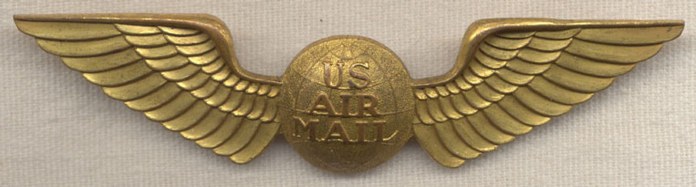
I knew from my historical readings the origin of my line, and it boils down to one word…airmail (in fact my uniform wings haven’t changed since their design in 1929. A globe inscribed with the words “U.S. Air Mail” with wings sprouting from either side). In 1925 Congress passed a law called “The Contract Airmail Act”, and the race between some very competitive aviation visionaries had begun. A hard charging Minnesota businessman convinced several members of the Detroit financial elite to contribute enough capital to form a small line to serve the Chicago-Twin Cities route, and with that decision my airline was born. They barely beat the October 1, 1926 deadline to have service flying by two weeks, with a grand total of two rented open-cockpit biplanes and three pilots.

nwa-wings-2a

(My uniform wings for 27 years…nowadays, the wings on my chest proudly display the Delta Airlines “widget”)

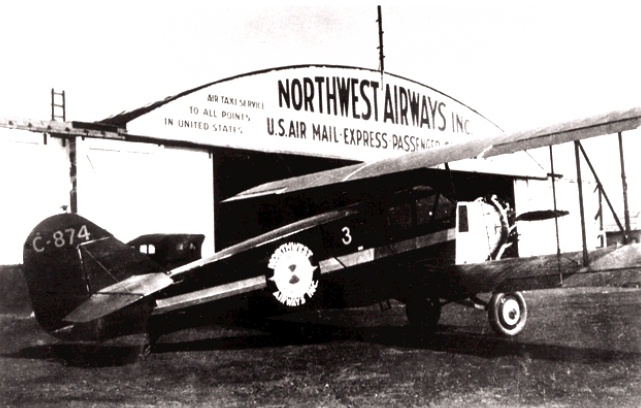
The business goal was to fly people, but in those infant days of commercial aviation, they all knew where the “real” money lay… in the airmail contracts. For my airline it all started on a sultry day in July (not at all unlike the one on my drive to the nursing home that summer morning). Northwest Airways would begin as a passenger airline with one passenger, one pilot, and a Stinson Detroiter flying machine. The year was 1927, barely 24 years removed from the miracle at Kitty Hawk, and flying was outrageously new to your average citizen.

They would depart St. Paul, Minnesota, their destination being Chicago, Illinois. This would be accomplished several hours later after stops in La Crosse, Madison, and Milwaukee, Wisconsin. At precisely 2 p.m., Charles “Speed” Holman (winner of many stunt flying and race competitions, and the number one pilot on NWA’s seniority list of three), and St. Paul businessman Byron Webster lifted off the brown grass runway. They were bound for La Crosse, Wisconsin, but they would fail to make it, their first stop being barely 50 miles southeast of where their journey began. Roughly thirty minutes into the flight, the 220 hp, Wright “Whirlwind” engine of the Detroiter suddenly sputtered and quit. This was nothing new to “Speed”, for all pilots of that generation had suffered this fate many times. He simply picked a suitable farmer’s field, and gently set the Detroiter down.

Unruffled, he climbed out, and after some wrench turning (with “maybe” an expletive or three), he felt that he had the engine problem solved. Unfortunately, the field wasn’t big enough for the biplane to lift off with the all-important mail sacks AND the one passenger, so Holman used the farmer’s phone to call St. Paul and have them dispatch a truck for the mail and Mr. Webster. He then flew the plane north to where they had started two hours before, and waited for the lorry to arrive. After an hour and a half spent bumping (and sweating) along a series of dirt roads, the truck arrived and Holman approached Mr. Webster with a fateful question. He asked, “Shall we try it again?”  “Sure” was the businessman’s answer, and with that one word, history was made.

stinson-detroter

(Stinson Detroiter)

They lifted off once again, and this time made La Crosse without an issue, consequently proceeding on to Madison. It was past sunset by now, and the dozens of “well-wishers” in the crowd had long since gone home. They had impatiently waited for the event through the long afternoon, but the evening thunderstorms and the late hour had taken their toll. Holman loaded more mail sacks, and after placing a phone call to Milwaukee (and learning that a thunderstorm was now over the field), he decided to delay. At exactly midnight, they touched down in Milwaukee, again to a mostly empty ramp. A few hours later, at roughly two-thirty in the morning, the first commercial passenger flight from the Twin Cities landed in Chicago. The almost four hundred miles had taken its toll on the clock… twelve and a half hours. It had also taken a heaping amount of other things: vision, courage, determination, skill and a bit of luck. It was a fascinating story, and now I was to meet one of those men; those incredible airmen that pioneered my beloved world of aviation.

Walking through the door, I was faced with a not totally unexpected sight. A gentleman in his ninth decade of life was lying in a bed, and looking to be asleep. He was tall in frame, but a bit slight in stature, and had a full head of ghost white hair. He possessed something else. My mother-in-law awakened him, and as the moment of disorientation gave way, and he began to realize who I was, a very wide grin spread across his time-worn face. His handshake was that of a bear (albeit, an old bear), and the clouded blue eyes shone like the thousand sunsets they had witnessed aloft. It was then, that the “something else” I spoke of came alive. For lack of a better description, he had the “air” about him. An air of a man from a different world, a world that had been gone for a very long time. He was from days long past, days alive only in his memories (and in the volumes of history), and he was about to welcome me in.

I didn’t know where to start, but thankfully he did. He asked if it was true that I flew for Northwest, and said that he had “put in a few years there too”. He told me that he had retired in 1963 on the Lockheed Electra L-188 turboprop, after flying nearly everything that had sat on a Northwest tarmac. When I asked if he had ever “checked out” in the jets, he said that the company knew he was close to retirement, and had offered him (leaning close so as to foil prying ears) “10,000 dollars to stay on the Electra”. Not that this is entirely unheard of; today it is quite common for an airline to save the cost of upgrading a “grey-beard”, by just offering them the money difference and keeping them on the same jet until retirement. But $10,000 in 1963! A king’s fortune to be sure.

lockheed-l-188-electra

(Lockheed L-188 “Electra”)

Now it was my turn to ask a question, but little did I know that his answer would unravel throughout the entire afternoon. I asked about his beginnings in aviation, and here he began his story. He was a young man back in the 1920’s, and in him the spark of flying burned deep. He had somehow managed to save enough money to log time in the rag-tag machines of that era, and was very close to becoming an actual “licensed” pilot. As we know from our history books, times took a turn for the worse that last year in the second decade, and flying and he parted company. The best he could manage was obtaining a job working as a “hangar boy” for a new company in the Twin Cities (side note; I too, was a hangar boy at my aviation college roughly half a century later). Northwest Airways was not an everyday company name, but he was fascinated by all things “airplane”, so he took the job. Their first few years were a struggle, and although the depression was closing business’ doors from coast to coast, they were somehow managing to barely hang on.

Then came the day that would change his life forever. It seems that the reigning “Chief Pilot” for Northwest Airways, Captain Holman (yep, the same “Speed” Holman from the inaugural flight) was in the midst of a dilemma.  The regular co-pilot for one of the “behemoth” Ford Tri-motors had called in sick that night for the Duluth run, and “Speed” needed a pilot, and needed one now. He knew that the young man on the business end of the broom sweeping the hangar floor had some time in a cockpit, and that made the decision for Captain Holman a bit easier.

He approach Ritchie and casually spoke the words “the co-pilot is sick for the Duluth flight tonight, drop that broom and go get in that Tri-motor…you’re now a co-pilot.” Just that simple. From “broom-pilot” to co-pilot in one sentence. Sadly, he would be the last pilot that “Speed” Holman would hire, for this amazing, world class aviator and pioneer would perish in a stunt flying accident within the year. Wow… I knew that my flying world was different from his, but I truly had no idea how great that chasm would be.

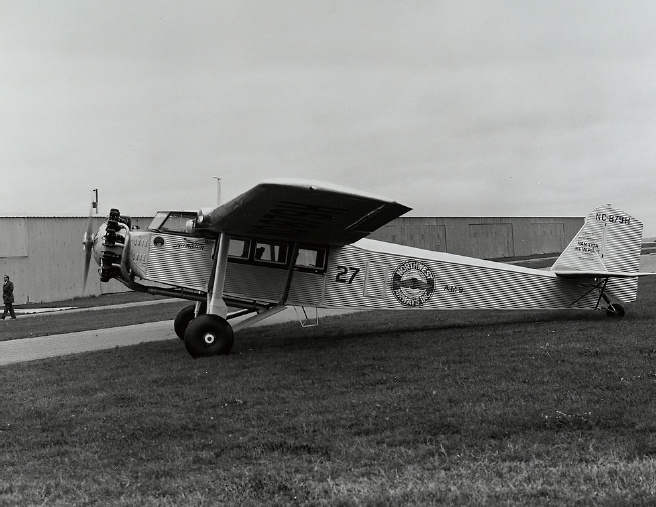
He told me of days flying as a new co-pilot when his job was to load the baggage and the mail, then sit in the cockpit and “shut-up and don’t touch nothing!” One of his first jobs was to sort the mail during his spare time. He told stories of some lines tossing old engine parts in the mail bags to build up the weight, and thus the fare charged to the U.S. Postal Service. These were days when competition with the rail system (which also transported the mail) meant everything, but on occasion they would become allies. A not uncommon event in those early winter days was to “find yourself in a blizzard and be forced to land. The common procedure was to find a railroad track, land in the field next to it and wait.” When the next train would appear, they would flag it down, load the mail and any passengers (the single engine Hamilton Metalplane held six), and wait for the weather to break. In casual conversation recently, I told this to one of our Flight Attendants, and she actually thought I was making it up! I assured her I was not. This was aviation in its infancy. This was the heritage of not only her company, but also of her country. Sad that so few of us know from whence we come.

hamilton-metalplane

(The Hamilton Metalplane)

As the battle for Northwest Airways to expand westward was at a zenith, the government again stepped in and drove a stake through the heart of many a small feeder line (thankfully, not mine). Fearing widespread corruption in the mail contracts, President Franklin Roosevelt issued an executive order canceling all air-mail contracts with the airlines. He ordered the Army Air Corps to begin flying the mail, and received widespread outrage from aviators nationwide. For ten days the nation was without air-mail service, and when the Air Corps did begin the service in old obsolete machines, the fatality rate was horrendous (famed WWI ace and founder of Eastern Airlines Eddie Rickenbacker called it “legalized murder”). He told me that after a third of the NWA employees were laid off, he and the other co-pilots continued to fly their schedules, but their pay was the paltry sum of $112 per month. After a few months of this debacle, government officials again opened the air-mail routes up for bidding by the airlines, but at a cost of a complete restructuring of said airlines. When the dust had cleared, a new company was formed by the present name of Northwest Airlines, Inc.

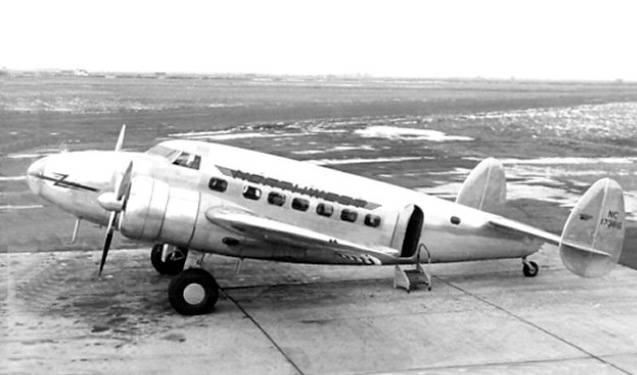
The fancy new machine was called the Lockheed 14-H, but to the slick airline ad execs, it was known as the “Sky Zephyr”. It would be bigger and faster than the Lockheed 10-A Electra it was replacing, but the pilots didn’t want it, it simply wasn’t safe. As he began to tell me of their disdain for this new machine, his eyes began to see old, long departed faces of friends. “We told them not to buy it. We lost Mamer in one at Bozeman, one at Miles City, and Whittemore hit that canyon wall. It was dangerous, and we told them. We had one almost go down taking off from Billings, and the only thing that saved them was being up on that bluff.” (I’ve flown in and out of Billings, Montana many times, and the airport does indeed sit high on a bluff overlooking the town.) “One of the big-wig chief pilots was in the co-pilots seat, and shortly after that one almost went down…..we got rid of them all”. Some things never change. Why listen to the line pilots, what do we know? Shortly thereafter, NWA placed orders for the “huge” 21 passenger Douglas DC-3.

lockheed-14-h

(Lockheed 14-H “Sky Zephyr”)

I was curious about his war-time experiences, so I asked what it was like during the forties. Most (if not all) of the bigger lines lost many of their planes and pilots to the Air Corps for transport duty overseas, but not NWA…guess we just weren’t a big enough “player”. He said that most of his duty was to help ferry new B-17s from the factory in Seattle up to Alaska. The Army Air Corps crews that were taking these north, were very young, very inexperienced flyers, so Boeing asked NWA if they would send an experienced Captain along with them. Times being what they were, Northwest said yes.

He told me of one such flight where he had met up with four crews to fly four of the big “Flying Fortresses” up to Fairbanks (they would ultimately continue to the Pacific to join the war). He was the lone airline Captain with these young men, and during the several day trip, he got to know them rather well. “They were nice young men, all of them. Very new flyers, only a couple of hundred hours logged by their most senior pilot. I sat between them in the cockpit as we flew north, and we got to know each other pretty well. They were pretty scared about what was in store for them, but wanted to do their patriotic duty. I remember we made it into Fairbanks, and within a few minutes they called and said we had to get to Anchorage fast. We flew down there after little or no rest. The next day all four of the airplanes took off for some place west, and you know what? They were never seen or heard from again. Forty young men…boys really…all gone. What a waste.” His beautiful blue eyes again were seeing a sky that was from fifty some-odd years ago. Deeply sad, they were…like he could still hear their voices, and see their young faces.

As the day wore on, he told me of many adventures. His mind was sharp with the details, and I was transfixed by his recollections. They included names, dates, places, etc. When he told me of a flight in the DC-3 “Gooney Bird” were he was caught in the fog and had to land blind; I swear I could feel the twinge of anxiety tamping down the fear. I could hear the throb of the Pratt and Whitneys, smell the stale tobacco smoke and dried sweat. I could sense the vibrating metal under my boots, and the lumpy leather seat that’s been glued to my rear-end for many an hour. I could picture his hair a little less gray, the blue eyes a little less clouded, and the old “wireless” headphones covering the cap with the trademark “fifty mission crush”.  I swear I was there with him in that cockpit, in that fog storm. (I’ve been where he was mentally…all pilots have…not scared really, just very, very concerned.)

It must be mentioned that they were doing this without the aid of our present day navigation aids. Helpers like GPS, INS, ILS, VOR, were merely figments in an inventors brain. They indeed had NDBs (non-directional beacons), but instead of a full instrument approach, they were using something  called a Radio Range approach. Basically you listened to the radio beacon while it transmitted two letters in Morse code: an A and an N. Once you heard one of the letters, you would know that you were on one of the four spokes of the radio range. The problems with this procedure were many. It didn’t give you any distance (ala DME) info, it didn’t tell you which quadrant of the four section pie you were in (you just had to know based on your direction of approach), and static from heavy rain or lightening discharges played havoc with the reception (so when you needed it most, it may be the most inaccurate). These men were aviation pioneers in every sense of the word. One can’t say that flying back then was dangerous, just maybe not very safe.

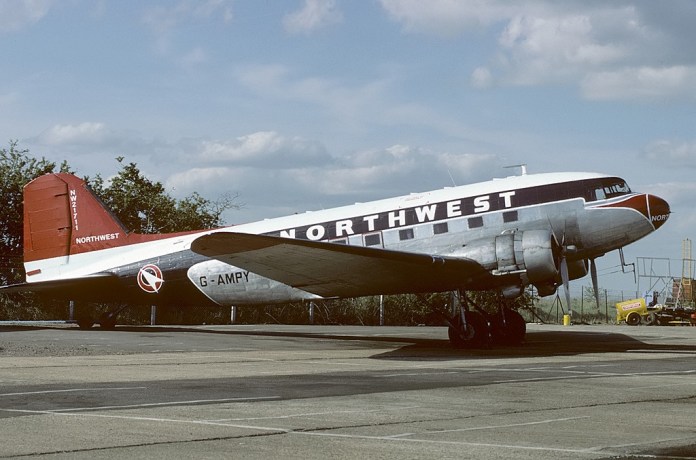
northwest-dc-3

(Northwest DC-3 “Gooney Bird”)

Late in the day, I could tell that he was tiring from all the talking, so he began to ask me questions about my world as it exists now. As I began to offer what being an airline Captain is like in the last decade of this century, his face became puzzled. “But wait a minute, you have to go through some sort of x-ray contraption to see if you have a gun or a bomb? You’re the pilot, why would you want to hi-jack your own airplane?” And, “you have to do what? Pee in a cup to see if you have drugs in you? You’re the Captain for God’s sake, just tell them NO!” But Captain Ritchie, you don’t understand, I can’t just say no, the FAA would ground me. “What do you mean you can’t tell jokes in the cockpit anymore?” Well, we can tell jokes, BUT we are sent to school to learn “sensitivity training”, so as to not offend anyone.” (Let me say that at best we just shut up when a Flight Attendant enters the cockpit…there have been plenty of “sexual harassment” lawsuits in the last several years.) At his bewilderment about the lunacy of these things, I could offer no explanation.

He had a look of shock and a little sadness when he began to comprehend what I was telling him. His beloved profession was not where he had left it. A pilot for the airlines used to be someone very highly respected; unfortunately, at times now we are treated like any other “Joe” that works at the airport.  I’m sad about that too, and not a day goes by at work that I don’t attempt to wear my stripes with pride, and dignity. I try to never forget that people like Captain Ritchie and his comrades, have (in a way) “paid” for my stripes many years ago with a currency that I barely comprehend.

15-landing-in-tokyo

(Landing in Tokyo in the Boeing 757)

Many times when I’m at work, and confronted with a problem or an obstacle (such as a mechanical delay), I have been known to utter, “but you know, when they write the history books a hundred years from now, this won’t even be mentioned”. It may sound a bit flippant, but I honestly don’t mean it like that, and I feel that it is in fact a very true statement. Most often I use it around the gate agents, etc to highlight the fact that what we are doing is not particularly ground-breaking, and certainly not historic. It’s simply another airline flight flown in a very safe jet, by a group of very skilled people. But the man that I was blessed to spend a summer day with, in the nursing home in Minneapolis, was one of the few who could never say that. They wrote aviation history every single flight, every single day as they flew it.

b767

(One of my current “mounts”…the Boeing 767-300ER)

A rather sad addendum. It seems that Captain Ritchie was to have a son, and that young man too was to grow up and dream of a life in the clouds. He learned to fly, and after many years of hard work, was hired on to the same line that his father pioneered. He was to rise to the rank of Boeing 727 Captain for Northwest Orient Airlines, but sadly, he would perish in an automobile accident the year I graduated from high school (1974). I could see his heart breaking again as he told me the wrenching tale, but I also felt like I was somehow now holding the baton that he and his son had both held.  I could only hope that I was up to the task.

boeing_727-51_northwest_orient_airlines_an0080194

(The livery…and airline when I was hired in 1983. A “Northwest Orient” Boeing 727-51. It was the small version of the 727, seating roughly 125 passengers…we fondly called her “the Stubby”)

Northwest Airlines Captain Bertram Ritchie was to pass away later that fall, and upon hearing this I couldn’t help but feel that a chapter in aviation was coming to a close. These men had done what no others had done before them, and (most) of them survived to tell about it. I was one of the lucky few who got to listen in person.

From an unknown author:

“Fly west my friend, on a journey we all must take…”

Tailwinds to you Captain Ritchie…tailwinds my friend and colleague. And one more thing. Thank you for taking me with you in your Time Machine…thank you very much indeed.

Till next time,

Standard

Passing the Torch

My life’s work as an aviator has been lots of things. It has been concurrently exciting and exhilarating, and (at times) excruciatingly tedious and boring.  For the last thirty plus years, I have had the good fortune to inhabit a job that has filled me with wonder and amazement, for I’ve visited places and witnessed things that few could experience in five full lifetimes. And, I’m sad to say, it has (again, at times) been tremendously lonely and heartbreaking. Days, and weeks spent on the road when heart and family beckons can be painful, and this will bruise even the stoutest of souls. I’ve been thousands of miles removed when death and pain have visited my loved ones, and that is a heavy burden to bear. With that said, it’s been nearly a four decade journey that is slowly nearing its last port of call.  Me thinks that will cause all but the most mundane to pause and reflect.

transitting TRWs SIN to NRT2

(Paralleling a line of thunderstorms just SW of Manila…Singapore to Tokyo.)

Without question, one of the pinnacles of a life spent in airline aviation, is that golden day when you are handed the keys to the jet. When you get to sew on that coveted “fourth stripe” assuming the role as Commander, and begin your work as the person in charge of the operation. As I grow longer in the tooth (in the world of airline parlance, we are referred to as “Senior Captains”), so do my First Officers, many of whom I’ve shared a cockpit with for countless hours. More than a few of them are now leaving the proverbial nest and moving on to write the story of their own Captaincy’s. This phenomenon has begun to accelerate in the last couple of years, and as I hear that they are leaving my world, it’s left me with a mixture of emotions.

An interesting side note. As these old-head First Officers are moving up the food chain, they are now being replaced by brand spanking new “kids” at the bottom of the seniority list. I flew an Anchorage trip with just such a young man a few weeks ago. After inquiring as to the year I was a new-hire (like he), I responded that I was hired as a Boeing 727 Flight Engineer at Northwest Orient Airlines in 1983. His retort was, “Really? What month? “November” was my response. His next question; “What DAY in November of 1983?”  From me; “November 14th”. The look on his young face was of shock and a bit of amazement. It seems I was in my second week of new-hire orientation THE DAY HE WAS BORN! LOL!  I think it’s fair to say that he felt he was now sharing a cockpit with Methuselah himself (and I must admit that I was unsure if he was indeed old enough to purchase a beer). It seems that “old Man Time” keeps plodding right along…the bastard.

999697167464_1983_Class

(My new hire class 14 November 1983. I recently flew a trip with a young “new hire” First Officer that casually asked what year I was hired…then what month…then what day. You guess it! He was born roughly two weeks after this picture was taken! LOL…)

A good First Officer.

What makes a good (or excellent) First Officer? The book defines this person as the “Second in Command” of the vessel, which of course means that if I choke on a chicken bone from the crew meal (assuming I will eat that mostly horrid food) and expire on the flight deck, they will now assume command, and steer the ship to a safe landing. The trick as said F/O having been “field promoted” to Captain is to NOT smile too broadly as they haul my carcass off the jet, for they have now “moved up a number” on that coveted System Seniority List. Just kidding of course…none of my F/O’s would do such a thing (maybe).

I was fortunate enough to spend several years crewing different jets from the right seat as an F/O (and from the third seat as an F/E), and they were almost always with men that I trusted, admired, and truly loved to work with (and for). I flew the Boeing 747 (or as we call it…”the Whale”) with exceptional Captains the likes of Harry B., Jim N., Terry M, and George K. I flew the McDonnell Douglas DC-10 with superb Commanders like Al T., Sherman C., Gene E., and Bob F. (the father of the young lady that inspired this piece). These men were very good at their job, they knew the machine well, could fly it through the eye of a needle, but they had more than just “pilot skills”…they knew how to be a great Captain. One can be a good pilot and a bad Captain (leader), but a good Captain has to be both…a true leader and an accomplished aviator.

BTW, the perennial joke about F/Os is that their world consists of: “gear up, shut up, clear right and I’ll take the chicken…” Lol. Obviously, becoming an accomplished “Number 1” can be a mixture of aviating skills, technical aplomb, and tactical prowess. Plus, a dash of psychiatric expertise (to deal with some of those “Captain’s egos”) is a great tool in any right-seater’s bag of tricks.

Needless to say, on very few occasions, I would be paired with a “bad Captain”, and that was most assuredly not fun. They could be demeaning, authoritative, brash, and petty (yes, some were even prone to yelling…lovely, right?). One guy was so bad that he would tell you how to fold your map, where to put your pencil, what to say on the radio, and a myriad of other such nonsensical things. His level of “control” was such that he was smothering the rest of us in the cockpit (not ashamed to say that I truly did not like flying with this gentleman). He went so far as to deem himself the “Captain of the layover”, and one rainy afternoon in Amsterdam as we were riding the trolley for dinner, he would become hellbent on making that point.

He and the F/E were comfortably seated on the tram, and I elected to stand. He told me (ordered me actually) to sit down, pointing to an open seat. I offered that it actually felt rather good to stand (we sit for a living, don’t we?)…but he was having none of it. He said, “Sit down Bill.” I replied, “Nah, I think I’ll just stand.” (Hercules himself couldn’t get me to sit at that point.) His next statement was, “I TOLD YOU to sit down!” I kind of lost it… “Look Dan, on the jet, you ARE the man! The Captain, el Hefe, “the Dude”, and I’ll do whatever you tell me to do! But we AREN’T on the jet are we? You are NOT the Captain of the layover!” I promptly exited the trolley at the next stop and left the poor Flight Engineer to eat with him alone (fairly sure I suggested he do something with his “guy parts” that is anatomically impossible). I vaguely remember the wonderful Dutch folks on the trolley car, slowly lowering their newspapers to get a glimpse of the Americans that were about to kill each other….lol.

Fortunately, Commanders like he were very few and far between. The longs days of such a trip would inch by like the drip of molasses, and when our time was through, a sigh of relief would sweep over me as I left the employee parking lot. Whether I realized it or not, as I was working with these two types of bosses, I was learning from both of them. I don’t remember actually saying something to the effect of, “I want to be like Captain ABC”, but I distinctly recall the times when I would think, “I will never be like Captain XYZ.” I guess we actually do learn as much from the failures as we do from successes.

NWA Whale

(A Northwest Airlines “Whale”. Notice how this pilot has just “cracked the engine thrust reversers” even before the nose gear has touched down. This guy was good.)

Whale SO 2

(Yours truly as a Boeing 747 Second Officer…circa 1987 or so. It always amazed me doing the walk-around on this beast, just how friggin big it truly is! Yeah, that was indeed 30 pounds and lots of hair ago…lol. )

I worked hard and endeavored to be very good at my job as their First Officer…Robin to their Batman, Tonto to their Lone Ranger, Chewbacca to their Han Solo, McCartney to their Lennon, Ernie to their Bert,  (I could go on forever… but I won’t). I tried to do my job to the best of my abilities (meaning both when I was flying the machine, and when I wasn’t…when I was “flying the radios”.  Nothing worse that sounding like an idiot on the ATC airwaves). I always tried to be ready with a suggestions and/or idea when the big vise began to tighten on their Captain’s brain (weather, mechanical, ATC, crew or passenger issues), and generally to have their backs under any circumstance. I think I did a good job, for at the end of the trip, the majority of them would shake my hand and thank me. A few even intoned that it was “nice to work with someone that knows what they’re doing”. I always felt like they meant it.

dd1 (8)

(A scene you never want to see walking onto the jet. This is what the start of the big vise tightening onto the Captain’s brain looks like. We were Tokyo headed to Guam one morning last summer…IIRC, it turned into a very long day.)

A good Captain.

So why am I writing this now? Here’s why. As I met up with Pam, my F/O for this 12 day trip (we are on day 12 as I begin to write this, and FINALLY head home this morning), she informed me that it was her last trip as a First Officer, for she was heading down to Atlanta to begin training as an MD-88 Captain next month. My first reaction was nothing short of “Wow…way cool! Congratulations!  You’ll make a great Captain!” (I sincerely meant every word). Her and I have crewed the big Boeing many times together over the last dozen years (and like I mentioned, she comes from good “airline stock”…her father and I flew the DC-10 together many times), and she’s always been a great person to work with. She will indeed make a fine Aircraft Commander.

But what does that mean? What makes a good Captain? Do they all run their “ship” in the same manner? Fly the jet the same, tell the same jokes, treat the cabin crews the same? Obviously not, but IMHO, there are certain traits and blood lines that are endemic to being a good cockpit leader. I grew up in the household of one such person, was fortunate enough to fly as a new airline pilot with many of them, and when they threw me the keys to the Boeing 727 that fateful day in June ’94 as a sparkling new “Four Striper”, I had them ALL (proverbially) sitting on my shoulder with me as I climbed into that coveted left cockpit seat. (I penned a blog entry about that day…it’s entitled: “Firsts” from a January 2015 entry.)

NWA 757

(My mount for the last 19 years…to include the B767 since the merger with Delta in 2008.)

Here are some of the traits that I gleaned from those that I flew under, and greatly respected. Most times they never enumerated such things, but after observing them, it was quite obvious it was part of their “Captain repertory”:

  • Never ask a member of your crew to do something you won’t do. If that means climbing up into a landing gear well to inspect (or nowadays, get a phone video of) a suspected hydraulic leak…then do it. Get your fat butt out of that “golden seat”, go down on the ramp, and see what’s going on. If you get some grease on that white “hero shirt” of yours, not to worry. They sell airline uniforms at the Crew Store…a little dirt won’t kill you.
  • Never, ever put your needs ahead of your crews. Case in point; midnight arrival at the layover hotel, not enough rooms for whatever reason (usually something idiotic like the guy behind the counter has yet to get the “magic fax” from the bean counters at Company Headquarters authorizing payment), and now the dance of musical rooms begins. Always be the person at the end of the line. I’ve sat for an hour in the lobby waiting for that last room…but that’s the bane of being the Commander. The cavalry soldiers of old always fed, groomed and bedded down their horses first, then looked to their own needs. Your crew care comes first…you, a distant second. I saw my Captains do it…I’ve done it myself.
  • Trust your crew to do their job (and do it well). I learned from many a great Whale (and “Diesel 10”) Captain to “empower” those people during your briefing. They MUST know that you will support them in a pinch, that you will “have their back Jack”, and then let them get on with their work. I’ve found that over the years, if you do this for them, they will make your life up in the pointy end far easier. Rather than involve you in EVERY little issue within their cabin, they will take some initiative, work it out, and you’ll hear about it later in the flight (or sometimes, on the crew bus hours removed from the event). Trust them to know their job, and do it professionally. You are in command, but that doesn’t mean you have to be (like Captain Dan) the King of Micro-managing.
  • If the cabin crew can’t do their job in terms of their service to the passengers, then you’re not doing your job very well. You are tasked with finding them smooth air…period…on every flight. This may fall more into the “pilot” job description, but do let them know that when the ride has become like your F-150 has a wheel in the ditch, that you ARE being proactive, and you ARE trying to find them smooth air. All pilots know that there will simply be days when that air is absent (I’ve spent many a long, bumpy night over the North Pacific bouncing along for hours). But they have to know that you are truly trying to “do some of that pilot sh*t Mav” and get them a better ride. We in the business end forget that just walking the aisles during ugly turbulence can be a challenge…not to mention doing it with scalding hot liquids. As long as they know you’re trying to make their life better, you MAY NOT get a squeeze of Visine in your next cup of coffee…just kidding…that’s “old school” stuff. 99% of the new flight attendants don’t even know what that means anymore…lol.
  • When the going gets tough, the Commander should probably be the one hanging onto the yoke. Not always, but most of the times. It certainly depends on lots of things. Your F/O (your previous experience with them, their experience in the machine and in the situation, etc), the weather, the airport, etc. I’m not speaking of those times when your “Captain-ness” is down around your ankles (like in the simulator LOEs, when you have an engine shut down, the blizzard is getting worse, and they’re delivering a baby in the cabin). I’m talking about “normal” times when it sucks. Late night, tired as hell, funky airport, raining sideways…you now, “normal suckiness”. This may be one of the more difficult decisions a new Commander will be faced with.

As 99% of my flying occurs on the other side of the planet, there sits but one destination whereby I prefer to be the dude driving the machine as opposed to the person flying the radios. It’s a tropical paradise known as Palau, and I love going there (the wonderful Mrs. BBall has been there many times with me…she loves it too). It’s a funny little airport, sitting on VERY dark island in the middle of the mid-Pacific. We arrive at midnight local time, and most times amidst the scattered showers that live there 365 nights a year. They have but one coral runway that’s “quasi short”, it’s almost always wet (meaning slipperier than snot), and quite often the landing is done with a bit of a tailwind. There is no “real” glidepath information other than our VNAV display and/or the VASI at the end of the runway. Oh, and the last piece of the “ugly puzzle” is that this typically happens early into our 12 day rotation into the Pacific, so our bodies haven’t switched over to Japan time yet. This means we’ve skipped a night’s sleep going from the West Coast to Japan, most probably have had a rather crappy night’s sleep that first layover in “Dai Nippon” (not uncommon for me to be wide awake at 0400 Japan time on that first night), and now we’re executing this little maneuver 20 hours later at midnight feeling like you’ve been hit on the back of the head with a shovel. To quote one of my favorite F/Os (Lionel “Digger” R.), “What could possibly go wrong?” LOL….

I’ve landed there two dozen times in the last several years, and every single time it gets me sitting up a bit straighter, and working really hard to be on my A game. I never try for a grease-job landing, I just plop the big jet onto the slippery runway, let the Auto-Brakes do their thing, use lots of Reverse Engine thrust, and let the Flight Attendants bitch to me about that “hard” landing at the de-planing door. As we’re kissing the passengers “Good bye”, they’ll usually offer a quip like, “That wasn’t a very smooth landing..ha, ha.”. My answer is usually something a bit flippant like…”Well, here you either get a “plop” of a landing, or you get to go swimming off the end of the runway…I always choose the firm landing…”

Again, this is a tough call for any Commander. I have indeed sat through the landing in Palau with the F/O as the pilot flying. Doesn’t happen often, and it doesn’t happen with those other than the ones that I have flown many trips with, and I know that they can do it correctly (meaning of course, safely).

a6

(Looking through the jetway fence in Palau. It’s 0430 and we launch for Tokyo in less than an hour.)

Palau Xmas 2015

(Sunset in Palau Christmas day 2015. I still can’t believe that they “make me” layover in this hell-hole for 96 hours! It kind of reminds me of the hotel pool in Grand Rapids…but not really. Did I mention that we layover here for almost FOUR DAYS?!)

a5

(The beautiful “Mrs. Captain BBall” suffering through a Palau layover with me…misery does indeed love company…right?)

  • My last bit of advice comes from my dear Father. Although he never captained an airliner with hundreds of trusting souls, he did command air machines (in combat) with those perched behind his seat trusting him with their lives. He told me countless times that I should attempt to be the first one onto the machine, and the last one off. This is a bit of a pet-peeve of mine for various reasons. There are indeed times when the cockpit crew will HAVE to bolt off of the jet early in the deplaning process, to hurry to the next airplane that’s perched 100 gates away, and with the next push time literally minutes hence. When I’m tasked with that brand of “fun”, I always try to (rather loudly) exclaim to the F/As that I hate to rush off, but we have to get to the next flying machine post haste (hoping of course, that the passengers have heard me and don’t think we’re just a couple of douche bags that can’t wait to get home and crack that first beer!). I think it simply looks awful to be sitting in the cabin and witness the cockpit crew bowling down old ladies in their rush to get off the jet….well, not really, but you know what I mean. Not what professionalism looks like.

When that’s not the case, I will always try to be literally the last body to walk off the machine. As my Dad would tell me, “You signed for that machine, and that means that you signed to be responsible for EVERYONE’S safety…yours, your crews and your passengers.” I have no problem at the end of the day, suggesting to the F/O to head toward the airline crew bus (and probably getting a 15-30 jump on getting home), but I will stay until the last passenger, and the last crew member have stepped off the machine. On many occasions, I’ve had a Flight Attendant ask if I’d like for them to move their suitcases out of the way so I could deplane, and my answer is always the same…”no thanks, I’ll be the last one off of the jet tonight.” This is (almost always) met with rather strange looks, but I’m ALWAYS left with a “thank you…you’re one of the few Captains that do that”. I never fail to give credit to my Father, and explain that I was raised by a professional pilot, and that I’m a “throwback to the old days”.

My rationale has always been this. So I bound off the jet and make the earlier crew bus. The machine is sitting at the gate “almost” empty of people, and the APU decides to erupt into flames. What now? Hopefully, it auto-shuts down, or a mechanic saves the day….but what if that doesn’t happen? What if someone is injured (or worse) because I wanted to make that early bus? How could I reconcile that with myself as the person that pledged to do my best to NOT let something like this happen? So I’ll stand there with my best “airline look”, say goodbye (or goodnight) to everyone as they gather their junk and walk off, then I’ll make one last trip to the cockpit and look around, and finally, after everyone is off, I’ll get my bags and head toward the door.

Oh, and one more thing that this “last man standing” attitude allows me. It gives me a few precious seconds to soothe this “big horse” before she goes to bed for the night. I usually give her a nice pat on the cold, firm metal of the fuselage as I step off, and a gentle “thank you” never seems out of place. Told you I was a throw-back…

So now I find that the last 22 years sitting in the “God Seat” on the jet wasn’t all about just looking regal, looking “stately”, and acting like you’re a super hybrid version of “Maverick/Goose”, Steve Canyon, and Buzz Lightyear, all rolled into one. Whether or not you’ve noticed (or cared to notice), Captain Ball, you’re been watched all these years. (wait…that sounds kinda creepy) I’m even guessing some of those young folks were taking mental notes.

Being a good Captain isn’t about airplane system schematics, figuring fuel loads, digesting weather reports and forecasts, knowing ATC lingo, understanding the hieroglyphics known as the FARS, being able to fly a “sierra hotel” ILS with an engine shut down, etc….well, it IS of course…but it’s just as much about something else. It’s about people. YOUR people. Your crew and your passengers. They trust you…they should trust you…but you have to EARN that trust. It’s not like putting a coin into a gum-ball machine…and “plop”…out comes their faith (and trust) in you. Doesn’t work that way. It’s a rare privilege to sit where you’re sitting. Earn that privilege.

In the golden years of my career, I can look back and say that I’ve met (and had the pleasure to work with) some of the most wonderful people imaginable. They are stellar aviators (of course…they should be at this stage in their flying lives), but along with that, they are just damned fine people. They’ve made my job as Captain a million times easier, and for that I owe them all a debt of gratitude and a huge “Thank You”.

a5a

(What we look like going across the Pacific “tracks” headed for Japan. Well, if the jet were painted differently, and we didn’t speak Japanese on the flight deck.)

So now, when these new Commanders are (regally) sitting comfortably up at FL350, sipping a cup of our line’s best java (sans the Visine of course), I hope that when they begin to pontificate about the “old days”, and the “old head” Captains they flew with way back in the day….a certain name either IS or ISN’T used in the conversation….

LOL…your call “Captain”… you’re in charge now.

Oh, and to new Captains the likes of “Pam F.”, “Norm L.”, “Terry P.”, and “Tom L.”, etc, it was a joy to fly with you all these years, and it was my distinct honor to be your Captain. You will all make fine Commanders…oh and do me a favor, will you?  Say “howdy” to the gang for me down at Big Bob’s Bowling Alley in Muscle Shoals, Alabama (one of the more exotic destinations for the “Mad Dog”…MD-88).   The “baby pilots” and I will hold down the fort out West (and I’ll keep your bar stool warm in Palau for you)!

a5aa

(Yours truly and [soon to be] Captain Pam. She will indeed make a great Captain… “see you on the jet airways Captain Pam!” Good luck and God speed.)


Some random glimpses from my journey:

MSP to ANC

(Minneapolis to Anchorage…more mountains than the good Lord has green apples.)

Dawn South China Sea SIN to NRT

(Dawn breaking at FL350 over the South China Sea…Singapore to Tokyo.)

HNL Pearl Harbor

(Descending into Honolulu…Pearl Harbor with Ford Island is middle frame.)

a2

(Rainy departure from Portland to Tokyo. Since they were smaller…and armed with AIM-120s missiles…I thought I would be nice and let them go first.)

Mt Fuji

(Probably the MOST photographed hill in the world…Mount Fuji. We were inbound to Tokyo from Guam.)

Lightning 1 SIN to NRT

(South of a line of thunderstorms…again over the South China Sea. Screeshot from a video I took of all the cool lightning.)

not always sunny HKG

(Not every day is clear and bright in BBall-world. Departing Hong Kong for Tokyo in the midst of some “liquid sunshine”.)

BF Mongolia

(Somewhere over the vast expanse of Siberia…Seattle to Seoul.

Night Landing HKG

(Night landing in Hong Kong.)

two ANAs NRT

(Twin All Nippon Airways jets in Narita…Boeings as far as the eye can see!)

St Elmos Fire 4

(Another screenshot. From a video of some “St. Elmo’s Fire” on the windshield. Night flight Tokyo to Portland.)

Sacred Ground Iwo Jima

(Sacred, hallowed ground… Iwo Jima. I never pass by without thinking of the thousands of brave Marines [and IJA] that gave their lives here. As was said, “Uncommon valor was a common virtue.” God bless you young men. May you all forever rest in peace.)

I love HELOs

(Can you tell I love helicopters? In the restoration hangar on Ford Island, Hawaii.)


a13

(Speaking of the love of rotary winged flight. A shot of my Surface Tablet’s navigation page showing Pleiku in the Central Highlands of Vietnam. I was transfixed knowing that five decades ago, my dear Father was flying directly below me in these war-torn skies, fearing for his life, doing his job, and thinking of me, my siblings and my dear Mother. I miss them both greatly…)

Tom and Huey love

(More “helo pics”. My F/O on this trip [Tom…superb guy] once Crew-chiefed on Hueys. It was very apparent that the love for this bird was still beating in his pilot heart.)

a10

(Not exactly sure what this “guard” was keeping safe here on the streets of Bangkok…but he seems to have things well in hand.)

And finally…

Pam and Roy SIN2

(From my last trip. Myself, F/Os Pam and Roy atop the Marina Sands Hotel in Singapore.)

The journey continues…

’till the next time.


Standard

The Sundance Kid

(Originally published March 2016.)

Few things in life are as pleasant as awakening to the smell of freshly brewed coffee and frying bacon (for my vegan friends, you can ignore the last part of that sentence, but it does not change the fact…sorry.) Smells are time machines, for they can transport us back to long-ago places. To this day, I can’t smell Old Spice without feeling the strength of my father’s hug, and when a pot roast is cooking in the oven, I am back in the loving arms of my dear mother. Ah, “thank you” olfactory nerves…you are the best.

This story begins before dawn on a Texas summer day with the smell of bacon and coffee. The year was 1969, and I was enjoying my 13th year of life. Obviously, drinking steaming hot “Joe” was not a part of my daily routine; I would not adopt that habit for another two decades, and then only to stave off fatigue over the long, dark Pacific as a new Boeing 747 Flight Engineer. Saying that international pilots cannot fly without that heavenly bean would be a gross understatement indeed. But the bacon? That was another matter altogether. I think it’s fair to say that your average teenage male can consume his body weight in fried pork without too much effort, and I don’t doubt that on this particular morning, that theory was alive and well.

The destination for this day, and the reasons behind an excited teenager bounding out of bed at 0400, were part and parcel of an adventure that few (if any) teens can say they’ve been a part of. My dear Dad and I quickly devoured the forlorn pig (plus an egg or two), washed it down with several cups of “mud” (me having milk), and mechanically (and stealthily, I might add) began the process of gearing up for our hour-long drive westward. We were bound for a small, “one-horse town” on the ragged, scrub-brushed plains of North Texas, and after loading into the Chrysler Town & Country wagon, my dad would pour another cup of coffee from his green thermos, light up a Salem, and find some George Jones on the AM radio. Backing out of our slanted driveway on Westfield Drive in south Fort Worth, we turned west toward the entrance to the Loop 820 freeway, and off we would go. The eastern sky would be sporting a faint glow, the cicadas would be singing their nocturnal summer tune, and life could not be better.

(The “mini-van” of the 60s and 70s…the family station wagon.)

Mineral Wells, Texas, lies just east of the Brazos River, squarely astride the demarcation line between Palo Pinto and Parker counties. Its fame lies not only in its mineral springs, but the fact that in the year 1919, it was the spring training location for the Chicago White Sox (the year of their infamous “Black Sox” scandal). One other fact about this hardscrabble little village: in the year 1925, an outfit by the name of the United States Army opened its gate to Camp Wolters just a few miles down the road, and it would soon become one of the largest infantry training facilities during the Second World War with two famous people (for far different reasons) receiving their training at Wolters. Two Army privates…one named Audie Murphy and the other Eddie Slovik…one lauded with praise, the other not. Shortly after the war, the Air Force held the keys to the facility, but it was not truly back on the map until 1956, the year two remarkable events occurred. In that pivotal year, yours truly was born and spanked into life in an Army hospital in Schwabisch Gmund, West Germany, and the United States Army’s fledgling rotary-winged world opened its Primary Helicopter School on the sun-bleached plains just outside of town.

At this time in my young life, my father had recently ended his active-duty career, having “separated” from the Army, and our family had moved from Germany to Texas (our second tour in Deutschland, counting, of course, my “birth tour”). A few years earlier, he had spent his time in the skies over war-torn Vietnam, and after surviving that, had taken a “cushy” overseas assignment in the cockpit of the CH-34 Choctaw with the 7th Army just outside of Munich. Toward the end of his Germany rotation, he received orders to train in the CH-47 Chinook (his dream machine), with the ugly caveat being that his next assignment would be in that lovely machine, but back in the bloody skies of Vietnam. By this time in his Army career, he had served more than 20 years and decided to retire, letting the young bucks win the war (it was, after all, his second war…his first as a medic in Korea).

(My Dad’s ride in Germany, the CH-34 Choctaw.)

The question then became…what to do next? As any pilot knows, if you can secure an easy gig that pays well and remain in the cockpit, then take it! He found one, and it did, so he took it. As the 1960s waned, the demand for young men to fly the Army’s newest marvel of aerial warfare (the helicopter) was skyrocketing, but there was a large problem. The big hurdle was not finding the volunteers to pilot these things, but finding those who had earned the coveted Army wings and were ready to teach their precarious trade to said volunteers. The Army supplied numerous qualified active-duty pilots (most with time logged in Vietnam) to serve as instructor pilots, but that was still not enough to meet the ever-increasing demand for cockpit crew members. An enterprising outfit named Southern Airways stepped in and offered a solution. They would not only provide the lion’s share of the maintenance on the hundreds of helicopters at the blossoming facility at Ft. Wolters, and be responsible for many of the support duties on base, but they would hire hundreds of retired Army aviators, train them to be Instructor Pilots, and blend them into the Army Aviation Primary Helicopter curriculum where needed. It was truly a win/win/win for everyone (Southern Airways/the Army/AND the retired pilots). With that “marriage of convenience,” history was made.

Where and how my father found out about this gravy train is beyond me, but I would guess it was from within his network of Army pilot buddies. He began his second career in aviation in the late 1960s, and within a short period, discovered that he took to it like a duck to water — and so did his youngest son (me). From his comments to my dear Mother, I surmised the following; he loved the fact that he no longer had to wear a myriad of uniforms (his “work clothes” consisted of a zipper-infested flight suit, his old Army combat boots, and a baseball cap), he had very little paperwork involved other than the usual student forms, and he did not have to deal with 99% of the unpleasant things that came with many of his active duty flying stints. He was in heaven…albeit a strangely scheduled one. It seems that the Southern Airways Instructor Pilots (or I.P.s as they were known) worked an “early week,” then transitioned to a “late week,” on and off ad nauseam. The students would also be subject to this rotational ping-pong; they would fly in the mornings, complete schoolwork in the afternoons, and then rotate to the opposite schedule the following week. Strange to be sure, but so are many of the ways of the Army…hence our pre-dawn launch.

Roughly 30 minutes after leaving my slumbering siblings, we would pull off the massive I-20 superhighway onto the old “Ft. Worth Highway” (legally known as Texas State Highway 180).  At this point, we would be just a few miles east of Weatherford, roughly 20 minutes from our destination, and the flavor of our drive would begin to change. My dad would start to lose his typical air of nonchalance while we discussed earth-shattering topics such as the upcoming season of the Dallas Cowboys, my last performance on the baseball diamond, or the football turf (he was the coach of my baseball team). His mind began its time-honored process of switching between the happy-go-lucky groundling to a serious, professional aviator (I notice I do it myself as I pull into the airline employee parking lot). I would react in the opposite realm, typically becoming more excited, knowing what lay in store for me that day, but I would sit quietly and let him sink into his thoughts. After all, every pilot has a “game face,” and he needed to slip into his.

(Map of north Texas showing our routing for the day.)

Before long, we would make the right turn onto Washington Avenue, pass under that iconic “Main Gate” sign, and I would be spellbound under those magic words: “Primary Helicopter Center” with the two beautiful rotary-wing machines, each standing guard on its respective side. Adorning the apex of the big sign sat a replica of the wings that I grew up seeing proudly displayed on my own father’s chest…those beautiful silver wings of an Army Aviator.  That shiny symbol always represents to me such enviable qualities as: courage, honor, integrity, intelligence, and that AMAZING ability to hover! Passing underneath this metal and mortar “gate,” we would enter Ft. Wolters, but we would also be crossing a Rubicon of sorts…we had now crossed from the world of those who know nothing about helicopters to those who knew everything about them. I was in heaven, and I knew it. To me, it was akin to walking into a major league ballpark before a game; these folks were “different” than the rest of us…not a point of judgment, just a simple fact.

(The main gate circa 1969, with the OH-23D Hiller “standing guard” on the left and the TH-55A to the right.)

(The main gate as it looks today.)

By now, the sun would be low in the morning sky, portending another scorching, sweat-soaked Texas summer day, and as we drove toward one of the big heliports, my dad would be lost in his thoughts. As a former Flight Instructor, I can only surmise that they were of that day’s lesson plan with his three students. The civilian (Southern Airways) I.P.s would take the WOCs (Warrant Officer Candidates…they also had Commissioned Officers coming through, but I don’t recall if he had any of those type students), and take them from Day 1 (the orientation “nickel ride” as it were) through solo and on to some magic “stage check”, where they would disappear off to an actual Army I.P. for the rest of their Primary training. After graduation, they would disappear roughly 800 miles southeast to the red clay world of Enterprise, Alabama, and “Mother Rucker” (Ft. Rucker) for the remainder of their journey into the world of Army Aviation. From there, the vast majority of his students had but one destination…Vietnam. I am convinced that his time spent with these amazing young warriors was not only some of the most challenging flying he ever did, but also some of the most rewarding.

(These words under the crossed rotor blades always fill me with pride. They were indeed the finest, and he was one of them.)

The Briefing.

Pulling into the parking lot adjacent to the old, sun-washed building where this would all begin was tantamount to entering a quasi-world of the military (mixed with us civilian and ex-active duty types). Lots of loud olive-drab vehicles, groups of men all moving purposefully, the iconic checkered control tower looming over us, and, of course, the requisite huge ramp area where hundreds of little orange/white flying machines sat inertly, squatting in anticipation of flight. The crunch of the gravel under my tennis shoes was drowned out by the dozens of “size 10 combat boots” that my dad and the other I.P.s wore. They would greet each other with the time-honored banter of all aviators, and although most of the conversation centered around how each of them was in fact THE best damned pilot the Army ever constructed…at times the conversation would become hushed, and snippets of “by the way, I flew with your boy Jones last week, and….” At this turn, their faces would adopt a deadly serious expression, and I knew that I was seeing them deep within their element…and they were indeed the best at their trade.

(The massive ramp area of one of the main heliports.)

My father would hustle me into the big room, get me seated at his briefing table, fire up a smoke while pouring another steaming cup of coffee, and start paging through the folder of each of the three WOCs he would be flying with this fine day. Many times, I would be in their world at a “post solo” stage for these fledgling pilots, so their first huge hurdle had been successfully jumped. This meant that a tiny part of the mountain of pressure that they were living with had been relieved, and this translated into relaxation and fun for both the student and the I.P. Presently, the loud hissing of the air brakes from an Army bus would announce the arrival of said students, and the bright morning sun would invade the cool room as the door flew open, and in poured a couple of dozen boisterous, smiling, young men (many of them were far closer to my age than to his). I am not sure what they thought of me being there, and since I never saw any other dependents hanging out with their old man, maybe they thought I was some “junior, junior ROTC” type kid. I’m not sure, but they were always friendly and essentially just accepted me being there.

(A typical briefing room.)

This is where the proverbial rubber would meet the road for them (and me, in some ways). For now, the imparting of knowledge and quizzing would begin. My father had an easy way about him, with a smile that could disarm almost anyone, and this lent itself to an air of ease in learning. (Side note: I strove hard to emulate him when I became an I.P., and fortunately, I had very few instructors over the years who had the opposite teaching style, which was beneficial. When the berating would begin, the learning would end.) Growing up in this world, I had added a strange mix of vocabulary that did not exist in the normal lexicon of most teenage males.  At this time in history, most American boys spoke in the language of such things as the wishbone formation, a double play ball, a Ruger .22 rifle, a Honda mini-bike, and the Cowboys versus the Packers. But thanks to my dear old Dad, you could add to my conversational English terms like translational lift, retreating blade stall, vortex ring state, pedal turns, auto-rotations, and about a million other little snippets from the world of Army Aviation. I must admit…I was a rather unusual 13-year-old kid.

With the formal briefing now underway, I adopted a fly-on-the-wall posture. These conversations were chock-full of amazingly cool things, such as traffic patterns, visual approaches, landings, auto-rotations, and mastering that all-important art of hovering. I noticed that my father always had a big pad of blank paper on the briefing table. In later years, when all his students were young Vietnamese pilots (Google Richard Nixon and “Vietnamization”), he would end each instructional dissertation with “Do you understand?” This was (almost always) met with vigorous nodding of three heads, and a resounding “Yes!” He would then push the blank pad toward them with the comment…” OK, you draw for me what I just taught you.” This was (many times) countered with a blank look and a resounding, “I don’t understand!” …lol.  I cannot imagine a more challenging task than teaching something as complex as rotary-winged flight to someone from a (mostly agrarian) third-world country. God bless the I.P.s and the ARVN (Army of the Republic of Vietnam) pilots that teamed up to get the job done.

The Stage Field.

One of the ingenious ideas that the Ft. Wolters brain trust developed was the concept of dozens of relatively small training heliports scattered throughout the local area. These small training facilities became known as Stage Fields, enabling the huge facility to train literally hundreds of pilots simultaneously. Originally, they were given cool “cowboy” names, such as Pinto, Mustang, Bronco, and Ramrod. Later in the decade, as the war in Vietnam ramped up to its horrific climax (requiring thousands of additional chopper pilots), more Stage Fields were built and given monikers of actual in-theatre airfields. These were christened with names such as Hue, Chu Lai, Da Nang, An Khe, Bien Hoa, Soc Trang, and several others. Here’s an interesting tidbit concerning these little airfields: they were positioned in the same relative position as their real-world counterparts, thus allowing the newbie pilots to have a modicum of familiarity with the names and locations before they shipped overseas. Cool idea…right?

(Map of the Stage Fields.)

With the lesson plans and briefings complete, my dad and his three students departed for the massive ramp to begin their pre-flight duties on the venerable little Hughes TH-55 (the I.P.s dubbed it “the Mattel Messerschmitt”). With the morning heat and humidity building by now, yours truly would be bouncing across the plateaus of North Texas in a (very) used Ford pickup truck. For each shift, one member of the instructor staff in each flight would be tasked with driving to the assigned Stage Field, operating the “Unicom type” radio, and generally managing the compact little airfield. It was typically considered a cushy duty, for rather than spending hours in a hot, sweaty, cramped little cockpit, he got to hang out, drink coffee, and provide the pilots with needed information, such as wind speed, temperature, and the altimeter setting.

(One of my father’s traffic pattern cheat sheets.)

(Stage Field Pinto.)

I would ride shotgun with this man out to the Stage Field. After thirty or so minutes of dusty gravel roads, several cattle gates, lots of hot Texas wind (and several good pilot stories), we would arrive at roughly the same time as the inbound swarm of small helicopters that was darkening the horizon. What was our exciting destination for this day? A magical place by the name of Stage Field Sundance. The protocol would be that one of the students would ride out to the training airfield with the instructor, while the other two would fly solo to that facility. They would then spend several hours completing the day’s syllabus, and my dad would rotate between students in their respective machines.

(Stage Field Sundance)

Once at the Stage Field, I adopted the guise of a de facto mascot for the Instructor Pilots. These men were all former active-duty pilots who had served in Vietnam, and most of them had been decorated for their bravery and valor. In my eyes, they all stood 7 feet tall, had the Wisdom of Solomon,  the strength of Hercules, and they all generally made John Wayne seem like a 98-pound weakling. To a man, they possessed a twinkle in their eye, a bounce to their step, and a spark in their soul that few people possess. Perhaps it was the job, perhaps it was the fact that they had survived a stint in Vietnam, or maybe they were just all happy fellows…I didn’t know, and I certainly didn’t care. In short, they were heroes of the finest order, and I felt honored to be allowed into their world.

What were my duties as said mascot, you might wonder? I was to keep the coffee pot percolating (this was back when coffee pots didn’t have fancy names/buttons/etc. ….you put in the water, the coffee, and basically boiled it to within an inch of its life), the snack machine had to be up and going, and generally just be ready to do whatever else they needed me to do, or “fetch” for them. Truth be told, I felt like my major job description was to stare at them, wide-eyed and speechless, and listen to their stories… of which there were plenty.

Within a few minutes of heading into the building at Sundance, it became evident that I was, once again, in the midst of a maelstrom of aviation activity. The radio frequency was alive with position reports, requests for landing instructions, and lots of other stuff that my neophyte ears could not discern. Nowadays, I routinely converse with air traffic controllers from nations all over the world. French, German, Russian, Chinese, Japanese, and yes, even those that are the most difficult to understand — the Atlanta ATC folks, lol. Back then, however, I was four plus decades removed from my current expertise, so I could barely make out the occasional word, but most of it sounded like a confused jumble of nonsense…but that didn’t matter. By now, I could hear the whine of dozens of little Lycoming engines and the steady beat of hundreds of rotor blades slapping the hot morning air. Looking out the yellow-aged window, I witnessed a stream of dozens of small orange and white helicopters forming a daisy chain and heading inbound to the Stage Field. Stepping out of the building and ignoring the glaring sun, my gaze was drawn skyward in an attempt to see them all…knowing that my Dad was occupying one of those small works of wonder.

The next several hours would be spent in a mix of excitement, exhilaration, and joy. I was in a world I barely understood, in the presence of men steeped in a society so closed that few (other than their own) had ever seen, and I was tolerated, accepted, and somehow even made to feel like I belonged in that strange place. I would sit transfixed by the constant noise of engines, the rhythmic beat of rotor blades, and the endless parade of little helicopters making their way around the traffic pattern.  Auto rotations were as exciting for me to watch as they were for the I.P.s and students to perform (maybe not, but they were fun to watch). At times, one of the machines would make its way past me, close enough for me to feel the rotor wash of hot Texas wind, settle to a landing, and out would bound the instructor. Up the machine would rise into a wobbly hover, make its way back to the conga line of machines in the pattern, and the dance would begin again in earnest.

(The TH-55 “Mattel Messerschmitt”.)

(I still have my Dad’s TH-55 Manual…I would not trade it for a king’s ransom.)

The art of the hover.

A common trait of the Stage Fields was the presence of a huge concrete area used for parking helicopters. Still, more importantly, it was for learning that one thing a helicopter pilot can do that no other pilot can — hovering. It always seemed to follow the same pattern: a helicopter would amble over to the middle of the area (always steady as a rock… obviously, the I.P. would be at the controls), and it would settle gently onto the pavement. There would be a few minutes of the imparting of a brain trust (I.P. to student) in the sacred art of acting like a hummingbird. Upon completion of the unveiling of the most sacred of secrets to this unenlightened soul, the fun (or torture as it were) would begin!

The little machine would rise and begin a rock and roll dance, ALL OVER the football field-sized area! The nose would dip, then it would rear back up, drift left, then drift right, the little machine would shoot up, drop back down…and all the while the instructors that were observing (their students were in the traffic pattern doing solo work), and I would be laughing our proverbial heads off! As a 13-year-old (and one who had never tried this myself), I was afforded only a small amount of guffaw. Still, these men in their zippered “hero costumes” would laugh, point, slap each other on the back, and generally have way too much fun watching some poor I.P. out in the “rodeo arena” trying to teach what must have been surely the un-teachable.

(Stage Field Bien Hoa)

Eventually (after several moments of “rock steady” hovering… the instructor was obviously once again on the controls), the student would somehow solve the riddle of his inability to grasp this golden chalice, and the torture would be complete. To quote my dad, it was like trying to teach someone to rub their stomach while patting their head, while walking up and down a staircase, all the while chewing bubblegum…and at a critical moment, the I.P. would yell “SWITCH” and it would all be reversed with surgical precision and correctness! They all said the same thing…eventually, the “light bulb” would come on over the student’s head, it would “click” somewhere in the deep recesses of their grey matter, the little bird would hover over the same patch of ground (mostly) for the required amount of time, and the fun would be over…

…until the next little orange and white machine would taxi into the “rodeo arena”.

“NOW…out of chute number 7….being ridden by WOC Jones…..WIDOW MAKER!”

It was a type of fun that few (if any) other young teenage boys can say they were ever a part of. Apparently, these “square-jawed,” “steely-eyed” Instructor Aviator types had all forgotten about their time in the proverbial barrel, and how inept they looked trying to hover when they were a bottom-feeding newbie. I’m certain they were no more adept at this dance than “WOC Jones” and his embarrassing maneuvering. My Dad used to say that if you could detect movement in the flight controls while hovering, then you were overcontrolling the machine — it was more about “thinking” yourself into the maneuver.

As an avid flight simulation enthusiast, I have often wondered (and have put these thoughts into writing a few times) what my father would think about the current state of flight simulations. Hovering the UH-1H “Huey” in DCS (Digital Combat Simulations) can be challenging, but would he believe it is even close to the real deal? My guess is that he would love it, spend my inheritance on a new PC rig, and I would never hear the end of it from my dear Mother.

(Yours truly flying the UH-1H “Huey” in the flight simulation DCS World)

All too soon, the day would begin to wind down, even though it was only lunchtime to my young body; I would have put in a full day. I would be riding high on adrenaline for hours, flush with thoughts of the heroes, and the sights, sounds, and yes, the smells of my time in their world. Funny, but it seemed that when those amazing men told their flying yarns, they often spoke of their awe of the OTHER pilots, their crewmembers (Crew Chiefs and door gunners), and they did it with a love and admiration that reminds me very much of how I speak of my beloved family. These men obviously loved their craft, their machines, but mostly their fellow airman. When my father returned from his tour in Vietnam, and I inquired about his medals, the question was always met with a “no big deal…they asked for volunteers, I simply raised my hand” type response. I would find out later that he had stepped up to fly into danger to pick up downed friends. I know ALL of them would have done it for him without skipping a beat. Such are the men (and women) of the Armed Forces.

One sad note.

Quite often, my Dad’s students would take a huge liking to him, just as he did to them, and many a time he would return home from Ft Wolters (after a class had graduated) with a symbol of that bond. It was usually in the form of a brand-new coffee mug with three names emblazoned on the side (and a requisite bottle of Jim Beam… lol). It was their way of saying “thank you” to a man they came to know, his knowledge they came to live by, and a person they learned to trust and admire.

Unfortunately, I’m sorry to say that on far too many occasions in those sunset days of his flying life, I would see him arrive back at our humble home with sad eyes and a heavy soul. He would sit at the kitchen table and speak in hushed tones to my mother, and they would stare at each other… knowing a thing that only they could know. Later, I would hear (from her) that he had been given the news that one of his students had perished in the crucible of combat in Vietnam. I truly know from within my heart that he would spend the remaining hours of that day searching HIS heart to once again see that young man’s face, to hear his excited “I have the controls” when my dad would give him the machine. I know that he would find that face, and a small piece of my dear father would perish along with that young man.

(My Dad as an I.P. with three of “his” guys…can you tell they liked him? Is it just me, or do they look too young to be doing what they were doing? I guess I have simply grown too long in the tooth.)

Side note on the above photo.

One August morning a few years ago, I was flying back from Anchorage with an older captain (he was crewing the Boeing 747) in the jump seat, and he inquired about the weather in the Minneapolis area during the two weeks he had been flying his trip. I casually commented that it had been so hot/humid that one would have sworn you were in North Texas. He quipped something on the order of “I spent some time in North Texas in the early 70s when I was in the Army.” This (of course) piqued my interest, and when I asked “where?”, his answer…”Mineral Wells…well, Fort Wolters” floored me. I relayed the gist of the above story to him, and this naturally led to a conversation about his experience going through Primary helicopter training as a new Warrant Officer before he went to Ft Rucker to complete it, then off to Vietnam. I inquired if any of his early instructors were the civilian pilots for “Southern Airways”…he answered, “yep, all of them.” I turned around in my seat and quipped, “Did you fly with a pilot with the last name of Ball?”, he answered, “What did you say your last name is?” When I answered, his eyes got huge. He exclaimed…”YOUR DAD was my I.P.!!! I have some pictures at home on my computer! When I get home, I’ll try to find them and send you some!” 

We…naturally…. spent the rest of the flight chatting in amazement (to the boredom of the First Officer, I might add…lol), and it was amazing. A second unbelievable part of this incredible story was that he and several of his classmates (also students of my dad) attended his funeral in February of ’93! He said he remembered seeing his son [me] in my airline uniform…and when asked why he did not introduce himself, he offered that “it was a traumatic time for your family and we didn’t want to bother you”…I, of course, said it would have been one of the bright spots of a very difficult day. When I got home from the trip a few days later, the above photo was among others waiting in my email “IN” box. 

Many times, flying for a vocation takes as much as it gives (lost time with family, missed birthdays, dance recitals, the list is almost endless). There are times in every aviator’s life when it takes a toll that is nearly too much.  But sometimes, every so often, as in my days spent as “the Sundance Kid”, it gives more than you can ever imagine. My days spent with my dad (and his contemporaries) on those funny little “airports,” spread across the hot, humid scrub-brush plains of north Texas, will live with me till my end of days. I hope to someday sit with him again, in the clouds of salvation, and speak of those times. We will laugh and he will flash that “million dollar” smile, and I will be sure and remind him of his days spent teaching the “art of the hover” to all those young WOCs (and one rather weird 13-year-old little boy).

“Thank you, Pop…thank you.”

(You cannot hover the B757…but if you could…if you only could.)

‘till next time.

Standard

“Dear Dad”


The sun remains an hour below the eastern horizon, and I should be sound asleep, but I’m not. I’m wide awake, and in front of this lousy keyboard.

That’s actually quite a statement from me, for one of the better traits that the good Lord has bestowed upon this body, is (was) the ability to sleep soundly in almost any time zone. Unfortunately, that seems to have changed in recent times, and it’s less than great. So the question becomes why? Why the insomnia of the last few months? Truly, it’s been a puzzle that was as troubling as it was annoying; however, a few hours ago (lying in the dark), the answer finally came. You see I, my soul, my heart, my “humanity” is in mourning. I have the feeling of being in the long, dark hallway that we’ve all seen in our childhood nightmares, but worse than that, I know that I’ve been here before, and I know not where it will end.

The following piece I penned shortly after the horrific attacks of September 11, 2001. It was in the form of a letter to my most trusted advisor, my mentor and a dear departed friend. I’m speaking, of course, of my father (hence the title “Dear Dad”). Like most of the world, I was still in a state of shock by the recent events, and I felt like I had to talk to him. It was as if I had to get the words out or I would burst. He and I shared a lifetime of love and joy with our flying machines, and these monsters had used their graceful beauty to kill and maim innocent people on a scale previously unheard of.

I now find myself at that same place. My soul and the very essence of what it is to be a human being, is greatly troubled…sickened really. Not for me, but for my children, their children and what lies ahead for my wonderful country (and the world). Birds must fly, fish must swim, and writers must write. Hence my insomnia coupled to a keyboard.

The world has seen Islamic terror for years, but recently on a scale of horror that’s almost unimaginable. A few weeks ago, it spread death on the streets of Paris, and less than forty-eight hours ago, it once again came to the shores of America, and it came hard. In Paris, it left several hundred dead and maimed, and in California a dozen innocent people dead, almost two dozen wounded, and truth be told, we were lucky. The demons (in this case, a radicalized man and his equally demented wife), were of the “sleeper” category, and only their ineptitude with explosive devices kept the carnage from being much worse.

At the risk of being labeled a political piece, I offer you the following thought. These innocent Americans were killed as much by the current culture in my homeland, as they were by Islamic jihadist. There exists a faction of the population of my country that simply cannot (WILL NOT is more accurate) acknowledge that true evil exits. This segment of our citizenry shares a view of the world that is so out of touch with reality, so “childlike” in their view of the world, that they actually live in a bubble that is not only foolish, but also very dangerous. The true evil that I speak of is, of course, Islamic terror, and its wish to kill those of us that don’t believe as they do. Part of America simply refuses to see this, and pools of blood run cold because of it.

The simple fact that days after the attack here, with EVERY shred of evidence pointing to Islamic terror, many in our government (and media) simply refuse to call this heinous act by its true name. This fact is shameful beyond words, for it cheapens the bravery and heroism of the men and women that killed this evil. It’s like watching Edward R. Murrow sheltering in the London subway during the Blitz of 1940, and hearing him say, “Well, we can see and feel the bombs falling, and Herr Hitler has indeed declared war on England, but since its dark, we can’t FOR CERTAIN tell if it’s the Luftwaffe doing the bombing.” What in the world has become of journalistic integrity? Has truth and honor given way to agenda and politics? Wake up America! The wolf is at the door, and it’s OK to call it a wolf, just as it was OK to call them Nazis and Fascists.

What makes YOU so smart? How do YOU have all the answers you must wonder? Simply put, I don’t. I will offer however, that even though six decades of heartbeats has taken its toll on this body, it has also given me (and many of my age) one thing in return…and that is clarity. Clarity in thought and deed. That we may no longer be young is offset by the fact that we are blessed with the knowing of certain things. We know that the majority of the world wants peace, prosperity, and to be simply left alone to live and love our children as God intended us to. But we know something else. We know that, beyond a shadow of a doubt, real evil lives and walks among us. We know that there exits an evil so horrible that we shudder at its thought…and it takes many forms. The form it took a few days ago cannot be ignored, cannot be wished away, and no form of “political correctness” will stop it from coming back.

Just as important as this knowledge, is this difficult truth; we know that we must face it, that we must fight it, and that we must prevail. This simple thought is the ideological crossroads where the aforementioned segment of my culture and I diverge. They are simply wrong, and the consequences of their folly are dire. Their most erroneous (read dangerous) construct is the following: since they refuse to face TRUE evil, they manufacture their own version of a Boogey man… a “straw man of evil” if you will. This begs the question…why do they do this? It’s actually very simple, and it’s where history will paint them with a cruel brush. If they acknowledge evil, then by their own human sense of morality, they are obliged to fight against it.

But this cannot be for them, for they believe that ANY type of fighting or war is worse than a war to vanquish evil. They believe that global warming (or “climate change”…or whatever the “nom du jour” currently might be for this) is THE BIGGEST THREAT to humanity. I have offered to those of this ilk, the following question. What do you think our climate would look like if these demons detonate a nuclear device in New York, London and Tel Aviv simultaneously? In my opinion, that monumental change in the atmospherics of this planet, would do far more harm than the carbon footprint of my F-150. Strangely, they never seem to have an answer to this query.

They also believe that second-hand smoke is evil, that sugared “big gulp” soft drinks pose a threat, that income and gender “inequality” is evil, and that legally owning a firearm is worse than wrong. But most damaging of all, they believe that I, myself must be somehow horrible, bad, even evil, because I don’t believe that these things are. Remember the word “clarity”? The collective conscious of the free world had it 70 plus years ago on the beaches of Normandy, the jungles of New Guinea, and on the streets of America, but unfortunately, many of us seem to have lost it. I fear that Islamic terror will force us to pay for our lack of this clarity…and that scares the hell out of me.

A certain leader of this country had it in spades a few years ago, but I was in my 20s/30s and mostly ignored him (and politics in general), to my shame. He once spoke these insightful words:

“Freedom is never more than one generation away from extinction. We didn’t pass it to our children in the bloodstream. It must be fought for, protected, and handed on for them to do the same, or one day we will spend our sunset years telling our children and our children’s children what it was once like in the United States where men were free.”

His name was Reagan, and he was beyond right. EVERY generation is tested. My parents generation was tested in the fields of Europe, and on the seas (and islands) of the Pacific. Mine in the jungles of Vietnam and the sands of the Middle East. My children now find themselves in the midst of their test, and it will be in the cities and towns of America (and Paris, and London, and Sydney), and on every street corner where freedom and liberty call home.

A certain group of people have been fighting this evil monster for years…long before they were an actual country. The people that surround them, that hate them, and wish their demise have slogans such as, “We love death more than the Jews love life.” They live with this horror daily, and have for generations. So now we must do the same. My heart weeps for them, it weeps for us, and it weeps for the world.

In a few days, my wonderful wife (my dearest friend and confidant) and I will take that next step in this war against actual evil. We will engage in weapons training (I’ve had many hours of formal weapons training, this will be her first time), and enter the world of the “sheepdog”. After becoming licensed, we will be legally armed while in public (truth be told, at home, I’m never more than just a few feet from a weapon). The circumstances that now have us thinking, acting and LIVING tactically sadden me, but the thought that evil Islamic terror lives in my beloved (free) America angers me past that sadness. America is at war…in the streets, the workplaces, the malls, the playgrounds, and yes, even our houses of worship. Regardless of the fact that the leaders of this country (and a certain segment of the population) can’t see it, simply doesn’t change the truth. I once had a person in my cockpit from the “other side” of the political isle than myself, speak these troubling words, “the truth is relative”. I recoiled at the comment, but he believed it to his soul. The blood of history has left this gory message; the truth is most certainly NOT relative. The unsettling truth is that we are in a fight for our very lives.

Several years ago, while in training to carry a firearm in the cockpit, my training class and I were subjected to a talk from a gentleman that lived his life amongst this evil. His former job was in the service of the IDF (Israeli Defense Force), and he was currently acting as an advisor to our group. He told us that America must suffer two more 9-11’s “before you will wake up to the kind of evil you are facing”. We all were a bit shocked, but his words ring true. Was the most recent attack by Islamic radical monsters our second “9-11”? I honestly don’t know. Do we need to “wake up” as a country, look this monster squarely in its bloodshot eyes, and send it back to the hell it most surely came from? The answer is obvious…at least to me. Maybe a few days ago, on a bright sunny day in California stained with the blood of innocent people, was the day everyone in America became an IDF fighter.

Do I love life (and liberty) more than the Islamic terrorists love death? Ask that question to the Jewish nation, then ask me again. I fear the next few decades will test America and the free world. I only hope and pray we have the clarity, courage and faith of our brothers and sisters across the globe from us. God bless them, and God bless the free people of the world

With that, I give you…


“Dear Dad”

(originally penned in October, 2011)

Dear Dad,

I know it’s been several years since I’ve written, but surely know that I think about you every day. How are you doing? I have many, many questions to ask you. Someday I hope that we can meander some distant golf course together under sunny skies, and just chat like we used to. How are Mom and Teresa? Please tell them that I am doing O.K., and that I love and miss them very much.

You must be wondering why I’m writing. I know that you received word about my health experiences of the last couple of years. Yeah, at times it was pretty rough. I was subjected to some rather ugly stuff, but through it all, I somehow knew that I would be strong enough to weather it. I watched you very closely as a young man, and when times got tough in your life, you did just what I hoped I could do. You toughed it out, and you shifted the focus away from you and directed it toward others. Last winter, I lay awake many nights and “talked” to you (and the Big Guy) while times were at their worst, and it helped immensely. Just the thought that you might be listening really eased my mind…you were right, there are truly no atheists in a foxhole.

The reason that I’m writing is to open my heart to you. You see, a cancer has returned, and I need your help. Please don’t be shocked, for you’ve seen it before, and you showed me how to handle it then, as I’m sure you will now. There is but one cure for this type of disease, and I’m not sure that I won’t see the cure without many, many days of pain and suffering.

Right now my heart is heavy, and I get by with thinking of the wonderful things in my life. I’ve been truly blessed with a loving wife and family. They are my pillars of strength, and my anchors in every storm. Plus, I’ve also been given the gift of many really wonderful people that I can call “friend”, and they too are what keeps me going. They’ve seen me through many bad times in my life, and I know they will be there for me again. And then, of course I have my airplanes.

I’ll never forget the morning that I made that momentous decision (as momentous as any 17 year old can make) that I wished to become a professional pilot like you. We were working on one of the many cars in our life at the time, and when I broached you with the subject, your response was, “you better go talk to your Mom about that” (I’m pretty sure I could see you grin as I walked into the house). Her answer was a roll of the eyes, and something on the order of, “oh great, another pilot”.

You and I began that wonderful journey together many years before that day, when you would take me with you out to the Army airfields. You were planting the seeds then, and now those seeds are towering oaks. I remember the time I asked you about taking the night freight job flying the Piper Navajo out of Albuquerque. This was to be my first “real” flying job out of college, and I needed your expert guidance. Your response was, “it’ll be great experience if you live through it, and if you don’t, it won’t matter will it?” (hehe, I loved the pragmatism) It was the perfect answer. Since that first “command”, I’ve had many wonderful experiences. The last 18 years with Northwest have given me so many wonderful aviating memories, that sometimes I feel a bit guilty. The flying machine in my life now is truly an incredible combination of grace, beauty, and raw power. I wish you could feel her in your grasp just once…you’d fall in love in an instant…just like I did.

But Dad, something terrible has happened. Something so incredibly bad that I can hardly understand it even now, many days later. I know you don’t get the news where you are, but you’d better sit down, this is truly a sad story. It’s almost impossible for me to understand this, but unspeakable evil has seeped into our daily lives. Evil that almost none of us can comprehend. The mongers of this curse, just a few days ago, unleashed death on such an unspeakable scale that it tears my soul just to think about it…and Dad, they used our beautiful, peaceful flying machines to do it. I know you’ve seen death on the battlefield, honorable death. But that was not this. This was no Gettysburg, no Normandy, no Dien Bien Phu…it was in the skies, and on the streets of America.

An armed group of terrorists hijacked four airliners (I can’t even use the word hijacked, for that speaks of commandeering an airplane to go to a different destination…what they did was murder the crews and take command of the jets), and then plunged three of them into prominent structures in New York and Washington D.C. In the process, they took many, many innocent civilian lives. Apparently, on the fourth jet, the passengers knew their fate and fought back. They died in their attempt to re-capture the machine, but they did what I know you (and I) would have done…they fought the bastards. They fought like their lives depended on it, as well they did. No matter what the outcome, they won…just by fighting back, they won.

I cringe when I imagine what happened on those jets…I just can’t understand it. I will NEVER be able to look to the skies, at one of those lovely machines again, and not think of those brave people. In a very real sense, something died in all of us that fateful day. Was it our sense of security in our respective worlds? I don’t know, but I do know that humanity lost something; something very precious. I remember writing in my journal about how, after losing you and Mom, I now viewed the world as if through a veil of tears. Maybe we all do now.

This is my new cancer Dad, and it’s spread throughout the world. ALL of humanity has it, and ALL of us will have to find a way to fight it. It’s a disease of hate, death and destruction. We are in for a very long fight, one that I’m afraid will take some of the best of us from this world, but I know what you would say to that. You would say, “Anything in life that’s worth having, is worth fighting for”, and you would be very, very right. Our peace and freedom most certainly fit into that category, right?

I know that you would tell me that this kind of scum has risen its ugly head before, and descent, peace-loving people of the world have fought it back to the hell it surely comes from. They fought it from the shelters of London, the streets of Stalingrad, and the caves of Okinawa, and they won. They won with the cost of much blood, pain and heartache…but in the end they prevailed. I know that you understand why we must do what will be done, and not just as Americans, but as a collective group of people sharing the same rock in space. We want only to live our lives and raise our families, in a world that doesn’t include in-discriminant killing of innocent men, women and children in the name of (religion, government, land, etc) ___________ (fill in the blank). The cancer of hate and vileness that these people spread, just simply can’t be stronger than our love for peace and freedom. It can’t be, it WON’T be.

I know you understand where my heart is now. The pain, the confusion, and the anguish I’m feeling…I’m sure you would be feeling it too. You are in a place that knows not of such things…and for this I am truly thankful. You live in a world were peace and love are the only things that prosper, where cancer under any name is unheard of. Someday, maybe we can have that here too.

Please take care of Mom, Teresa, yourself, and all of our loved ones. Also, please know that we here are trying our best day in and day out to be what you (and the other wonderful parents) have taught us to be. When you feel the gentle wind blow, and feel the warm sun on your face, please send some of that peace our way. Oh, and Dad, you’ve probably seen a lot of new faces about since a few days ago. Give them a hug, hold their hands, show them around, and realize that they’ve been through a very, very tough time.

Your loving son,

Bill

Standard

“Driving the Bus”

(The following intro to this piece I wrote in 2015; the original Logbook “Driving the Bus” was written over a decade earlier on 02 October 2003.)

Greetings from sunny Tokyo!

Actually, not sunny at all (rather dark and dreary).

In a few days, we in America will celebrate another of our milestones. We will look back in time to commemorate the “eleventh hour, of the eleventh day, of the eleventh month” event, the 11th of November.  It was the day the final bell of the “war to end all wars” tolled; four years so devastating that it claimed an entire generation of European youth, and many thousands from around the globe. From Sydney to Sevastopol, they marched off to war and never returned. We in the United States know it as “Veterans Day”, and it proudly holds a special place in my heart.

Why is that, you ask? Essentially, one simple reason. Each year on this one day, I ponder my adult life, and I am left with the same conclusion each time: that a part of it has been an abject failure. I know, harsh words to be sure, but brutally honest nonetheless.

I reflect on the fact that I was raised in the family of a veteran, groomed to love my country (and the liberties and freedoms she represents), and for most of my formative years wanted nothing more than to enter military service and do my duty. This would not come to pass, and in that regard, I’ve failed in my quest to repay the wonderful idea we know as America with time spent “on the wall watching and waiting to defend”. My failure to serve would change my life in ways I will never be able to comprehend fully.

I wanted to fly. From my early days, it was my calling, and I heard it loud and clear. I yearned to be in the spot that I have been fortunate enough to call my “workplace” for almost 4 decades…the cockpit of an air machine. Fate would intervene and steer me down a path far different from the one I dreamed of and wished for as a young man. This was envisioned as a path that began with the rigors of military service and culminated in the civilian world of the airlines. I worked hard as a teen, kept (mostly) good grades in school, stayed in shape, and was pointed toward a scholarship that ended with a jet that had the initials USAF proudly painted on the fuselage. It was to be, and my dad and I could not have been more excited. Then the unimaginable happened… I failed.

To be exact, I failed the vision test of the entrance physical of the Air Force ROTC program that I was to attend (at Texas A&M University). Back in the 1970s, part of the physical exam included a test titled the “near vision acuity” evaluation. This involved an Air Force enlisted person placing a ruler on the bridge of your nose, and you reading the letters on the little slide sheet that moved up and down on said ruler. The issue with my vision was inherited from my dear father himself – it was the “problem” of having exceptionally strong ocular muscles related to my far vision. I could swear my dad could see a gnat on the ass of a mule at 500 yards, and I could, too, it seemed! Since my muscles were born of his DNA, I was tested at an amazing far vision of 20/15 (meaning that I could see at 20’ what most folks could see at 15’). Unfortunately, this meant that my near vision muscles were weaker than most, and the best I could do was 20/30 (what you see at 30’, I have to be at 20’ to see). The United States Air Force required no less than a rock-solid 20/20 for pilots, and I could not hack it. Vision enhancers like glasses, contacts, and/or ocular surgery were not allowed.

My dream of service in a military cockpit was over. We were both upset, disheartened, and (yes) disappointed greatly. I felt like I had not only let my country down, but that I had let him down, too. However, he (being the beautiful man that he was) would hear none of that and helped me devise a plan to put me in a cockpit sans the help of the American taxpayers. I would attend an “Aviation University”, graduate with a four-year Bachelor of Science degree (the airlines require such), and have a life amongst the clouds after all.

It worked, and that is essentially the story of my life. Interestingly enough, when I was interviewing for the position at Northwest Orient Airlines roughly 10 years to the day from my failed USAF physical, my near vision muscles had gotten stronger, my far vision muscles had grown weaker, and my vision was a perfect “20/20”. I know now that such was the path for my journey by the good Lord, and it’s been nothing short of an incredible life.

But again, on that one day each year, I give thanks to those who have served, admire those who are serving, and feel a tinge of pain that I was never fortunate enough to be a part of that group of my country’s most honorable men and women. They deserve nothing less than our undying “thanks” for their sacrifices and what they have done for each one of us. The hard work, the long months away from loved ones, and the dedication to keeping our freedoms and liberty cannot be understated.

“Thank You!”

The following piece I penned several years ago regarding a military charter I had recently flown. Part of the addendum that would be the “current one” (not the one at the end of the piece) is that my son grew up to enter the United States Army (through the ROTC system), has deployed to a war zone twice, and is currently serving wearing the twin silver bars of a Captain. The father’s “grip of fear” that I mention in this piece has lived in this dad’s heart, and it’s a dark place indeed. With all that said, his mother and I could not be prouder of him. I will add his two sisters to that list…the older no less, married to an Army officer herself…he too, an exemplary young man.

With that, I give you…

“Driving the Bus”

(Originally penned 02 October 2003)

“You’re just an overpaid bus driver.”

I have heard that little quip from passengers, neighbors, and yes, even friends and family. Over the years, I have spent countless hours trying to explain my world as a professional pilot to those who will never truly understand what it’s like. I’ve told of the many long years of training for all the sundry licenses and ratings, the ugly (and sometimes dangerous) jobs taken to build precious flight time, the frustration of yearning to work for a major airline, and (through no fault of one’s own) failing to land the job. Then, after the grueling interviews and finally getting the nod, being faced with many, many hours of training and check rides, all under the jaundiced eyes of the FAA and company check-airmen. I would be remiss if I failed to mention the “endless journeys” on the treadmill (and in the weight room) to stay in shape for that semi-annual trip under the medical microscope. Getting the job is one thing; keeping it can be an entirely different battle.

Strangely enough, even the folks who should “almost” understand what my world is like (the cabin flight attendants) mostly do not. They see us sequestered into our little closet with windows, but they are only allowed in when things are at the dullest point in the flight — the segment at cruising altitude. I have heard them say after a long duty day, “But why are you so tired? You just sat there all day?” It can be very frustrating, for although I’ve spent countless hours attempting to let “earthbound” folks peek into my world in the cockpit, it seems to have been for naught when I hear that infamous “bus driver” comment.

Truth be told,  sometimes that is exactly how I feel when at work.

(My closet with windows, a Boeing 757-300.  Anchorage to Minneapolis/St. Paul.)

My journey into a professional cockpit began in my third year of high school with obtaining my Private Pilot License. Still, for flying to become a vocation, I would need further training. I received my Commercial Pilot License in the summer of 1976 while attending an aviation college in Oklahoma, and my very first passenger-for-hire mission was what we termed a “Lake Texhoma tour”. I was tasked with loading a couple of locals into one of the university’s “mighty” Cessna 172s and spending the next hour flying them on a sightseeing tour over the expanse of that huge lake on the border between the Lone Star and the Sooner States. It was not anything on the order of a Grand Canyon tour, but this rather large body of water offered some rather cool viewing. During those hot summer months, these flights were inevitably sweaty and quite bumpy, and the barf bags were known to return filled to overflowing, but it was “professional flying”, and I loved it. I had finally turned the corner in my aviation career, and when I turned the Cessna keys in at the flight school counter after the flight, there wasn’t a wad of my dollars attached to them… cool. It was pretty awesome to actually be getting PAID for flying an airplane, and a bit heady for this shy 20-year-old.

Nowadays, my “tours” take me from one end of this planet to the next. The jet that I call home flies to several continents and dozens of cities. I’ve seen most of them…many, many times. I can share a wealth of information about them; for example, Milwaukee boasts the best airport bookstore in the system, runway 33L in Baltimore has such a large hump in the middle, when you’re on one end of it… you can’t see the other end, Air Traffic Control will ALWAYS keep you “high and hot” on the arrival to the south runways at Orlando…so you better configure for landing the jet early, and there is a better than even chance you’ll get moderate turbulence below 300′ while landing on runway 06R in Anchorage when the wind is out of the south…but 06L will be smooth as a baby’s bottom.

(On a final approach for Runway 06R in Anchorage.)

Oh, and the crew hotel in Tokyo can be as noisy as the Super Bowl at halftime, and for God’s sake, do not get the chili at the Bangkok airport…you AND your spouse will regret it. Does this sound like the rantings of a person who has been to these airports/towns hundreds of times? Yep, I am afraid it does, and sometimes when the alarm sounds at 0500, I have to look at the phone book to see which city/country I just woke up in. The flying is wonderful and exciting, but sometimes the travel … not so much.

(A UPS 747 a few thousand feet below us, heading northwest bound over Canada toward Anchorage.)

A few weeks ago, I flew a trip that would put an end to all that for a few days. It was advertised as a charter, but not just any charter flight. We fly all sorts of “offline” flights in the airline business, and I have done my share of them. Most have been sports charters, and I can honestly say that picking up a load of “20-something NFL millionaires”, and kissing their (at times) prima dona posteriors all the way across the country is not my idea of fun. Some guys love it…. I do not. These superstars can be a bit less than nice at times, but I guess that’s O.K. when you feel (and are constantly told) that your feces have no odor; maybe that is just the way they learn to act. This charter, however, would be something different; far different. It was what is known as a “CRAF” flight. CRAF stands for Civil Reserve Aviation Fleet, which means that basically the airlines supply aircraft and crews to the military folks (“MAC”, or Military Airlift Command) for transporting personnel across the USA and around the world. One of my first MAC flights was back in 1987 when I was a Second Officer on the 747, and I remembered it as being massively “different”…but in a good way.

What makes these trips so different? First, there are the destinations. Mostly places I have never been. On this particular junket, we were scheduled to leave at 0600 on day 1, ferry the aircraft from Minneapolis to Grey Army Airfield on the massive Ft Hood Army reservation on the outskirts of Killeen, Texas. Ever been to the sprawling metropolis of Killeen? Me neither. Despite spending my formative years on Army bases worldwide and my teen years in north central Texas, I have never had the pleasure of logging quality time in Killeen. After a scheduled hour on the ground, we were to embark a plane load of troops, deliver them to Victorville, California, then ferry the airplane empty back to Ft Hood. A two-day layover was scheduled, followed by a trip to take more troops back to Victorville. After that, the First Officer and I would ferry the empty aircraft through the middle of the night to Andrews Air Force Base just outside of Washington, D.C., arriving at approximately 0430. A short nap at the hotel would be in order, then we would be tasked with dead-heading home later that day. So, with the prospect of flying to several new airports and ferrying the aircraft empty on three out of the five scheduled legs, I was rather excited about releasing the brakes on this one.

(The aviation flight line at Grey Army Airfield. I logged many an hour on flight lines like this with my dad when I was a youngster.)

Ferrying…or “repositioning” the jet is a different animal altogether. After all the hoopla that the cockpit door has seen since 9-11, it’s strange to tool around the country with the flight deck door open and the cabin attendants free to come and go as they please (in cruise flight). During take-offs and landings, the door is closed, and one of the flight attendants is allowed to occupy a jumpseat if they like (someone will always take the offer, it seems), but after 10,000′, we open the “cell door” and they can visit freely. I think it’s a GREAT way for them to peek into that world I spoke of earlier, and I would champion a cause that would require all newly hired flight attendants to ride at least one leg in the cockpit. This would allow them (many of whom have never been around a small airplane, much less an airliner) to gain lots of insight into what running a cockpit can entail. It would show them a slew of important things. When we are busy, how busy are we, and why do we always seem to be doing nothing when they enter the cockpit at 35000’? Plus, it’s always fun to have someone sitting on the jump-seat that is not sporting a badge with F.A.A. printed all over, or some sweaty, bad-breathed pilot-type that’s been wearing the same coffee-stained uniform for the last three days.

With that said, there is one other important thing that makes these flights very special to me, and that is that I am given the opportunity to serve the most amazing people by safely flying them where they need to be. I’m talking, of course, about the young men and women who serve in our armed forces…in the case of this trip, the United States Army.  I am blessed to have been raised in this “family of honor”, and I deem it a high privilege to chauffeur these wonderful folks from point A to B.

What makes them so special, you might ask? I’m not sure I can explain it fully, but I’ll give it a try. It is a look, a walk, and an air about them that most civilians do not have. My Dad had it, my “Uncle” Wade had it (he was not really my uncle, but he and my dad were best friends from their early Army chopper days), and these “kids” sure as hell had it. It is as if they are aware that they are carrying America’s history of long-forgotten battles on their young shoulders. When they speak with you, they look you square in the eye, and they aren’t afraid to let loose with a “yes, sir, or yes, ma’am” when it’s appropriate. They seem to understand that they have a purpose to their existence, and that purpose is wrapped in the service of keeping our freedoms with honor and integrity. They are indeed the best that America has to offer, and, again, I am privileged to serve them.

(Some of my special charges for the day.)

One of the curious by-products of being raised as an “army brat” is that I can recognize and decipher that bizarre collection of symbols and insignias that every soldier lives by; I’m talking unit patches and rank. I was raised knowing that the beautiful gold shield with the black stripe and horse silhouette is, of course, the storied”1st Cavalry Division (Airmobile)” of Vietnam fame. The four green stars linked within the tilted square can only be the deadly “4th Infantry Division” (or Four Ivy), and I know that the “Hell on Wheels” patch is the feared “2nd Armored Division”.

From a mile away, I can spot a patch from the “All American Division” …the “82nd  Airborne” that pioneered jumping behind enemy lines, or the “Screaming Eagles” of the “101st” who fought the Nazi’s to a standstill in the freezing snow of a tiny Belgian town. And who, of course, can forget the “Big Red One” patch of the legendary “1st Infantry Division”… the unit that began it all in the bloody Meuse-Argonne forests of the First World War? All these Army units have histories bathed in honor and blood, and I teethed on their lore.

(Some of the famous patches of the United States Army.)

The maze of confusion known as rank sends most civilians into a tizzy. Still, I can tell the difference between a Staff Sergeant and his boss, the Master Sergeant, with the “three up and three down”, a “butter bar” Second Lieutenant from a Chief Warrant Officer, a gold-leafed Major from a silver-leafed Lieutenant (or “Light”) Colonel’ and I know that nobody loves seeing a “full Bird” Colonel headed their way. But of course, history has shown that the most important of all ranks is the “dog face” PFC, or Private First Class, for they are the backbone of the infantry. Throughout time, in the heat of battle, it has been the NCOs (non-commissioned Officers…Sergeants and the like) and the “dogfaces” that have carried the day. The generals get the glory, while the grunts get the Purple Hearts.

I was schooled at an early age about tradition and respect, and in the military, one of the principal forms of respect is the salute. I was told that you salute the rank and not the person, and that EVERYONE salutes a Congressional Medal of Honor wearer, no matter their rank or stature. I watched my dad salute lots of higher ranks, and he always seemed to mean it, but it was truly special when someone snapped off a crisp salute his way, for the respect and reverence that it intoned always made me walk a bit taller next to him. He taught me that serving a cause higher than “self” (for instance, one’s country) is the most noble and honorable thing a young person can do, and I have never wavered in that belief. I loved growing up in the Army family, and a few months ago (when we were all glued to our television sets), I had many thoughts of just how proud he would have been to see “his” Army, and how they were faring in battle.

The last days of my father’s active service were many years ago, and all the soldiers in my life then were much older than me. Now I wear the face of four (plus) decades, and all the troops on this trip seemed to be young…. very young. Hell, most of them seemed to be just kids. Both times we landed in Victorville, I stood at the cockpit door to say goodbye to each of them, and I swear that I saw my 16-year-old son’s face under many of those helmets. As a father, it was scary as hell, but I’m sure their fathers feel that grip of fear far more than I do. It has been said many times that “war is a young man’s game”, and I guess it’s a true statement. However, that does not make it any easier for the young widow or the grieving family. These young men and women serve in a very dangerous profession.

(Peering out my cockpit window as we descend inbound to KVCV (Victorville, CA). If it looks hot, it’s only because it was.)

Even “the brass” sitting in first class seemed young. Heck, the Captains looked 20, the Majors 25, and the “full bird colonel” looked all of 30 years old. I’m not joking …they really seemed (to me) to be that young. With the current events in Iraq and elsewhere in the world, there is a very good possibility that these folks will be deployed to a combat zone sometime during their time in uniform. If they do deploy, there is always a chance that some of those young, fresh-faced, Harry Potter-reading, “I was carrying a Gameboy last year, and now I’m toting an M-16″ kids won’t…. well…. You know…. make it back…. and that breaks my heart.

My Father once told me,” Son, the Army took me out of the slums of Dallas, got me my High School G.E.D. (my Dad had dropped out of high school), sent me to night school to gain a college degree, taught me a trade, and showed me the world. All my country EVER asked in return was to fight her battles twice on foreign soil. Once, as a medic in Korea, and once as a pilot in Vietnam…. and I think that was a pretty fair trade-off on my part.” I have never forgotten those words. I am convinced that many of the kids I flew across the country have grown up in “soft” America, where they’ve had everything from MTV and Windows XP to “soccer moms” to make their lives easier… but all that has ended for them now. They are being shown the “hard” world, where bad guys fly airplanes into buildings, where RPGs take off arms and legs, and where your buddy’s life can mean more to you than your own.

In the last few years, I have had my doubts about the youth of today. I have wondered if they could stand up to the inevitable challenges that evil will throw at folks who live in free, honest, hardworking, and decent societies. History tests each generation, but could these youngsters step up to the plate, like the “20 somethings” that braved the trenches of the Argonne, the beaches of Normandy, and the jungles of the Ia Drang? I can honestly say that after what I have seen from Iraq in the last many months, and my CRAF trip a few weeks ago, I no longer have those doubts. These kids can handle it.

(Off-loading in Victorville.)

So, when someday a precious grandchild is sitting on my knee and they ask,

“Granddad, what did you do in the war on terrorism?”

“Oh, I flew my airliners around the country and the world, always working hard to fly safe and protect my passengers from the bad guys.”

“But Granddad…what did you DO during the war against the terrorists?”

The real answer will be:

“Oh, honey, that’s easy….

I drove the bus that the heroes rode on…. I proudly drove the bus.”

(The hero’s bus.)

One final note:

God bless all the coalition troops, and special prayers to my two nephews who are serving. Recruit Jason Hobbs is just beginning his journey of service, and Specialist Nicholas Stewart, 2/3rd ACR, 7th Infantry Division (Light), United States Army, deployed in Iraq. We love you, Jason, and Nick, and we are very proud of you and your comrades. Do your duty well, gentlemen, and return home safe.

till next time,

BBall

.

Standard

“Requalification Part III” (Final Installment)


So Mike and I now find ourselves in the Briefing Room poised to do the actual checkride itself, and we’re feeling pretty good about the whole thing. That would change within the next few hours. Day 2 of this extravaganza was best when it was over.

The evening before the event, we met for a nice dinner of good ‘ol southern Bar B-que, headed back to our respective hotel rooms, and after a last minute skull –session reviewing junk that I would be required to regurgitate on the morrow, I instituted “Reveille”, and got a surprisingly good night’s sleep.

As any professional aviator knows, the annual trip under the “instructor pilot microscope” is something that (early in our careers) is filled with dread and foreboding. However, after about a thousand times down that rabbit hole, you learn to relax, do your thing without feeling intimidated, and (many times) actually learn something new about your jet. It’s not a bad thing, can be a good thing…but is mostly a pain in the ass thing.

After arriving at the “schoolhouse”, our I.P. (“Bennie”), started the checkride as most all of them do…a scant amount of small talk, and then a look at our Airmen, Medical, and FCC Certificates. With those little pleasantries taken care of, we divide into teams (his and ours), choose which goal to defend, and the actual checkride kicked off. This normally consists of a “round-robin” volley of questions concerning the Boeing Limitations and performance issues, a waltz through lots of pictures showing various parts of the exterior of the airplanes, whereby you simply explain to the I.P. what you would be checking and/or observing whilst doing an exterior walk-around. This “oral exam” typically ends with some in depth discussions (and questions) concerning new procedures that are the “hot topics du Jour” for that time frame. This can be very informative, even fun, but it can also be ugly.

But with that said, one thing that EVERY instructor knows deep down in their shriveled little rock-hard hearts, the hearts that beat blacker than the depths of Mordor itself (speaking as an ex-CFI-AI-MEI and B727 I.P.): no one is perfect. No one person sitting in a checkride “oral” exam will know everything about everything…period. If you simply ask questions long enough, you’ll eventually find something that even the sharpest of pencils will not know. We call it playing “stump the monkey” (or “stump the dummy”), and it’s a dick move by an I.P. Unfortunately, I’ve seen it up close and personal.

Usually, at this point, the I.P. briefings begin. He/She basically breaks down each maneuver we will be required to perform. If you have any question about such…now is the time to raise your hand. Rest assured, 99% of us have “chair flown” these many times in the proceeding weeks (days), and they SHOULD feel pretty ingrained by now.

For whatever reason this bright sunny afternoon (except in the windowless basement of the schoolhouse where all the simulators and/or briefing rooms reside), our “Herr Bennie” decided it was time to play STM with yours truly. Not a big deal, I’ve been yelled at and berated by the best of them. I remember being a brand spanking new-hire at my former airline, on about ride 5 of my initial training to be a Boeing 727 Flight Engineer, and the I.P. literally screaming at me and saying that I was “the worst student he had ever seen”! I was devastated…until I talked to my roommate and (you guessed it) “Mr. Warm And Fuzzy” screamed at him during his entire lesson also informing him that HE was indeed “the worst student he had ever seen”. Wait a dang minute there Hoss! I thought I was #1 on his Hit Parade…always the bride’s maid and never the bride.

So now we have the dude that’s giving us this rather important checkride, trying to show us (me) that he’s uber cool, and knows everything about everything when it comes to the collection of metal that Mr. Boeing’s wunderkind bolted together up in Everett, Washington those many years ago. He’s off into some rant about VNAV ad nauseum, and he hits me with some obscure question about…”well Bill, if it’s Tuesday in Canada, and the distal constellation is in the house of Mars, and Elvis walks into the building…what will the FMA say when you…..” la, la, la…. I gave him the doe in the headlights look, and he pulls out the big gun of all I.P.’s the world over…”wait a minute Bill….how many years you been flying this?” “Uhhh….18.” “And how many hours do you have in the B757?” “Uhhhh…about 10 or 12,000.” (wait for it)…”AND YOU DON’T KNOW?” “Uhhh….I don’t even understand the question Bennie…”

I get the eye roll, he asks Mike, and gets the same response, and OFF TO THE RACES HE GOES to show us that he’s way cooler than we are. Don’t get me wrong, I didn’t get that upset, I didn’t even want to smash the QRH checklist into his face. I’ve seen this too many times, and in too many places. He’s just a guy playing “my penis is bigger than your penis”, and if that makes him feel better about his deal, then so be it. I did however, many years ago, basically tell an F.A.A. check airman to go “f*ck himself” after a simulator check ride. It’s a long story, from a galaxy far, far away, and rest assured, I was right, he was wrong, he walked out of the briefing room (as he should have) and we passed our ride. A yarn for another day.

Back to Bennie and our little jaunt to get blessed to go back to the line and do what we do. It’ll be a two-act play: the MV (Maneuvers Validation), and the LOE (Line Oriented Evaluation).

He eventually has his fix of making us feel like morons, asked a few more (relevant) question…which we answer correctly, and all seemed to be well in “Bennie World”, so we head down to the actual flight simulator itself. Mike and I have been in this cockpit so many times over the years that it literally feels like putting on a pair of old shoes…plus we were in this exact “box” the day before, and did a very credible job rattling the dust out of our collective craniums. THAT however was a “warm up”, and THIS is the real deal…for “the win” as it were.


air_534a_001

(The “office” at FL350 ANC to MSP.)


ACT 1: The Maneuvers Validation.

Mike and I strap in, we do our preflight duties, load the jets FMC, load up our Surface Tablets, and start briefing. This is essentially going to be the twin sister from yesterday; operating out of KSFO with all sorts of different weather, different approaches, different “issues” with the jet, and we’ve briefed it all before, in fact less than 24 hours before to be exact! But not in front of Bennie, and that’s huge. Mike knows the game and how it’s played, Bennie knows the game and how it’s played, and yours truly DAMN SURE knows the game and how it’s played. As a transport-category, heavy jet, airline aviator you know (and your experience tells you) one sure thing. Half of the issue is controlling the machine (the PF or “pilot flying” duties), and the other half (and sometimes the much more complex…read harder…half) is the dude NOT controlling the machine. The ring master is always the Captain, but the PM (or “pilot monitoring”) is many times the make it or break it guy in the equation of keeping the dance grooving along like it needs to be. It’s a choreography, and when it’s done right it’s a thing of beauty…when done wrong…well recollections of my disco dancing in college come to mind…uggh.

We brief it ALL again. Start Up, Taxi (single engine to start the remaining engine on taxi out), the Weather, Aborts, Abnormals, Runway to expect, SID for said runway, Terrain issues, Transition Altitude and any “Special” things to consider at this airport. I’ve done it a thousand times, and Mike played the part and attentively listened while I bloviated.

My notes from the actual ride (I’ll only put up the notes I have on my turn “in the barrel”):

– Normal Takeoff = “good here”

– VOR Approach RWY 19L = “I.P. hammered me on the briefing. Mike selects “PPOS HOLD” coming out of the holding pattern, doesn’t take it out and we blow through the LNAV final approach course. We get a GPWS warning and do a CFIT escape.”

*** As Bennie was rushing us to get set up for the VOR RWY 19L approach, I told him that we needed more time and requested a holding pattern. He, acting as ATC, gave us some funky clearance to an obscure point, and I had Mike set it up for an entry into the hold. We got in, I briefed the approach (we actually use our VNAV function on non-precision approaches as a pseudo “glideslope” as it were…works great, but takes longer to brief for you have to use a different manual on your Surface Tablet to brief it…AND…keep the Jeppesen approach page displayed at the same time. Remember, Mike and I had never used the Surface do-dad on the line yet, and some of its “magic”… like showing two pages at the same time… was still a bit of a mystery for us). We eventually feel like we’re good to go, Bennie gives us a quick clearance for the approach, I arm “LNAV” to intercept the final approach course, but Mike gets a bit behind the program, and doesn’t make the FAF our active waypoint…hence the autopilot doesn’t capture the LNAV track and we head through the final approach course. Within about 15 seconds of “what the fkk is it doing now?” from Mike, and me saying we need a clearance to turn back toward the course and for him to “clean up” the FMC…we get a …you guessed it…Ground Proximity Warning System…”whoop, whoop, terrain, terrain.”

Frigging lovely! In the goo, at night, heading toward some hills east of Oakland (and I don’t even have my Crips or Bloods colors proudly displayed), and we get this crap. Oh well, one thing to do (just as we would in the jet), the old “CFIT Escape Maneuver”. Basically, FULL THRUST (not climb thrust…I mean turn off the auto-throttles and push those funny little levers as far forward as you can), stand her on her ass (about 20 plus degrees nose up), and climb like a homesick angel! Funny thing…we were tasked with having to demo one of these later in the ride, so we just got a tad bit ahead of ourselves…lol.

We recover, Bennie bitches a bit, but can’t really say anything, for even though we dorked up the intercept on the VOR approach, we did the right thing by NOT merging metal with dirt. He gave us a vector back to the course, Mike and I pulled our collective heads out of our asses (remember, I had been off for about six months, and Mike for almost an entire year), and executed a beautiful VOR approach, culminating in a nice landing on 19L.***

VOR RWY !(L

(the VOR 19L SFO)

– Engine Failure After V1, RWY 28R = “nailed it”

– Engine out CAT 1 ILS RWY 28R, Engine out Missed Approach = “nailed it”

***On the engine out go-around, Mike was a bit late on getting the rudder trim dialed in, and I did a small amount of weaving on the SFO 295 radial out through the hills. It’s a bitch to have zero thrust on one side, and 37000 lbs of “push” on the other. Thank God, Mr. Boeing puts big-assed rudders on his jets! (and thank God for my Bowflex leg exercise contraption!)***

– Engine out CAT 1 ILS to a landing RWY 28R.

***The F.A.A. (in their infinite wisdom) require that on every other checkride, we actually HAND FLY this monster down the ILS to a landing in “CAT 1” weather (basically 100’ overcast and 1800’ RVR…or just under ½ mile visibility) with an engine out. This is utter stupidity, for in the real world, if I had one motor in the bag, and the weather sucked balls, I would let Mr. Sperry’s incredible autopilot (3 autopilots to be exact) smoothly, gently and no-plussed, ride me down the glideslope and on the localizer until I once again glimpsed the world, then I would click them off, and hand fly the thing the last 30 seconds to a graceful (and light as a feather) touchdown and rollout. Nope…the F.A.A. (meaning Bennie in our case) wants to see if you can “do some of that pilot sh*t Maverick”, and watch us sweat keeping a broken jet flying right side up using our amazingly razor sharp instrument skillz (and a great Flight Director), and all the while whistling Dixie (the last part I made up). It’s stupid, but it’s their bat and their ball, and they can play the game anyway they want. I just show up to sing bass… I did a good job here, although still thinking it’s a stupid thing to have to demo.***

– In-advertant Windshear Encounter After Liftoff = “really ugly windshear…do well.”

– CAT 3 ILS RWY 28R to a landing = “nailed it”

– Approach to Stall During Departure RWY 28R = “nailed it…lots of trim”

– Upset Recovery = “good”

– Approach to Stall in Clean Configuration = “good”

– Controlled Flight Into Terrain GPWS Warning = “did already…lol”

– Approach to Stall in Landing Configuration RWY 28R = “good”

– Holding = “good”

– RNAV (RNP) Y Approach RWY 28R to a Missed Approach = “Mike briefs the wrong page… we figure it out, do the approach to a G/A…good”

End of my MV checkride. Mike does essentially the same stuff (with a few differences), and after about three hours in the box, we take a break and get ready for the LOE.


Final Act: Day 3, the LOE.

As luck would have it, we draw “Bennie” again…wonderful…lol.

First a bit of background on the LOE. It’s a different animal altogether from the M.V., and was pioneered way back in the infancy of airline flight simulators (by my old line I’m proud to say). It used to be called a “LOFT” (Line Oriented Flight Training), was filmed with old (wait for it) VCR tapes, and it would be fun as hell replaying the “brain fart” moments to everyone during the debriefs.

We don’t watch movies at the end of these things nowadays, but some of the old films were great! I distinctly remember watching one (in black and white…hehe…lets you know how long ago that happened), whereby Capt. “Bob” and his intrepid crew of Boeing 727 airman were in the throes of some sort of sim problem, and about every five seconds “Bob” would turn around to Flight Engineer “Bill” and task him with something to do. Within seconds, poor “Bill” was utterly and completely tasked saturated, and it went something like this:

– Captain Bob, “say Bill, would you begin the fuel dump…take us down to 5000 across…and give me a time to dump.”
– F/E Bill, “OK Bob.”
– Captain Bob, “oh, and Bill, would you pull up the latest MKE weather?
– F/E Bill, “OK Bob.”
– Captain Bob, “And Bill, let’s start that engine shutdown checklist right now…OK?”
– F/E Bill, “OK Bob.”
– Captain Bob, “Oh and Bill, call Suzie in the back and give her the briefing on the emergency…she needs to be in the loop on this.”
– F/E Bill, “OK Bob”
– Captain Bob, “One more thing Bill, why don’t you give the company a call, and let them know we’re headed back.”

***Now Ray Charles can see what’s happening here, poor Bill is busier than a one legged man in an ass kicking contest, Bob is doing nothing but barking orders, and First Officer “Ned” is looking out the window basically doing nothing! You can see the frustration start to build in “Bill” and his “if looks could kill” program is starting to rear its ugly head…crew continuity has completely broken down. Bill can’t get anything done, and he finally just loses it!***

– Captain Bob, “Say Bill, have you got the fuel dump time for me? I thought we were going to start that checklist? How about that MKE weather? How’s Suzie doing in the back? Did you call the company yet and let them know we’re RTB-ing?”
– F/E Bill, without saying a thing, literally throws his hands into the air, and (BEHIND THE CAPTAIN’S BACK) begins to shoot him the “middle finger salute” with BOTH HANDS! Over, and over, and over….


Boeing_727-51C,_Northwest_Orient_Airlines_JP6399046


LMAO. We call it CRM (Crew Resource Management), and the above example is NOT the way it’s supposed to work. It’s hard to believe, but when this idea hit the airline world many years ago, it wasn’t very popular. Certain commanders with a little “Captain Queeg” in them saw it as usurping their (God given) authority, and they didn’t like it…not one bit. But it wasn’t that at all. It was the concept of using ALL of your available resources to get the job done…and in a way that you didn’t have a “Bob” and “Bill” show. Many other industries have since adopted this attitude (medical E.R.s and/or Operating Rooms), and it seems to be working well.

So the premise is to give Mike and I an actual “line flight”. Fly from point A to point B with “normal” things that might happen on any given flight. Weather issues, mechanical problems, passenger things to deal with, ATC headaches….you know, just a normal day at the office. The I.P. wears all sorts of hats…basically whatever you need him to be. Find an issue during preflight…call out the “mechanic Fred” (I.P.), “Barry” the Purser has an issue in the cabin…call out the catering dude (I.P.), Dispatch wants to talk to you…guess what…it’s our very own “Bennie” playing the Dispatcher. You get the jist…he’s here to “help” you, but not break character and instruct you. You’re on your own, and it can actually be kinda fun.


Two funny LOE stories.

#1. I was a seasoned First Officer in the DC-10 doing an LOE from Milwaukee (non-stop) to Minneapolis one snowy morning (actually, it was June outside and the sun was shining brightly). We launched toward KMSP, and shortly thereafter, the Flight Engineer (don’t remember his name) leaned forward with a small note that the I.P. had obviously given to him to read to the Captain (Jerry). “Captain…I don’t feel very well, I’m going to be sick.” Jerry looked at me (I was the PF), looked at the F/E and said this, “Don’t you die on me! Don’t you dare die on me! You croak, you do it right there at your desk! Don’t you move!” (I was laughing my ass off). Sure enough, within a few minutes, the F/E “died”, and the two I.P.s (one for us pilots, and one for the F/E) had him get out of his seat and take a seat in the back of the simulator! We were now on our own….

Of course in the next :30, we had to shut down an engine, declare an emergency, dump fuel, and do the LOC only approach to RWY 12L at KMSP in a blinding snowstorm! Jerry got out of the Captain’s seat, worked the F/E panel like a pro, and I basically just flew the jet, talked on the radios, and answered the checklists as he read them. Worked like a charm. Of course….at the debriefing…the (dead) Flight Engineer who was getting his “LOE checkride” also (and did basically nothing), quipped…”Wow, I learned soooo much just sitting in the back observing you two! That was cool!” (We told him he sucked as a human being and that he was buying all the beer that night…)


northwest-DC10-sea060803-02

(That beautiful lady…the DC-10. I spent five wonderful years in the front right window seat.)


#2. As a new B727 Captain, I was doing my first LOE checkride with a very experienced F/O and F/E. Good guys, I had flown with them on the line, and they knew their sh*t. We departed KDTW inbound for KMSP when about ½ way across Lake Michigan we get a call from “Suzie” in the back that there is water leaking out all over the aft restroom. “Could the F/E come back and shut off the water handle for us?
Again, Ray Charles could see this coming…F/E goes back, gets in a fight with a drunk passenger, gets the snot beaten out of him (simulated), and I’m stuck where Jerry was in that DC-10 scenario!

I looked at the F/O and asked him if he knew where the water shutoff handle was…he sheepishly said “no” (playing the game for the I.P.s…they wanted an “important” member of the crew…the F/E to get whacked). I said to the F/E….”you I need”….to the F/O…”you I don’t need….get your ass back there and find that handle and shut it off” (not playing the I.P.’s game…loll). He gets up from the F/O seat goes to the back of the simulator for a few minutes, comes back and tells me he can’t find it. I do what any good commander would do, I send him BACK to look again! (I REALLY didn’t want to lose the F/E…..). Back he comes a few minutes later with the same story…can’t find it….lol. I FINALLY cave and send back the Flight Engineer and (you guessed it), he gets assaulted by a drunk Navy pilot (just made that up), and he’s out cold.

OK…so me and “numbskull I can’t find the handle” F/O are going to have to work out any small issues just by our lonesome. Guess what #2? Yep, we experience a catastrophic engine failure, and part of the collateral damage is that the “A” system hydraulics begin to bleed out. OK…time to do some of that pilot sh*t. We have to secure the engine, dump fuel, electrically extend the flaps/slats, and last but most assuredly not least, we have to manually crank down the landing gear…and WHO do you think will be doing all of that? Not this cowboy…lo. About this time, me thinks that our intrepid F/O was dearly wishing he would’ve found the handle, had his brains beaten out, and could sit in the back of the simulator and watch the two up front flail away like “Bonzo and Bobo” the pair of trained seals!

Needless to say, we got it all done. He was cussing just a bit as he was lowering that last main gear (if you’ve ever cranked the gear down in the Boeing 727, then you know of what I speak…it’s like monkeys fornicating with footballs), but we got it all finished in time to shoot the ILS to 30L in KMSP, land and be towed to the gate like two conquering Roman Gods! (well, maybe not, but it’s a cool visual, right?).

Naturally, “numbskull #3” who did his entire check-ride from the observers seat in the back of the simulator hit us with the usual…”Wow, I learned soooo much just sitting in the back and observing you two! That was cool!” Dickhead…he bought the beer that night also.


Our LOE.

This won’t take long for I don’t actually remember too many details from this little “flight of the damned”. We launched with crappy weather (requiring a take-off alternate), headed up the west coast for our :30 flight to KSEA, and somewhere enroute we had a “CARGO FIRE” warning light come on! Lovely!

I ALWAYS elect to have the F/O be the PF on an LOE, for all the obvious reasons. I will be the “ringmaster”, directing ATC, Dispatch, Cabin Crew, Checklists, and most importantly, be the “keeper of the time bucket”. It’s all about time management…slow down to assess and plan, or as in this case, speed up and keep the fire from doing its thing.

You can see which one this became quickly. I had Mike get on the radios, declare an emergency and have ATC inform Dispatch of our predicament, we ran the checklist, talked to “Bruce” the Purser, made the appropriate cabin P.A.s, and about a million other things all while watching Mike fly the jet like a bat outta hell. We were approaching from the south, KSEA was landing south, but ATC offered us a straight-in landing north on RWY34R. Mike, how do you feel about that? Mike was “performance peaking” about now, had it wired, felt good about a “fast” approach (the weather was great), and I cut him loose. “Bruce” was calling with sitreps in the cabin…floor is hot…smoke in the aft of the cabin…have moved passengers to front…etc. Good man. I now had enough info to make the big decisions…we WILL BE EVACUATING THE JET ON THE RUNWAY. Bruce knew it, ATC knew it, Mike knew it, Dispatch knew it…pretty sure even the Kardashians knew it by this time.

We kept up with the checklists, Mike elected to use “MAX AUTO” on the auto-brakes (good thing, ‘cause we were going to us them regardless of what Mike wanted…it’s good to be King), and I directed him to slow when he felt comfortable, but stay fast as long as he could (we were well past the 250 knots below 10,000’ rule by now). Checklists done, Bruce ready in the cabin, Mike flying like a big dog…all that was left was to plop it on the pavement, get ‘er stopped, and get everyone off.

He did, we did, and they did. ATC said it looked like a fire when we were on short final, and Mike performed flawlessly. He planted the big jet on the runway, we screeched to a halt (MAX AUTO works like a charm), and we began the EMERGENCY EVACUATION CHECKLIST. When that was done, I did my “Sully” routine…took my flashlight, cleared the cabin, and exited from the farthest aft (use-able) exit. We then headed for the nearest “virtual lounge”….


evac

(These things are NEVER without injuries…ugly to be sure.)


LOE complete.
MV complete.

Mike and I were now OFFICIALLY back in the game. He and I shook hands, I thanked him for being a terrific partner, and wished him luck on the line (with the promise to buy him a cold beer next time our paths crossed). He left to drive back home (he lived in the next state over), and I nestled into seat 22B (lodged between two fat guys…what else?), and winged my way back toward the Northland.

It had been a very long five + months away from my world in the cockpit…but it wasn’t the first time I had ridden that roller-coaster. I LOVED the parts about being with my lovely wife and youngest daughter every day, sleeping in my own bed EVERY night (weird to be sure), having the ability to eat and workout on MY daily schedule and not the airline’s (my waistline approved), and just generally feeling “better” physically and/or mentally. It’s a hard job kicking your body’s ass all over the world each month. Lots of strange times, strange meals, strange beds, and just when you start to feel “normal” again, it’s time to pack the trusty suitcase, kiss the loved ones goodbye and head toward the setting sun.


a2

(from one of my favorite destinations…Palau)


Someday (in the not so distant future) the merry-go-round will turn its last turn, the music will stop, and yours truly will step off for the very last time. Will I miss it? Of course I will. Will I miss MVs and LOEs? LMAO…what do you think?


It’s good to be back.

me ckpt 1


’till next time…


Standard

“Re-qualification Part II”


In the last installment, we saw that “Mike” and I met “Larry” (our I.P. for Day1), and we eased into the scheduled “3 fun filled days in the box from hell”. Larry was actually quite cool, and put us at ease rather quickly. So after our little hour of remedial Surface tablet instruction, Larry began the briefing concerning all the maneuvers he had planned for us this day (the list is at the end of Part 1). But one must ask the question, had we both NOT done all of these things in the simulator many times before? Yes we had. Had we forgotten how to do them in the last five months off (or in Mike’s case, eight months)? No, BUT….much like a pro athlete, time away from the game can be brutal to your skill sets. For the next hour or so, Larry broke most of them down, and we “chalk board flew” them step by step. It helped.

Many of the things we would be doing this day were things that most ANY instrument, multi-engine rated pilot could do in their respective machines, but we are not just “any” pilots. It sounds a bit narcissistic, but we represent the very pinnacle of our profession. We are Airline Transport Rated, Boeing or Airbus type rated, wide-body international qualified aviators, employed by a giant, world-renown airline, and by-God we better be up to the task.


1


The briefing went well, some dust was blown off of our collective brains, and after a few questions, we departed for the simulator itself. Strangely enough, after climbing into these funny little “rooms on stilts” for most of my adult life, I’m still amazed at how cool they really are. In the old days, the crews (from DC-3s to Boeing 707s) had to find a jet that was not being used in line operations; which usually meant in the middle of the night, and spend hours cutting holes in the sky in holding patterns, doing countless approaches (and missed approaches), and heaven knows how many touch and goes. This of course, was not only incredibly cost prohibitive to the airline, but was actually rather dangerous. More than one line lost entire crews in training accidents.

Along came the early simulators, and with them, the associated big-assed map-boards. These things were usually mounted vertically within some massive room, and had many tiny little towns, villages, trees, roads, airports, etc., all arranged as in real life. One of my first tours through the American Airlines pilot training academy way back in the late 70s (while attending college), brought our tour group into the big room where this giant map was held. It sounds crazy, but a camera “flew” around this map, and this was the “visual” that you would see while in the simulator cockpit. Not kidding here, it really worked that way. I often wondered what happened when you “crashed”. Did the tiny little car/village/tree/cow have to be re-glued back onto the map? I would guess the answer was yes…lol.


787 Simulator - Exterior ViewK65021

787 Simulator – Exterior View K65021

(These things are truly marvels…fun if your career were not on the line.)


Firmly in the seat now, tablet all set up, seat belt on (yes, we do wear the belt/harnesses…these things have been known to come down hard off the jacks, and a back injury can stop a career quickly), and it was time to “let the games begin”. Larry had us positioned at a gate in SFO, so we could begin with our respective “flow patterns” associated with each pilot position’s Pre-Flight duties…a great way to get back up on that (simulated) horse as it were. Obviously, we don’t just plop our big butts down, stick the keys in the ignition, crank her up, and away we go! Nope, just doesn’t work that way. We have a VERY specific choreography of where we begin in our pre-flight duties, and where we end. When the myriad of things to check and set are finished, the talking begins in earnest.

We converse liberally, and this is the meat of the check-ride…any check-ride (or any good line flight truth be told). Good, effective communications is a must in my profession. We brief the rest of the cockpit crew on lots of very specific things. I’m usually briefing just one other brain, but ocean crossings require we have at least one “relief” pilot depending on the duration of the flight, so sometimes it’s one or two more included into this verbal huddle. I won’t go into ALL of the things we discuss, rest assured we cover pretty much everything…ordinary or not. In real life, I also spend some quality time briefing the cabin crew. They too need to know about things that will affect their lives for the next several hours…weather (turbulence/delays, etc.), mechanical issues, security concerns, and the like. We talk a lot, and we talk often.

The day in question then became a bit of blur, but, as luck would have it, I kept notes for just this occasion. We pushed back, started one of the engines, taxied to RWY 01, and about ½ way there, the F/O started the second motor. This doesn’t wad my panties into a bunch, for it’s more of an exercise to assess the F/O’s ability to perform a cross-bleed start (and use the correct flow pattern and checklist). I basically taxi the big machine, let him (or her) do all the work, and sit there looking regal and handsome. As it should be.

We launched off of 01R, and shortly after that, we were instructed that we would be diverting back into SFO (don’t remember why…out of Colombian coffee maybe?). “ATC” slowed us down below flap extension speed, and guess what? When attempting to extend the flaps, we experienced a trailing-edge flap malfunction. We proceeded to do the checklists involved, briefed and accomplished a visual approach to RWY 28L, all without incident.

Larry then pushed a button and we were “snap-shotted” back into take-off position on RWY 28R for an IFR take-off. Weather was now at 100’ overcast, RVR of 1600’ with a 10KT left crosswind…just a lovely day in the “city by the Bay”. We made sure all the boxes were checked when doing something like this (engine anti-ice on, take-off alternate, etc), and off we went. Larry then gave us vectors to accomplish the VOR RWY 19L approach. We (again) went through all the checklists and briefings, configured the machine correctly, flew the approach, and landed (again) without incident.

Back into position on RWY 28R, WX now 100’ overcast, 500’ RVR and that same pesky 10 KT left crosswind. Another “yawner” of a take-off…but…when in the box (and in real life), professional pilots live by the following credo: “every take-off will end in an abort, and every approach will end in a go-around”. What? It’s all about mental preparedness. Be mentally ready on EVERY take-off to perform an abort at a whisker under V1, and you’ll never be caught napping on the take-off roll. Also, be prepared (and brief) to do a go-around at 50’ on every landing and (again) you won’t be caught with your pilot skills around your ankles when you need them most. I’ve done more go-arounds in the last 30 years on clear, beautiful days while flying a visual approach, then I’ve ever done in IFR weather.


3

(A rainy day in Narita, Japan. I had just stepped out of this machine, and was headed toward the Customs/Immigration line…)


Speaking of IFR. Larry now gave us vectors around to do the “ILS RWY 28R, Glideslope Inop” approach. Not much of an event nowadays with the advent of VNAV. It’s fairly simple to set up the machine to fly a faux glideslope down to your MDA, but you DO need an understanding of how/what/where/why. A certain B777 carrier boned this up a couple of years ago into this very airport, with disastrous consequences. Oh, and speaking of go-arounds, Larry (acting as ATC) told us to go-around at approximately 50’ AGL on this approach (too bad too, for I had it wired…or so I thought). Bastard…lol…but I was ready for him!

Back around for another “ILS RWY 28R”, with the big difference being that the glideslope was now magically fixed, and the WX had deteriorated whereby we would be working under Category II minimums. The worse the weather gets, the better the big Boeing likes it (I know, she told me). CAT II ILS approaches have much lower minimums than your normal CAT I ILS, and that means you MUST have certain equipment (airborne and ground based) working, and the crew must be CAT II qualified (and that young Jedi, is why we do these on every checkride…it helps keep us “current” in the eyes of the FAA in regards to these type approaches).

The other big difference is that we let the jet do the lion’s share of the work…meaning we use all 3 autopilots, and let Mr.s Boeing and Sperry do their magic and the jet lands itself. It’s a tad bit weird the first time or two you do it in real life, but it does all the MANY things it’s supposed to do (when it’s supposed to do them…which is nice), you watch all that taking place (it’s mostly annunciated) with your hands lightly on the controls (to take over and go-around if necessary), and “VIOLA!” you land in the touchdown zone on the center-line as if put there by the good Lord himself. The auto-brakes begin doing their thing, you add a touch of engine reverse, and to leave the runway, you must physically turn the autopilot off so it will stop tracking the localizer beam. Does it always work so perfectly? Well, most of the time it does. We are required to do a certain number of “autolands” on a regular basis (usually in VFR weather) to keep the machine (and our skills) tweaked. We log each one in the aircraft maintenance logbook, and if it was ugly (I had one bounce back up into the sky about 20’ once in Denver many years ago), we let the maintenance wizards know and they get it back into shape post haste.

So we do our CAT II approach to a landing, and Larry once again, re-positions us back into take-off position for RWY 28R. Right about now, I’m starting to wonder…”when is it going to go to hell with engines failing and stuff?” Guess what #2? Yep, ol’ Lare was back at the I.P. console brewing up some “fun” for this retread pilot at the exact same time I was doing my wondering. WX now 600’ overcast, 2 SM vis and that buggered 10 Kt left crosswind mocking me. Usually, when the WX starts to get just a “schoshie” better, it’s time to play “V1 cut” and let’s see if BBall’s reputed strong leg muscles are what he says they are (honestly, hours on the elliptical and BowFlex doing those horrid leg exercises weren’t just for looks…I hope).

Mr. Boeing’s amazing 757 (and the 767) are modern marvels…well, OLD, but marvels nonetheless. In the 80’s the geniuses up in Seattle had abandoned the old concept of “build it like a tank, use plenty of steel, slap tons of engines on it, and send it flying”, to the more economical, and eco-friendly way of building a jet. They used fancy things like computers, composite materials, and new whiz-bang avionics. The brilliant folks at Pratt and Whitney, G.E. and Rolls Royce got on the band wagon and gave birth to the high by-pass fan engines that flew sipping Jet-A like it was made out of gold (and if you remember the uber long lines at the gas pumps in the 1970s, then you know why). These machines became the closest things to a perfectly matched airfoil and engine that aviation had seen in a long time. The two monstrous Pratt and Whitney PW2037s that hang below that 757 wing are bigger than my first apartment after college (not quite as loud though…lol). Rest assured, when one of these babies is at take-off thrust and the other gives up the ghost, it can turn into a wrestling match quicker than a Kardashian can take a selfie!


4


Larry gave us some generic clearance…”Fly the SFO 8 Departure, maintain 5000’, cleared for take-off 28R”. Away we went….and “boom” just about the time I was lifting the nose, the right engine became useless. Whoopeee! I did my thing, kept on the correct heading (LOTS of left rudder pressure…”come on BowFlex…don’t fail me now!”), managed to keep the airspeed within the limits just north of V2, called for the gear up, called for all the correct mode control panel inputs from “Mike”, and after getting her cleaned up and settled down, called for an autopilot and the appropriate checklist. I had mentally “chair flown” this maneuver a zillion times back when the realization started to sink in that I would indeed be going back onto the line. I knew that this is one of those “make it or break it” maneuvers that one MUST perform well before moving on to the next phase of getting back into the cockpit for real. Much like the Navy pilots that can’t put the jet back on the boat, or the USAF guys that simply can’t hook up to the re-fueling boom, if you can’t fly an engine-out take-off (and landing) in a transport category jet, then the airline doesn’t need (or want) you. Find employment elsewhere…

Now the problem becomes getting the thing back on the ground. Larry has now raised the weather to be 250’ overcast, with an RVR of 1800’ (just barely above CAT I ILS minimums). In the real world, a smart pilot would engage an autopilot and let “George” do the work (assuming the jet is trimmed correctly), but in this little scenario, the FAA requires that I hand fly the machine on the ILS down to minimums. Is this a big deal? Not really, but it DOES require an instrument scan that is sharp, and it also requires knowing the machine and its trim proclivities. Once you know the thrust/flap settings, and can keep your scan going, it’s a matter of VERY small adjustments, and the next thing you know, you’re at 250’ looking at the approach lights, and making ready to land the beast on one engine. One important thing to remember is to STAY on the gauges even after you acquire the runway visually, for in the simulator (at night), the tendency to “duck under” and go low on the glideslope is always there. Stay cool, stay focused, stay on the gauges, and it’ll work out fine. One other thing, be prepared to “go around” on that one remaining engine. We get that regularly in the simulator, but this time Larry was kind and we met the runway in a timely manner.

Down, stopped on the center-line, and again Larry chats to us what he wants (in terms of flap settings, stab trim settings, airspeed numbers, etc.) while he re-positions us back into take-off position for another jaunt into the wild blue. He also utters…”Oh, and Mike, this will be your take-off.” My brain is working overtime now….”let’s see, several IFR approaches, IFR take-offs, engine failure at V1…what’s left?” Remember, the old “every take-off ends in an abort”? Plus…and this comes from the brain of an ex-sim instructor… if you’re sitting in the left seat (meaning, YOU make all the “go/no-go” decisions on take-off, and YOU perform the abort maneuver), then I know that 99% of all “first take-offs” for the F/O will end in an abort for the Captain. They need to see how the “hand off” of control of the jet during a hugely critical maneuver will be accomplished. Remember when I mentioned the briefings we do while sitting at the gate all warm and fuzzy? Needless to say, this event (and how we will handle it) is one of the most important briefings we do.

Yep…me thinks good ol’ libertine Larry is cooking up something to make the next take-off a bit more interesting than usual. Sure enough, at about Vr minus a few knots, a lovely little bell announces that we have a cargo fire. I kick into gear, announce “Abort! I have the aircraft!”, take control of the jet from Mike, and safely get the hurtling mass of metal and flesh stopped before the pavement gives way to dirt. Larry seems to be satisfied, so he asks for me to set the brakes, and “badda boom, badda bing”, he magically puts us back into take-off position.

We then took a well deserved break, and for the next two hours, Mike did essentially everything that I just did, with slight variations of course (sans the Aborted Take-off). This means that I have to mentally change hats and switch over to the “PM” (pilot monitoring) mode. Not a big deal, but I now would be responsible for all the radio traffic, the checklists, setting up the FMS computer, and just generally being the “manager” of the projectile. Oh, and like any good commander (or F/O), I would be tasked with adding suggestions and/or differing opinions toward Mike when I deemed it necessary. Not much of that was needed, for Mike did an outstanding job.

The only thing left to do was some windshear stuff. On departure and during a visual approach. Sounds ominous, right? It essentially calls for managing pitch and thrust (the difference between full thrust and fire-walled thrust levers), and flying out of the shear. Obviously in real life, the best way to recover from windshear is to avoid it like a Far East rash, but Larry wasn’t going to play that game, so we had to fly into it, recover, and fly out of it. Just like in life, if you don’t die, then you win. We did the deed (both of us did both types), and the entire day culminated with yours truly doing a gratis visual approach to a landing on RWY 28R, taxiing to the gate, and performing our Shutdown flows and checklist. Of course, Larry being the dedicated person that he seemed to be, asked if there was anything…ANYTHING…we wanted to do again, or practice more.

“NO THANKS LARRY….but thanks for asking!” (which is pilot-speak for “Are you kidding me? Let my ass outta here!”)

The following were my notes regarding my performance:
– (First take-off): Pitch limit is V2 + 15-25 knots…right at limit… a bit too high.
– (TE FLAP DISAGREE): went well
– (landing with flap/slat malfunction): good
– (instrument take-off): better rotation rate this time, V2 + 15
– (ILS GS out): “LAVS” on go-around pitch got a bit too high
– (CAT II): went well
– (V1 cut): nailed it
– (engine out ILS CAT I): hand flown, went well
– (rejected take-off): did well, pulled APU fire handle (oops)
– (windshear): both went well

So, all in all, Day 1 of the scheduled three round “thrilla in the simulata” went well all things considered. It had been over a year since my last time in the box, and after about 30 minutes, I felt like I was back to about 80% of my fighting form. By the end of the day, I think both Mike and myself felt like we were ready for Days 2 and 3, the actual “real deal” Maneuvers Validation Checkride and the LOE.

Part 3 coming soon…


Oh, and just a small “spoiler alert”. Both Mike and I did indeed make it back to flying the line. In fact, here are a few shots from the last few months:


5
(Yours truly sitting in a restaurant in Bangkok a few months ago. I seem to be excited by the beer menu…go figure.)


6
(Headed back to Tokyo from Bangkok. We are looking down on DaNang, Vietnam.)


7
(Sunrise on a leg from Japan back to the USA.)


8
(Sunset on a leg Guam back to Tokyo. This is the (in)famous Surface tablet we now use for ALL of our charts/manuals, etc. The little pink waypoint I added on the right side of the screen is a typhoon that we’re routed around. IIRC, this was a rather bumpy 3+ hour flight back north…lol.)


9
(How can ANYONE ever tire of seeing things like this from FL390? Sunset over the western Pacific.)

 
And finally…


10
(Climbing out of Honolulu on my last trip, headed back to KLAX…”say goodbye to paradise Junior!”)


‘till next time…


Standard

“Re-qualification”

“Reports of my death have been greatly exaggerated.”

Greetings all! Things have been moving pretty fast around here for the last six weeks or so. My medical roller coaster ride seems to have finally ended. The mind-numbing, excruciatingly slow exercise (in dealing with idiots) to get all of the paperwork to the appropriate FAA (and airline) authorities, finally ended, and with that I was O.K. to return to work. But…and there’s usally a rather large “but”…before I could actually fly again, I would have to take a spin through my airlines Boeing simulator to prove to the world (and myself) that I still had enough of “it” to fly the big jet.

With that said, here’s Part 1 of that three day adventure.


“Re-qualification”

(Or How to Go From Village Idiot to Ace of the Base in “XXX” Easy Lessons…)

So you work in one of the most highly technical, regulated, observed, (and sometimes) intense jobs on the planet, and you suddenly find yourself sitting at home for six months nursing a medical anomaly. The question then becomes…when the “gods of the FAA Medical Certificate” smile down on you and all is well, how do you go from standing still to Mach 1, thus getting back up to speed enough to go back to work? You simply have to be equal (or better) to a set of very lofty standards, before they will throw you the keys to the jet, let you load up 200 plus unsuspecting souls, and launch you into low Earth orbit? Its called being “Requal-ed”, and the airlines do it constantly.

In the normal scheme of things, to simply to keep the job, we are required to show up at “Star Fleet Command”, and dazzle the army of the un-dead (the simulator instructor pilots/check airmen) with our immense aviating skills once every year (every 9 months to be exact). Add to that fun, the semi-annual stroll in front of your friendly F.A.A. AME (Aviation Medical Examiner) for a “full Monty” look under your proverbial medical hood, and the everyday normal stress of drunk passengers, bad weather, and ATC delays seems like nothing to your average airline pilot.

But this time it’s different. You’ve been AWOL for many months, and like rust, the world of aviation never sleeps (nor does the associated “technology creep” of your world in the cockpit remain static). What has changed you might ask? Rules, regulations, procedures, destinations, aircraft tech, and yes Virginia, even the way we read our maps. In the mere 180+ days that I was off flying status, my airline morphed from the old fashion way of opening a book, pulling out a map (or approach chart, etc.), and simply reading such, to the “new age way” of powering up your Surface Tablet, “syncing” it to the rest of humanity, and doing the “tap, pinch, slide” dance to see what we need to be seeing. And this means EVERYTHING we might be looking for. For example, to simply read our Company Bulletins, not to mention our maps/charts/etc., we have to bow to the God of the computer tablet, speak its native tongue, and hopefully be rewarded with the information of which we seek! Lovely, right?. Good thing I’m a bit of a computer geek, or I might be feeling like a hemophiliac in a razor blade factory.

Thank God for the company minions that kept me supplied with the requisite bulletins, update emails, training docs, and other assorted paraphernalia during my time spent away. As the notion dawned on me that I might indeed be going back to work, I began the attempt at getting back into “pilot mode”, and it started by gathering all the things I would need to get back in the saddle. But where does one start in this journey of regaining all of the needed knowledge? In a fairly short period of time, I would be tasked with going from a dim-witted, slack-jawed yokel, (that’s been sitting for the last 6 months, on a bean bag chair in my underwear, eating Cheetos and watching re-runs of “Bay Watch”), to a by-God, senior (read know it all) wide body “four striper”, working at one of the world’s premier international airlines. I attempted to channel my inner “Yoda”…but he didn’t answer (must be in the Bahamas on vacation).

The journey actually began over 40 years ago. That first check-ride in the little blue/white Cessna 150, on that scorching hot, July day, with the examiner (80+ yr. old Mr. Robinson), bouncing over the North Texas countryside. The oral exam consisted of me belching forward all the accumulated facts/figures from the paper thin Cessna owner’s manual, and strangely enough, all the worry and anxiety would vanish once my skinny, teenage butt was strapped into the cramped two-place cockpit. Pilots have this funny ability to relax and turn on their “pilot brain” once firmly seated in front of all those funny (yet oddly comfortable) clocks. I’ve gotten to the point in my flying career where I don’t mind the Boeing simulator at all, in fact, it feels quite comfortable. I have no problem relaxing, joking a bit, and each and every time, I seem to learn something new (my wonderful Dad once told me that the day I stop learning in aviation is the day I should quit flying…amazingly smart man). I wondered if I’d have that feeling on this little “spin/dry adventure” through the machine…

So the template for studying all things airplane was forged in the crucible of my Private Pilot training more than a four decades ago. Two things about airplanes that will never change. 1: you gotta move an airfoil through an air mass rather quickly to get it to do it’s magic, and 2: you WILL have to know certain hard facts about your machine, (and perform certain maneuvers) or you will not pass an airline simulator check ride. We call these facts, the “Limitations” (as in FAA/Boeing/Airbus limits), the “Memory Items” (as in emergency checklist steps), and finally the hundreds of items you check on the jet during every outside walk around before flight. I’ve used my lovely bride to quiz me on these things so many times during my career, that I’m fairly sure that she could pass the oral part of the Boeing 757/767 check-ride. Maybe someday I’ll send her in my place…lol.

1

(It’s a gorgeous machine, but you better have your shite together or it’ll eat your lunch.)

The first step was to visit the company website, and download the syllabus for the 3 joy-filled days in the simulator. Day 1 would technically be a “no jeopardy” day. Reason being the fact that you’ve been on forced vacation for many months, and they’re simply giving you a chance to get your sea legs back. We call it a “warm up”, and it’s just that. Mess things up, look like a boob, and no one really cares (well, except you). Nary a pilot has lived, that doesn’t get upset if they dork something up in the simulator. I’ve done it, we’ve all done it, and even on a “warm up”, it eats away at that most fragile of things…your pilot ego.

Day 2 is an (almost) repeat of the Day 1 maneuvers, but now they count. In the old days, if you messed things up, you would get a “down” for that checkride, be off payroll status, be given a second “proficiency check” (fancy name for a check-ride), and if you didn’t get MUCHO better, then you would be handed your walking papers. “Canned,  “fini”, “thank you for playing”, “we have a nice parting gift for you behind door #2”… I’ve seen it happen when I was a 727 instructor, and it’s not a pretty sight (remind me to tell of the time I flunked a guy on a check-ride, and later that day HIS WIFE called me crying on the phone…sometimes being the I.P. sucks too…lol). Nowadays, the industry is much more “warm and fuzzy”, but you still have to do things right, or you’re put under a VERY hot spot light, re-tested and watched like a hawk.

Day 3 would be the culmination of this journey with what we call an “L.O.E.”, or Line Oriented Evaluation. The day would start with that dreaded oral exam (to include looking at .jpgs of the exterior of the jet …757 or 767, the I.P.’s choice), then the ride in the box would resemble an actual day on the line. You’re given a flight plan, some MEL items (broken things on the jet that you’re allowed to dispatch with…like galley ovens, APUs, etc. MEL stands for Minimum Equipment List, or the Bible for all things broken), some weather/NOTAMS info, and away you go. Needless to say, lots of things get pear-shaped on this little mission, and it’s up to you and your F/O (and the Check Airman acting as ATC, Dispatch, Mechanic, Flight Attendant, etc) to act like a well-oiled team, solve these issues, and safely get the jet from point A to point B. Sounds like fun…right?

My Day 1.

After meeting “Mike” (not his real name… my F/O for this little adventure) in the elevator of the hotel, we decided to have dinner and plot our strategy. He had been off line for about eight months due to a shoulder injury, but was back in fighting form and ready to rock. He’s based at our big southern domicile, but like 99% of all pilots, we quickly hit it off, and it looked like we’d work well as a team.

We showed up early at the huge training facility (they almost all look like big-assed hospitals, with a bit of a sterile feeling ….no matter how many cool pictures of big jets they have hanging on the walls), mostly ready for the day. After following Mike through the maze of hallways and staircases (thank God he’s been coming to this monstrosity for years, seems like every time I come down here, I get lost), we found our assigned “Briefing Room” and awaited our I.P. Within minutes, in walked “Larry” (not his real name); our tour guide for today’s little adventure. He proceeded to put us at ease by asking about our reasons for the “Special Re-Qual”, and like any good instructor, gave us a good little “war story” about something similar that he experienced during his career (many of the Instructor/Check Airmen are retired from the airline, and work part time at the Training Center for whatever reason: extra money, bored, wife wants them gone like the last 30 years…lots of reasons.)

IMG_0859a

(doesn’t this look like a place where LOTS of fun things happen?)

The day’s work began when Larry asked us how comfortable we felt with our Surface Tablets, for we would be tasked with using them in the simulator for the next 3 days. This was met with two “doe in the headlights” looks coming from the two morons sitting across the table from him…and the sounds of crickets chirping. We had both watched the “training disc” sent to our respective homes, but as far as feeling good about using the device…”well, I know how to…ummm….push the O-N button…and that’s about it.” Larry laughed this off, for he felt our pain, and proceeded to spend the next hour getting us up to speed on this little grey box from hell. (side note: after using it for the last six weeks…to include a 12 day trip to Asia…I actually like it. It has some “quirks”, but for the most part is pretty cool)

At the termination of our “remedial tablet” training, Larry’s face lost a little of its jovial-ness, and we got down to brass tacks. He launched into the briefing on what we would be doing that day, and here’s the laundry list of what our next four hours would look like:

– Before Start Operations

– Pushback/ Start Operations

– Taxi/Before Takeoff Operations

– Instrument Takeoff Operations

– Engine Failure After V1 Operations

– Rejected Takeoff Operations

– Visual Approach Operations

– Non-Precision Approach Operations (one each pilot)

– CAT II ILS Precision Approach – Missed Approach Operations (each pilot one from below)

o Engine Out Go-Around

o Manual Go-Around

o Rejected Landing

– Landing Operations

– Landing With Engine-out Operations

– Landing with Slat/Flap Malfunction Operations (one each pilot)

– Inadvertent Windshear Encounter Operations (one each pilot)

o Windshear After Liftoff

o Windshear encounter during Approach Procedures

End of Briefing.

Piece of cake…right? 🙂

Next…part 2.

Standard

“Little Max”


Good news on the medical front! Looks like I may be going back to being a “working stiff” soon. The mysterious eye affliction has cleared itself, the Ophthalmologist has cleared me, my FAA doctor has cleared me, and now it’s just a matter of HIS bosses in the Regional FAA Office doing their paperwork dance and issuing me my “1st Class Medical Certificate”. It seems like years since I was in a cockpit (only four and half months to be exact), but I must confess I grow tired of the doctor’s offices, the hoops that require jumping through, and all the hard work that my lovely bride has asked of me!

Actually, that last one is a lie. If there’s been any silver lining to all of this, it’s the fact that I’ve had the joy of spending more time with my wonderful wife (and youngest daughter) than I have in years. From a person that’s traveled non-stop for the last 35 years, it’s been a bit weird being in the same time zone for so long. What’s this about sleeping through the night? Eating at the same body-clock time every day? The hell you say! I have enjoyed being on a REGULAR work-out schedule (and my waistline has shown the results…lol)…but…

…it’s time to get back to work and let the journey continue.

I’ll keep you in the loop.

In the meantime, here’s a piece I wrote several years ago. His name is “Max”, and I can still picture his face.


“Little Max”

 
Over the years, as I’ve piloted my airliner through the heavens , I’ve spent time thinking about the lives I have in my hands. Technically though, that statement is something of a misnomer. My hands only control the physical operation of the aircraft on any given flight, it’s actually my brain that holds my charges well-being in the balance. Most of the time, the only contact I have with the folks that sit on the other side of the cockpit door is at the end of the flight as they exit the machine. If at all possible, I try to finish my shutdown duties quickly enough to stand in the cockpit door and wish my customers a heartfelt “thank you” and “goodbye”. Occasionally I have an experience like the day I will describe below, for on those rare flights, I have the chance to meet some of the people that put their trust, their faith, and their lives in my hands for safe keeping. When that happens, it invariably leaves me with a feeling of awe and respect for the awesome magnitude that my life’s work holds.


Gate LGA

(Parked at Gate 5 in KLGA)


It was a clear and warm this particular evening in New York and we found ourselves moored at gate 5 at arguably the ugly step-sister of the 3 airports serving the “city that never sleeps”. We were preparing to leave La Guardia airport for a short milk-run trip over to Detroit, and the preliminary look at all the paperwork showed that this should be a ho-hum event. That would change quickly, for as our departure time grew near, three very special, very different people would come into my life and interrupt my happy little world in the cockpit.

I had finished my preflight duties early, and found that I had little to do but watch the clock tick down to our scheduled launch time, so I took the opportunity to enjoy a brief respite from the harried world of aviation in the New York area, and simply sit back to enjoy a fresh cup of my airlines best java. From behind me in the boarding door I heard a woman saying to her little someone, “see, that’s were the pilots sit”. As I turned to greet them, I found myself face to face with a young lad of about four or five years of age. His smile met mine and I immediately waved him up into the cockpit. With two cobalt blue eyes as wide as saucer plates, he cautiously came forward and we talked for a few minutes.

He was an adorable little boy. Standing about three foot nothing, he was dressed like many of his age…adorned in a mini version of a football jersey with little rumpled blue jeans, all complete with the (required) untied tennis shoes. In other words, he was the picture of a rough and tumble little tike his age; truly from within a Normal Rockwell painting. He shouldered a backpack full of little boy treasures, was beside himself with many questions, and judging by their smiles, he was the pride and joy of the two people standing in the cockpit doorway. We greeted each other, I gave him some plastic aviator wings, a Boeing 757 “baseball” card, and we conversed as only a fifty year difference in ages would allow.

He told me his name was Max, and that he was going to be a football star when he grew up. The F/O and I introduced ourselves, and we talked for a bit. I showed him some of the cool flashing red and green lights we have on our instrument panels, and even tested some warning systems that have “voices” associated with them. His big eyes grew bigger and his bright smiled suggested that he was having almost as much fun as I was. Within a few minutes he was gone and I turned around in my seat to smile and reflect about my three wonderful children, and how very lucky I am to have them in my life.


Me cockpit MSP

(Yours truly at the gate in Minneapolis several years ago. I know what my daughters would say…”Hey that’s back when you HAD HAIR!” Lol…women.)


The next person to interrupt my cockpit tranquility, was someone I never actually met, for I was merely informed of his presence by the Lead Flight Attendant. He boarded with two agents of the Secret Service, and was immediately rushed to his First Class seat to be guarded and sequestered from the other passengers as much as possible. This man held the esteemed position of the Secretary of the United States Treasury, and with his hands on the purse strings of one of the most powerful nations in the world; he would indeed fit the definition of a V.I.P. In a few hours we would taxi into the gate in Detroit and be met by a dozen or more very stern looking government agents, both in the jet-way and on the ramp next to their vehicles. Their job of making sure this man would have the luxury of his next breath (in an age where too many people believe that murder is a fine means to a political end), was neither to be envied nor taken lightly. At the termination of this evening’s flight, he would be rushed off to whatever destination his duties required.

And that brings me to the last person that carved a place in my psyche on this flight. She was at first glance a very ordinary looking woman in every respect. Average height, average build, mid-thirties, and seemed to be very un-remarkable except for one small detail; she was utterly and completely terrified to be on my aircraft. She came forward into the cockpit, sat down behind me on the jump-seat, and with a large dose of trepidation, began to explain to us her problem. It seems that she suffered from severe bouts of claustrophobia…not a good thing to have in a metal tube crammed with hundreds of human beings.

I could immediately tell that the look in her eyes was born from the terror of two demons, the known, and the equally horrid unknown. The known of course, were her familiar feelings of being trapped in this cramped vessel seven miles above terra firma, with the unknown being exactly what her reaction to those feelings would be. She nervously questioned me about how long we would be taxiing for take-off, how long the flight would take, and if we would be delayed on the taxi into the gate after landing in Detroit. The expressions on her face were a mixture of fear, dread and anxiety, softened slightly with a glimmer of hope based on my answers to her questions.

Naturally, as her Captain I’m responsible for not only her well-being, but in this case, to a certain extent her sanity. She would expect me to “have all the answers” for her, and I was not sure I was up to the task. Of course I had absolutely no idea how long we would wait at both ends of this journey, for that can depend on literally hundreds of things beyond my control. I’ve pushed back from the gate here at La Guardia during what seemed to be a non rush-hour, only to find myself in a line of jets two dozen deep. This little airport is nothing more than the cross of two short stretches of concrete, squeezed between cramped neighborhoods, on a sand bar in the Flushing Bay off of Long Island. It was popular (and very busy) back in the 1940s bathed in the sounds of DC3s and Constellations, and today with that popularity intact, it can define the word “gridlock” on the taxiways.


LGA taxiway

(The view rounding the corner in LGA headed for RWY 04. As mentioned, I’ve sat on these stretches of pavement for HOURS waiting to take-off…frustrating to be sure.)


In addition, I’ve had to sit in the “penalty box” taxiway area in Detroit waiting for our gate to free up many times. The choreography of moving a hundred jets off the gates as the next hundred are landing can obviously be challenging on its best day. With as much compassion as I could muster, I explained those two unknowns to her (being sure to leave out the part about the possibilities for long delays…the last thing she needed from this Captain was a reason to borrow more worries than she already had). My last statement to her was that if we indeed experienced a delay at the other end and she was severely feeling the effects, she was to inform the Lead Flight Attendant, and I would do whatever I could to get my jet to the gate as quickly as possible…up to and including chewing some ass on the “gate radio” frequency. Yelling is not my style, but if this would get us an open gate sooner and keep her from an attack, then I was prepared to do it and suffer the consequences.

As luck would have it, the flight was very routine, which was obviously a good thing for all of us. We rounded the corner on the taxiway for runway 04 in La Guardia and unbelievably, we were number one for departure! We lifted off without delay, climbed quickly to our flight level, and settled down for the hour and a half journey. The evening air was very smooth, the ride superb, and we were treated to a spectacular sunset shortly before landing (any pilot that tires of seeing this type of display from 35000 feet should possibly find employment elsewhere). With no hint of delays from the air traffic controllers inbound over Lake Erie, it began to look like Lady Luck was indeed riding comfortably with us on this flight.


Sunset Mt. Fuji

(Sunset looking west at Mount Fuji. On this flight last summer, we were inbound to Tokyo’s Narita Airport from Guam.)


I purposely pulled all the tricks out of my “pilot skills” bag, made a smooth approach to runway 03R in Detroit, and a better than average landing. Truth be told, I was trying especially hard for a gentle touchdown for the lady with the health issues. Rare is the pilot that will say he doesn’t wear the shame of a bounced landing long after the fact, I know I do. Being a few minutes early, I was concerned about arrival gate availability, but low and behold, our gate was open. I’m certain it was due to the Secret Service needs for expeditious handling of their charge. Whatever the reason, I was pleased that there would be no “penalty box” for us tonight, and we taxied to the gate rather quickly. In no time, I was setting the brakes, and asking the First Officer for the Parking Checklist. With this “milk run” over and everyone safely deplaned, I now had time to think about the people who had just given me their ultimate trust…their very lives to safeguard. In particular, I found myself thinking of those three very different, but important people, and the ramifications of my decisions during the last few hours.

How would I have changed countless histories had I NOT safely gotten these three to their intended destination this night? For instance, would one of the richest economies in the world have been affected with the loss of this cabinet level Secretary? Would his successor have the wisdom required for the job, or would he/she have steered the country and its economic engine in the wrong direction. And if America’s economy failed, how would this effect millions of lives across the globe? His demise might well lead to economic chaos and heartache on a massive scale.

Would the woman with the claustrophobia have been just another statistic in a news flash or a number on an accident report? Would the media learn of her story and the nightmarish battles she fought with her affliction? Would the hell that any simple flight might hold become her legacy, or would her problems die with her? With no personal experience regarding her medical condition, I could but guess how she must have felt for those couple of hours trapped in that metal prison. I shuddered at the thought.

Truth be told though, my overpowering thoughts this evening were of little Max, with his cherubic smiling little face. He almost certainly has a long life to live, little boy things to accomplish, and when manhood is reached, a family to have and to love. I couldn’t help but follow farther down the path with my thinking. Would he grow up to lead an industry? Paint the next Mona Lisa? Maybe cure some hideous disease? How about the possibility of becoming the mighty football hero that lives in his dreams? Someday his grandchildren will sit on his lap and listen to stories of when he was a child, and how different things were “way back when”…and this made me smile. Had I not fulfilled my part of the bargain that night, his future and the family genealogy he would supply, would have perished with us, and the ramifications of that were more than I cared to think about.

He of course, will forget his encounter with me on that warm November evening in New York, but I doubt that I will soon forget him. Maybe it was his sweet little “childlike innocence” that made his trust in me more real, more special than usual. I’m convinced that he didn’t understand that the funny man he was talking to in that room (with all the cool lights and funny sounds) could alter his future, or even destroy it if he’s negligent in his duties, but rest assured my little friend, “that man” understood it.

It goes without saying, but all professional aviators feel that every one of our passengers are very important people; as well we should. However, maybe on this night, that little angel with the excited voice, the glowing eyes, and the big smile seemed just a little more important, maybe just a little more special than the rest. Have a wonderful life my little friend Max, and come fly with me again anytime.

’till next time…
Standard