

“Ya know Bill, you suck as a baseball player. You cannot catch worth a damn, your arm is like a wet noodle, and you bat…well, let’s just say you don’t bat. I’m afraid you won’t be playing in today’s game…you’ll be riding the bench.”
“O.K. Dad…. By the way, thanks for coaching my Little League Team.”
For those of us who grew up participating in the world of kid’s sports, being told that you would be “riding the bench” carried less than stellar connotations. It would invariably mean that you would not be playing as the team’s premier first baseman, kicking game-winning field goals from the 50-yard line, or shooting your patented three-pointer from the top of the key. Nope…you would be what every other person without a uniform is…the dreaded “S” word. That’s right, a worthless spectator. Not a good thing, but as long as you’re on-field performance did not reflect in your paycheck (and what 12-year-old has that sort of problem), then it would not be the end of life as you knew it. Just embarrassing as hell. Just to set the record straight, the above story never took place. I happened to be our Little League team’s STAR first baseman…I swear.
In the world of professional aviation, we, too, have a “bench,” as it were. The official terminology is “the first observer’s seat,” but we airline types call it by its more popular name: the jumpseat. Moreover, when you are sitting on that seat, we say you are (you guessed it) “riding the bench.” Most airliner cockpits have at least one jumpseat in the cockpit, some have two, and some even seem to have LOTS of them (most notably the Aeroflot Tu-134 that I toured at the gate at Charles De Gaulle Airport). If I recall correctly, it was in the neighborhood of 6…. I had no idea you could fit that many people into a jetliner’s cockpit. My jet has one, and it is, without a doubt, the most uncomfortable seat anywhere on the 757; however, when it is the sole way to travel from point A to point B, it can be the best seat in the house.
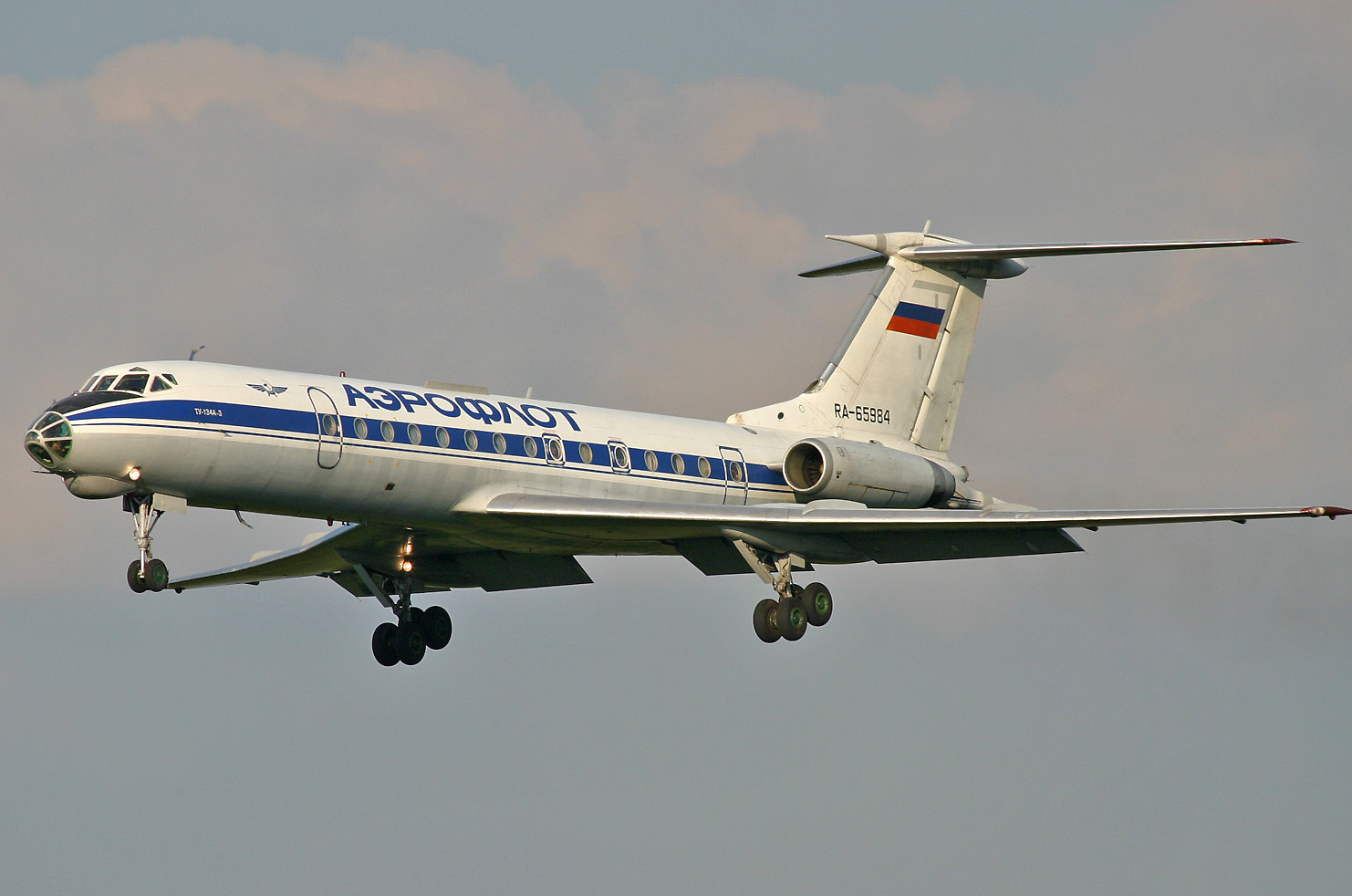
(The Tu-134 has a “gaggle” of jumpseats, and they do not look like a baby’s high chair …like mine does).
Initial ride on the airline bench.
The first time I had the pleasure to ride on an airliner jumpseat, the year was in 1982; I was in my twenties and flying for Scheduled Skyways (a “commuter airline”) based in Fayetteville, Arkansas. I found myself at the Southwest Airlines gate in Tulsa, looking to bum a ride down to Dallas as part of my plan to spend the weekend back in “God’s country.” My girlfriend was in the cabin with a real-life ticket, but I was looking to do better than that. Since I was now an “airline pilot” (even for a puddle-jumper outfit), as long as I was in uniform and presented all the correct credentials, I could legally sit in the cockpit with a couple of “real” airline heroes… didn’t matter that I wasn’t on any official type of business. I was a 26-year-old airline captain bound for the big city to party; if that is not official ENOUGH business, then what is, right?

(A Southwest Boeing 737-100 from the early days. We used to say that their paint scheme resembled the contents of your average baby diaper.)
Upon introducing myself and presenting the paperwork to the Captain, I stood in the cockpit doorway like an idiot, wondering just where I was supposed to sit. The “jumpseat” is not visible to the untrained naked eye, and my eye could not have been “naked-er.” In some of the smaller jets, like the Boeing 737 and McDonnell Douglas DC9, the jumpseat is tucked into the doorway bulkhead itself. Depending on the model, you stand out of the way, squeeze some levers, pull at the right spots (do a dance, whistle a tune, and say a prayer), and VIOLA! Down it slides on two vertical rails and locks into place. To be totally accurate, you are actually sitting IN the doorway to the cockpit, and the door acts as the back to your “chair. You are sitting spread-eagle, legs straddling the center console, a bit behind and between the two individuals who are doing all the work. The idea that on these smaller airliners, you sit in any real comfort would be a gross delusion of the truth.
They explained the physical gymnastics required to drop the “bench,” but in the end, the First Officer graciously climbed out of his seat and showed me how to lower and latch it into place (must’ve been the “doe in the headlights” expression on my face). I climbed on (you really do sit high up; I’m 5’ 11”, and I can dangle my legs) and began the process of getting buckled in and familiarizing myself with the Crew Oxygen Panel, Communications Panel, etc. In the middle of the “pre-takeoff” briefing the F/O was spieling concerning all that (plus what would be expected of me in the event of an evacuation), we were interrupted from the cabin. To be totally accurate (again), interrupted isn’t completely accurate; I felt two rather enormous breasts pushing against my head and heard the sugar-sweet voice of a Texas angel ask, “Ya’ll want anything to drink before we take off?”
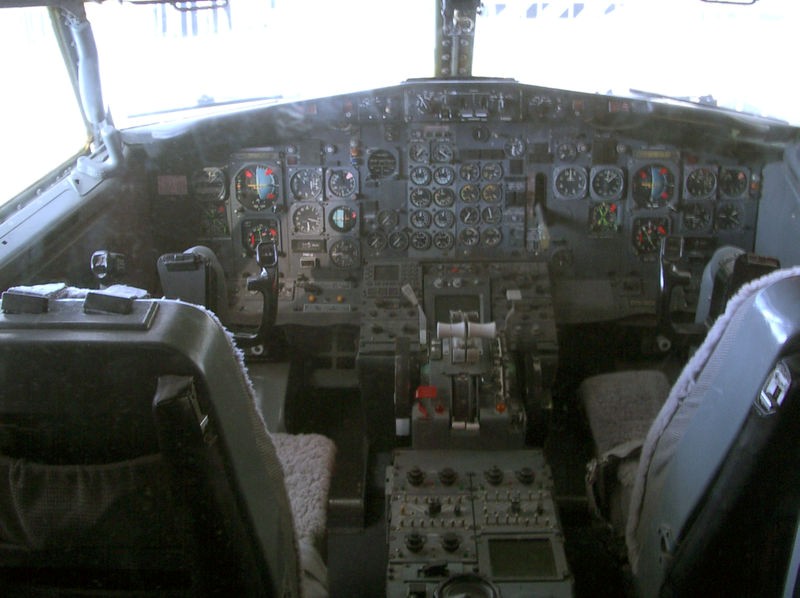
(The view from the “bench” on an early model of the Boeing model 737.)
I truly did not know what the proper protocol called for. Was I too:
-act like an idiot and try not to notice that I was being pushed forward so hard I was about to tumble out of the bench itself.
-turn around and take my chances on asphyxiation.
-sit motionless and enjoy this unexpected nirvana,
or…
-wait and see what the other pilot-types did.
I chose the latter.
It was then that the First Officer looked at me with a stupid smile on his face and began to spew words that I thought would get him (and me) a ferociously stern rebuff by this wonderful woman (whose face I had yet to see). In the present day and age, if he crossed the invisible that he was about to cross, he would probably be fired for this most heinous of acts…making a crass comment. But then again, Ronald Reagan was president, and the world was most certainly different. He said (and I quote), “You know Thelma Lou (or whatever her name was…good “Suthurn gurls” always have two names), you have the NICEST TA-TA’S I HAVE EVER SEEN.” (Note. He did not use the term “ta-ta’s”. He used a term far more crass beginning with the same letter “T”.)
If I’m lying, I’m dying. I cringed and attempted to sink my head into my shoulders but could not, for it was held in a vice-like lock. I awaited the onslaught of yelling and incriminations that was sure to come from Thelma Lou, but all I got was a little wiggle from “the vice” and a heartfelt “WHY THANK YA’LL!” The vice released my skull, and off she went to attend to other duties. Needless to say, I sat dumbfounded, and the F/O just looked at me and winked. The details of the flight itself are a blur, for my gray matter had chosen to forget all that, but I’m sure that the skill and professionalism demonstrated by these two brave aviation professionals was indeed impressive. I do recall that after the Captain had set the brakes at the gate at Love Field, I unbuckled, shook his hand, thanked him for the ride, and walked off thinking to myself, “Holy crap, this jumpseat thing might be O.K. after all.”
Over the years, I’ve ridden the bench on just about all of them, from Saab 340s doing the Memphis to Gulfport milk run to FedEx heavies hauling a load of purple-striped packages at 3 in the morning. One of the funny parts about being on an “offline” jumpseat (not your airline) is that you get to see the culture of the different lines, and that can be something to behold. I won’t use company names, but on one particular line, the Captain rules with an iron fist, his word being the Law…period, no discussion allowed. I’m sure this world-renowned company does not have a policy to upgrade only a-holes to the rank of Captain, but it sure seemed that way to me. On other air carriers, everyone is routinely friendly and nice to the point that you’d swear you were their long-lost cousin. At one line that I used quite often, the cabin attendants would frequently pack a small “goodie bag” to give me as I was deplaning…playing cards, First Class amenities kits, and yes, even several mini-bottles of their finest booze. All compliments of riding the bench.
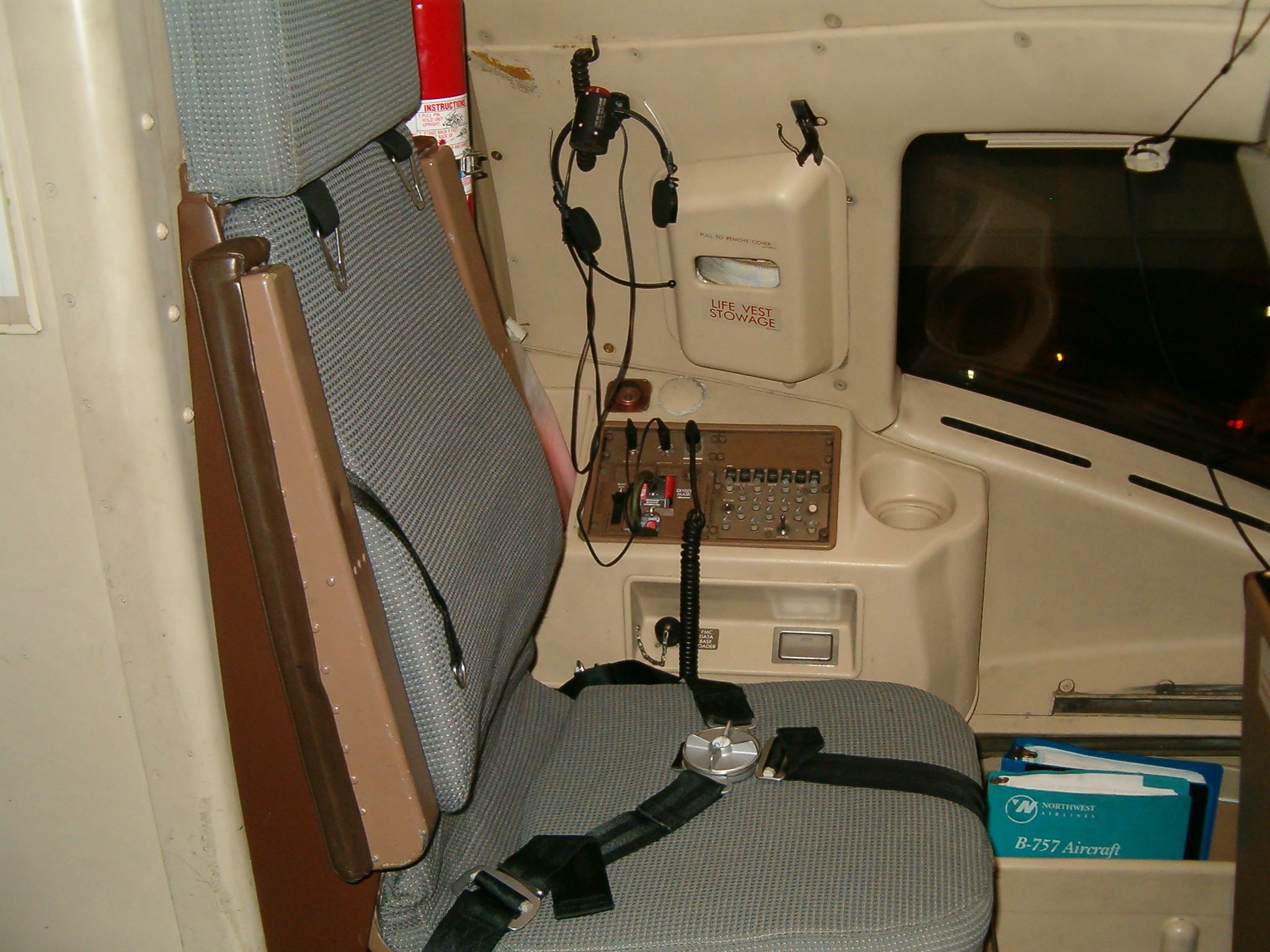
(My jumpseat sits VERY high on the bulkhead, and if the Captain has a bald spot, you’ll be looking square down on it…LOL.)
A couple of my favorite “bench” stories.
A ride on the “Hoot”-Mobile.
I was living in Little Rock, Arkansas, but flying as a Second Officer (or Flight Engineer if you wish) on our Boeing 747s out of Minneapolis/St. Paul. Since my airline did not fly into Little Rock, the best way (really, the only way) to get to work was to ride on TWA’s jumpseat through St. Louis to MSP. I had done this dozens of times, and the TWA folks (from agents to pilots to flight attendants) across the board were some of the nicest airline people I have ever had the pleasure to meet.
On the day in question, I boarded the Boeing 727-31 at Little Rock, got comfortable on the First Observer’s seat in the cockpit, and prepared for our hour-long flight to St. Louis. The crew was wonderful, the departure routine, and, once settled down in cruise flight I began to notice things. Things about this particular jet that didn’t seem right, most notably the trim settings. The rudder had what appeared to be a large amount of trim applied (not normal), but that paled by comparison to the aileron trim settings. Over the years, I had seen older jets that were a bit “bent,” if you will (a few too many hard landings), but I had never seen one skewed this much. The Captain noticed the puzzled look on my face as I peered at the large, black trim knobs on the aft section of the center pedestal.
He turned in his seat and offered, “Bill…what’s up? You’ve never seen rudder and aileron trim settings like that before?” He had a sly grin on his face. “Why, you don’t know, do you? You’re on ol’ ship 840…you know…the HOOT-MOBILE!” HOLY SHIT! It was true; I was riding on the very same jet that became famous after it experienced a “jet upset” and did a big “high dive” over Michigan! The event was infamous in the industry, as much for the maneuver as with the legendary pilot, Captain Harvey G. “Hoot” Gibson, at the controls! If you are a fan of either Boeing 727s or TWA, then you know that on an April evening in 1979, this machine essentially went out of control while in cruise flight, and only by extending the landing out (and superior airmanship blessed by Lady Luck herself) did the crew gain control and land the crippled aircraft.
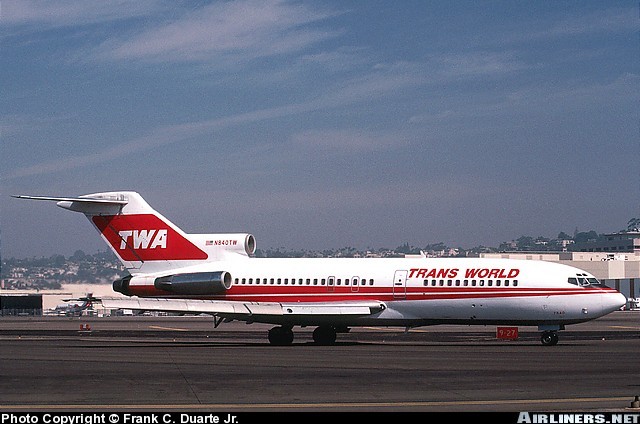
(N840TW in the flesh. Many thanks to Frank Duarte for its use.)
Controversy surrounds the legend, and only the three in the cockpit would ever know exactly what happened. The crew claimed that some of the leading-edge devices (called slats) extended while at 39000 feet without being activated by the flight crew, thus causing an asymmetrical condition that resulted in the aircraft tumbling out of control. Legend has it that the flight crew “may” have attempted to extend the flaps (thus making the wing “bigger) to aid the jet to climb to an altitude that was higher than the current weight would allow (a big no-no). I don’t recall the limitation on the 727, but the 757 restricts their use to below 20,000 feet, and in their case, it would have required an ill-advised “Rube Goldberg-type” non-approved procedure to accomplish this.
The industry-wide legend is that while the Flight Engineer was in the forward lavatory depositing some of TWA’s finest coffee, “Hoot,” and the First Officer found the circuit breakers for the “LEADING EDGE SLATS” (panels that extend on the forward part of the wing to add lift at slower speeds) and pulled them rendering that system inert. They then moved the FLAP handle to the 2-degree position and extended the flaps on the trailing edge of the wing (again, the “bigger wing” theory). The F/E (not privy to the plan) returned to the cockpit, noticed the circuit breakers out, and pushed it back in. The hydraulic system next did what it was designed to do, and (since the FLAP HANDLE was in the 2-degree position) it attempted to extend the numbers 2 and 3 slats on the left wing and the 6 and 7 slats on the right wing. Unfortunately, they did not extend symmetrically, and since the days of Sir Issac Newton (and the “what goes up must come down crowd”), the lovely red and white, 170,000-pound wonder from Boeing abided by the laws of physics. It rolled over and quickly pointed toward Mother Earth, displaying the flying qualities of a steel manhole cover.
In effect, they caused their own emergency. The last-second extension of the landing gear probably saved the 89 souls on board, but not before plummeting roughly 7 miles in a very short period. My guess is that after the emergency landing in Detroit, hours of therapy awaited most, if not all, of them. The TWA Captain I was with on that flight relayed that Captain “Hoot” Gibson had become an expatriate somewhere in Central America. Truly, after that small “life event”, maybe a life spent beachside, to included several million umbrella drinks, just might be the most appropriate therapy required.
The final NTSB report vaguely implicated the crew, and that’s where history left it.
( http://aviation-safety.net/database/record.php?id=19790404-0 and https://en.wikipedia.org/wiki/TWA_Flight_841_(1979) )
Either way, I was firmly plopped on the jumpseat of a famous piece of aviation lore. Only history will know the truth behind the event, but from what I could tell by the position of the trim wheels, it was either the most “bent” Boeing 727-31 that ever flew, or the TWA mechanics pulled the wings off and put them back on upside down and backward. The mere fact that it ever flew again is a glowing tribute to Mr. Boeing’s wonderful flying machines.
A bookcase can be a bench.
A few years later, I was still living in Little Rock, Arkansas, domiciled in Boston and flying our DC10s overseas. Again, the best way to get to work (or home) was on an “offline” jumpseat. 99% of the time worked like a charm, but now and then, it got a bit “pear-shaped”, and I would end up spending the night in a bed other than the one I intended to be in. Not the end of the world, but still a pain in the ass at times.
On this day, we had gotten into Boston too late to catch my usual flight home, so I ran over to a different carrier that would get me to Little Rock, albeit by a rather circuitous route. I was to leave Boston, fly to Charlotte, North Carolina, change jets, then move on to Little Rock. I dashed over to this airline’s gate, filled out the paperwork, and proceeded to the aircraft to plead with the Captain for a ride home.

(Rush hour at Boston’s Logan International Airport. Thanks to Josh Rawlin for the use of the picture.)
The Boss on this flight was an older gentleman, and the wrinkles and grey around the temples hinted that he had been with his line since way back when. When he was hired, they probably still had those funny twirly things that stuck out in front of the engines. He was standing at the boarding door and introduced himself with that same graceful southern accent that “Thelma Lou” had soothed me with so many years and miles ago (it could have been her dad, for all I knew). Following that, Captain “Billy Bob” took those southerly good manners (reminiscent of Rhett Butler himself) and proceeded to walk me into the cockpit and introduce me to the First Officer. He climbed into his “Captain’s throne,” and I dropped the jumpseat on the 737 (I knew how to do it without looking like a spastic moron by now), and I prepared to let these two rather amicable gentlemen fly me down to Charlotte on my first leg homeward bound.
The ticket agent had informed me that the flight was going to be full, with the intent of making sure that I knew I would be occupying the jumpseat all the way down to North Carolina. On most airlines, even though you are “booked” on the jumpseat, if a seat in the cabin is available, you can ask the Captain if he would rather you sit amongst the regular folks. Some allow you to go back; some don’t. As a rule, I always tell a jumpseat rider in my cockpit to sit where they would be most comfortable. Regardless, the jet was packed; I was strapped in tight on “the bench,” and this line’s version of Thelma Lou had plied us with coffee. Life was good.
Within minutes of the planned departure, I heard the sound that would ruin my plans this evening. Another pilot-type was introducing himself to Thelma Lou as their jumpseat rider, but not to panic; if this guy were another “interloper” like me (not employed by this airline), then I would have won the “first come, first served” lottery. Unfortunately, this was not to be the case, for he did work for this carrier, which meant that the only thing for me to do was to unbuckle, gather my junk, deplane, and wait for the next flight headed in my direction.
I began the ritual of extracting myself from the cockpit, but Captain Billy Bob turned around and said something to the effect of, “Don’t go anywhere; just slide on over here (slapping a flat surface to the left of the jumpseat) and make yourself comfortable.” Paint me confused, for it seemed to me that he was motioning me to sit on what looked to be a technical manual storage box that stuck out from the left side bulkhead. I moved toward that “box,” and he handed me a first-class pillow he had procured from “Thelma Lou.” I plopped it on the spot he wanted me to occupy and was telling the ticket agent that all was set and she could shut the door for an on-time departure! Surely, I mused, he meant for me to sit on the pillow until he could explain exactly which little cubby-hole their second jumpseat would fold out from.
Amid all of this, the other jumpseat rider was strapping onto the “bench” (that I had warmed up for him) and was giving me a hugely quizzical look… mirroring mine. I sat down, and while looking around for the seatbelt and shoulder harness, it finally dawned on me. A) this was no jumpseat, B) there was no second “hidden” jumpseat, and C) I was about to occupy the made-up jumpseat (that the rest of the aviation world would call a storage box), and for the next two hours of winged flight! As this insane realization set in. I noticed that we had pushed off the gate and were starting the engines. “WHAT THE HELL!!??”

(Essentially where I was sitting (sans the jumpseat on the back bulkhead). My kingdom for a seat belt and O2 mask!)
I was faced with an interesting dilemma. I could kindly ask Captain Billy Bob to taxi back to the gate and allow me to deplane. I could DEMAND that Captain Billy Bob taxi back to the gate and let me deplane. I could grab the microphone and begin yelling over the Boston Ground Control frequency…” HELP, I’m being kidnapped!” The answer to this dilemma, of course, is that I could do none of those. I was essentially trapped in this (now) cramped cockpit, with no FAA-approved place to sit, no FAA-approved seatbelt or shoulder harness or crew oxygen mask…no FAA-approved anything! I was tasked with sitting on a pillow on the top of the cockpit storage box, with nothing more than a window support brace, and hanging on for dear life. Lovely.
The elderly gentleman driving the jet and sitting directly in front of me offered, “Don’t worry, Bill, that seat ain’t so bad; I rode it all the way to Florida a few weeks ago.” My thinking was “Gee, thanks, Captain Billy Bob!” I guess I was a tiny bit glad that his airline did things a bit differently from mine (otherwise, I would be stuck in Boston for the night). I confess I was pining away to have something that vaguely resembled a seat belt. As we fell in line behind a dozen other jets taxiing toward runway 22R, I had visions of us aborting the takeoff with a blown tire, bouncing off through the weeds, and me riding her like I was a rodeo star on “ol’ Widow Maker” and waiting for the 8-second bell! If the FAA got a whiff of what was going on…well, let’s say that Captain Billy Bob and I would have a bit of explaining to do.
Fortunately, the flight turned out to be uneventful. Smooth air en route (thank God) kept me in one spot on my “seat,” and the F/O painted the landing gear onto the runway in Charlotte with the touch of a feather. He was either showing off, or he was envisioning me bouncing around (and ending up in his lap), and it gave him the heebie-jeebies. I was glad that we were now nearing the end of this little adventure, but as we taxied toward the terminal, thoughts of the FAA began to set it yet again.
)I seriously DID NOT want to see a badge with this logo anytime soon.
The gate agents at every airline wear several hats. Not only do they assign the seats for each passenger on the jet (except for Southwest Airlines…they are the exception to the rule), but they also position the jetway up to the aircraft and open the passenger door once it’s in the chocks. As we are being motioned into the gate, they will pass a few feet to the left of the side windows of the cockpit (most smile and wave). The agent who would meet this flight would be well aware that the Boeing 737 had but one cockpit jumpseat, and the appropriate number of heads to count as we taxied by should be three…and only three. Our issue would be that they would see that we had “grown” a head en route from Boston. I hated math in school, but I did know that three does not equal four.
I was concerned by what their reaction might be, and I visualized it running the gamut from being amused at seeing four noggins in the cockpit to calling the FAA and turning us in. My heart was in my throat as we pulled up to the gate, and I attempted to get VERY small on the stowage box, thinking that maybe they would not see me. I held my breath as we slowly taxied past her, not sure if she saw me or not. When the brakes were set and the Shutdown Checklist was complete, Captain Billy Bob turned around, shook my hand, and thanked me for coming along. I choked out a “You’re welcome, thanks for having me!” I grabbed my belongings, left the cockpit like I was shot out of a cannon, and did the “fade into the night” thing as best I could.
The ticket agent never gave me a second glance as I walked past, and I quickly put as much distance as I could between myself and that gate. The next flight was completely uneventful, and I was offered a very comfy seat in the coach cabin of the little Fokker F28. I not only had a seat belt and an oxygen mask (behind the little pop-open door), but I also had a reading light and air vent! Life was good, and I was living large! I have thought of that night and dear ol’ Captain Billy Bob and his “creative” jumpseat assignments often and wondered if he would have been just as happy with me riding down to Charlotte that night, sitting on the toilet reading the Sunday New York Times. I’m guessing he probably would have been.
I have ridden many a cockpit jumpseat over the years, and while not all were on the order of your favorite comfy leather chair (actually, none of them were, for that matter), they all served a purpose. I will be eternally grateful to the Captains who so graciously allowed this stranger to ride on their jets, and almost without exception, they made me feel welcome and very much at home.
So, the next time you see three pilots come out of a cockpit designed for two, you will know that one was “riding the bench.” They may look a bit frazzled from the less-than-comfortable seat, but the smile across their face will mean that comfort factor notwithstanding; they are at last home. Or, it might mean that they had the luxury of a seatbelt, a shoulder harness, and an oxygen mask. One of the two.
‘till next time,
BBall


 BBALL'S LOGBOOK