It happens each month like clockwork. Nope, I’m not talking about the normal ills of being a (greying) whisker shy of seven decades of sunrises. Nor am I speaking of “old friends” like the aches and pains that come with moving too fast, or midnight bladder runs, since that thing called “middle age” hit like a tsunami. No, I am speaking of something that comes with the regularity of the tax man; the monthly publication of my union magazine (yes, even retired pelicans continue to receive it). The “Air Line Pilot” magazine’s ability to track one is legendary, almost mystical, for after several cross-country moves with no effort to update my address, it still inhabits my mailbox on a regular basis. I am quite certain that after the wizards at the Witness Protection Program erase you from all memory, the ALPA gnomes will locate you, and the magazine will show up just as it did the month before (when you were an actual person).
Regardless, it magically appears and is mostly filled with articles regarding airline safety, various FAA issues, new technology on the horizon, and information regarding the various ongoing contract negotiations within the industry. All those are fine and dandy, and mildly interesting to a retired pilot. Still, within the slick, glossy pages of this periodical, there remains one section that I (and most of my contemporaries) thumb to immediately.
It is called “In Memoriam.”
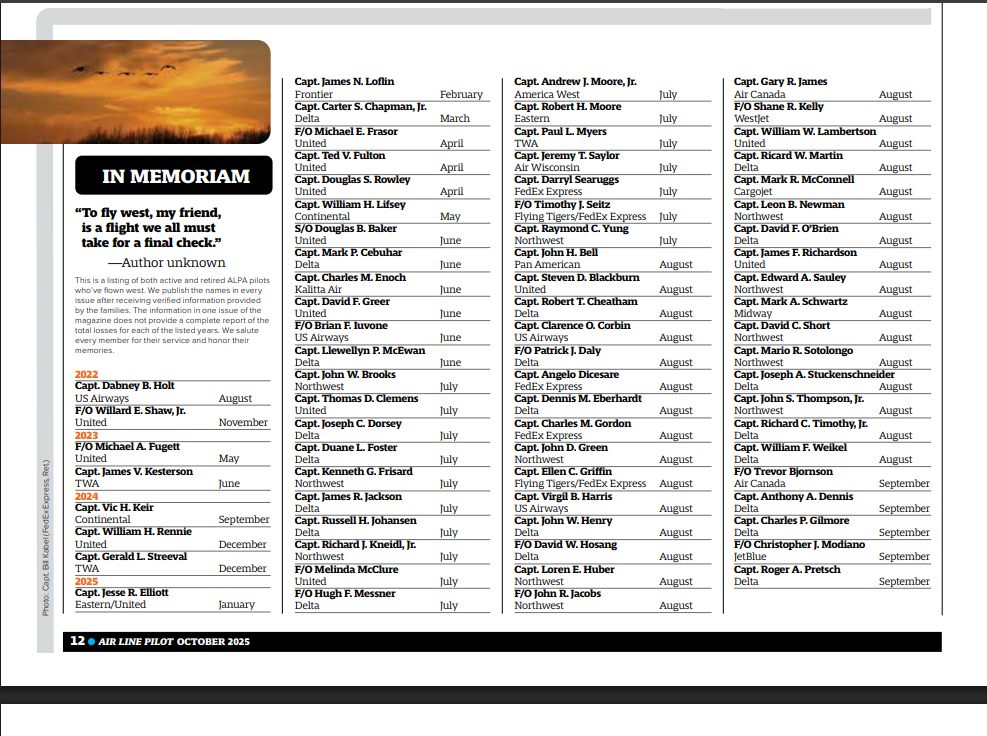
In aviation, we have a saying when one of our brothers (or sisters) passes from this Earth into the next realm… we say they’ve “flown west.” Within this section lies a hallowed list of aviators that reads like a roster from the dusty book of line pilots who have taken that journey “west”. Under the title sits a short poem/mantra that is as familiar to most pilots as their Pre-Start Checklist. It reads:
“-Author Unknown”: “To fly west, my friend, is a flight we all must take for a final check.”
To those of us who have shared our world among the clouds, sitting but a few feet from a person for hours (even days) on end, there exists a bond that is as sacred as it is unexplainable to those who have lived within the restraints of gravity. Each month, as I page through the names, the list seems to be longer than the last. As the months pass, I recognize more of the names as those of brothers (and sisters) with whom I have had the privilege of logging flight time. They have all departed “west” to their eternal layover, and not surprisingly, some of the names spark the memory cells in my brain. Many of the names evoke wonderful memories (occasionally one that conjures the opposite), and I’ve either written about many of them or (in some cases) intend to pen a yarn about them in the future.
(The “In Memoriam” page from a recent ALPA magazine.)
It was a pleasure and an honor to fly with these folks, the ones who groomed me as a young “birdman”, and those who had my back as a new Captain. In later years, as my experience and comfort level in the Commander’s seat took on the “old shoe” style comfort, I endeavored to mentor the younger crewmembers and (at times) take on the role as a trusted advisor and marvel at their talent. They all (the wrinkled and the young) were amazing pilots, skilled in their profession, and they were a joy to work with (and for). The following link is a yarn penned many years ago of one of my all-time favorites when I was a new-hire at Northwest Orient Airlines:
Before my 37-year career at Northwest began, I was fortunate to fly with the most incredible group of pilots I had ever been a part of. We all worked for a small airline called Scheduled Skyways, based in Fayetteville, Arkansas. There were fewer than 100 pilots at this line. The following list reads like a “who’s who” of the gifted Captains at Skyways in the 1980s: Jim H., Jay T., Ron R., Wendall L., Gil M., Bill L., and Pat B. After a year, when I moved to the left seat and took command of the small “airliner” for the first time, the list of trusted First Officers was as hallowed as the list of four-stripers: Steve “Buzz” B., Cortney K., Pete C., Strawn F., Will H, Sinotra O., Ted J. Al M., Matt S., Don P., Stu B., Greg W., John A., Buddy A., Mike C., Scott E., Grady W., Paul B., and Mike D. Every name from those lists were (are) excellent pilots, and I was extremely fortunate to have them in the cockpit with me. Not every pilot at this line was mentioned; some were inadvertently left off (my apologies), some not so inadvertently.
The names mentioned are the men who helped shape me as a professional pilot, and many became friends (some to this day), and I was blessed to spend four years in my mid-twenties with them. Although we never shared the crucible of flying bullets and flag-draped coffins, we shared many a rain-swept, lightning-filled sky, more than our share of trials with difficult flying machines, and lots of bad days with difficult airline management. Pain spares no man, and we were no exception. We helped each other through death, divorce, and illness. When my beloved oldest sibling tragically took her own life in 1982, a dear friend and colleague made a suggestion that has become a lifelong outlet for my thoughts and feelings. He suggested that I begin a journal (“blogs” did not exist back before a guy named Gates hooked a keyboard to a screen). He explained that many years removed from the event, I would recall the event itself, but the details, and especially my feelings/emotions, could easily be skewed. He was spot on, and thousands of hours, ten calloused fingertips, and gigabytes of X’s and O’s (and one novel) later, I would be remiss if I failed to thank him profusely.
“Thank you, Peter, your suggestion has left many with sore eyes and bruised brains, but it has saved what little sanity I ever had… many times over. God bless you, brother.”
During those days in and out of the loud, cramped cockpits, we laughed, we bitched, and we bonded. Thank you, gentlemen, you will never know just how much I cherish those days.
Then there was Mark Detrixhe.
I first met Mark on a clear, pre-dawn September Sunday in 1979. I had been in the employ of the small “hometown” airline in Fayetteville for one month and one day. This was to be my fifth day of flying as a new First Officer on the Swearingen Metroliner in the livery of Scheduled Skyway. The initial training was “interesting” to be sure; it was flown in the middle of the night (the machines were far too busy to use during daylight hours), and under the intense tutelage of the Chief Pilot Ted B. The one other pilot in my “new hire class of two” (Howard S., who became a good friend and ended his career with FedEx) and I felt like we were taking a sip from a gushing fire hydrant. It was a huge amount of information for two young pilots (me, from the world of night freight in the Piper Navajo, and he, from the SoCal world of flight instructing). Still, we studied hard, flew to the best of our ability, and completed the program. I recall my first impressions of the machine was that it was very loud (we wore “noise cancelling” headsets…they did not cancel much of anything but a nice haircut), was much larger and heavier than anything I had piloted before (it had a 12,500 pounds gross take-off weight…by comparison the Navajo tipped the scales at just over 6000 pounds), and was rather over-engineered… a fancy way to say it was a complicated airplane (it was my first experience with things like “bleed switches”, “start locks” and “current limiters”).
(A typical Piper PA-31 Navajo cockpit.)
———
(A typical Swearingen Metroliner cockpit.)
The previous four days of this, my “virgin” week, were a blur. For the first two days, the weather was characteristically ugly for late summer in the Ozarks. Thunderstorms across the entire route structure (to include a missed approach at one of the smaller stations, Harrison, Arkansas), with lots of turbulence, heavy rain, and winds. After the front had passed, the next two days were a daze of dense, hazy skies and hot, humid flights. The four Captains for these first days were either the oldest guy I had ever flown with (Ray Y., … in his 70’s!), silent and surly (Art K.), or just rather “different” (Ed F. and David R.)…nice guys each one, but not the kind of commanders that might put me at ease (and thus relaxed) enough to truly glean anything useful about operating this beast in the 14-hour day, 10+ leg world of the commuter airline flying. I hung on by my fingernails, did exactly what they told me to do, mostly just watched them fly the aircraft (they were all “old heads” with lots of time in the machine), and finished each day wrung out and exhausted. Day five with Mark would be completely different.
Northwest Arkansas, in the Fall, can be a stunning place to live. Endless forests filled with vibrant hues that leave nothing of the color spectrum to the imagination. Cool mornings, warm afternoons, and gentle winds. This was what I expected on the first four days of my fledgling airline career; luckily, this was what I was presented with on day five. After meeting this man (roughly my age) whose smile was eclipsed by his easy manner and friendliness, we departed Drake Field as the eastern horizon began to brighten with the approaching sunrise and settled into our day of hauling posteriors through the clear blue skies of the deep south. We motored through Ft Smith, Memphis, Harrison, and Fayetteville, back to Memphis, and finally returned to our home base of Fayetteville as the clock was a few hours north of noon. Where the previous four days were long, intense, exhausting hours in the cockpit, this day was exactly the opposite.
(Scheduled Skyways ship number N501SS on the ramp at Drake Field.)
My most vivid memory was that we laughed. A lot. He told (and showed) me things with the machine that no one had mentioned (admonishing me to “don’t try this until you have hundreds of hours in this piece of sh*t”). He did it all in such a way that as I walked to my car at the end of the day, I felt as if I had just flown with a “guru,” a pilot who had been doing something very difficult long enough to make it look easy. He had, in effect, given me a “master class” on flying a machine that was most assuredly NOT easy to fly. And he did this all the while keeping the cockpit atmosphere relaxed and fun. I would not crew with Mark again for two months (flying almost every day), and when I did, the weather that day was characterized by rain, fog, low clouds, and wind. It was decidedly more challenging than our first day as a crew, but did the pressure of a day of ugly weather change this “easy-going” pilot in the command of our machine (and me)? Nope, same relaxed manner, same fun “banter,” same practiced “wizardry” at the controls of a difficult steed, and same feeling for me at the completion of (another) long day in the Metroliner. The “master class” continued, and I looked forward to seeing his name next to mine again on the schedule.
For the next few years, we crewed many more flights through many more beautiful (and at times angry) skies, and I learned a great deal from him. He became a friend, and I can still see his smile, hear his funny yarns, and recognize his influence on me as a new “airline birdman” as real and positive. He was a “Captain’s Captain,” and it was a pleasure to fly with him so early in my airline career. Like the rest of us brothers at this line, we all went our separate ways (I being hired by Northwest Orient in November of 1983). For some of us, our journeys would cross at regular intervals; for some, we would never see each other again.
Sadly, Mark “flew west” a few days ago, and although the years saw us drift apart and our lives move in different directions, I knew my aviation brother was still an integral (read important) part of my flying journey. Our last “conversation” was in a group text, and it breaks my heart to say it was not as “easy” as our early days in those noisy, cramped cockpits. Though we might have parted as polar opposites regarding things of this Earth, I pray that he knew I respected him as a man, an exemplary aviator, and loved him as a cherished friend. Several from our little group have journeyed before Mark, and in the end, we all will pass that invisible barrier between here and what awaits us. He will be missed by everyone who knew him.
I sat in my office a few nights ago and raised a glass of spirits to Mark. I prayed that he found his “paradise” and that he knows that we miss him.
“Fly west, Mark, on your journey that we all must take for a final check. I wish you only following winds and calm skies, my friend. Buy Buzz a beer for me, oh, and grab one for yourself… put it on my tab, brother.”
As I penned the previous blather, I mentioned one of the “resolutions” for the New Year was to finally finish a project that has been banging around in this melon for many years. As I began writing in earnest the year was 1982, and after the tragic passing of a beloved sibling, I was advised that putting pen to paper might be used as “therapy”. As it turns out, the dear pilot-friend who proffered the suggestion (thanks again Pete Connelly) was sage-like in his advice. The upside is that it helped tremendously with my loss, the downside is that it began a lifelong addiction of trying to integrate a brain with a keyboard. Some have said it was a good thing, just as many said the opposite. I never took that to heart, for I knew that the ghosts of Twain or Hemmingway flowing through these fingers was never going to happen.
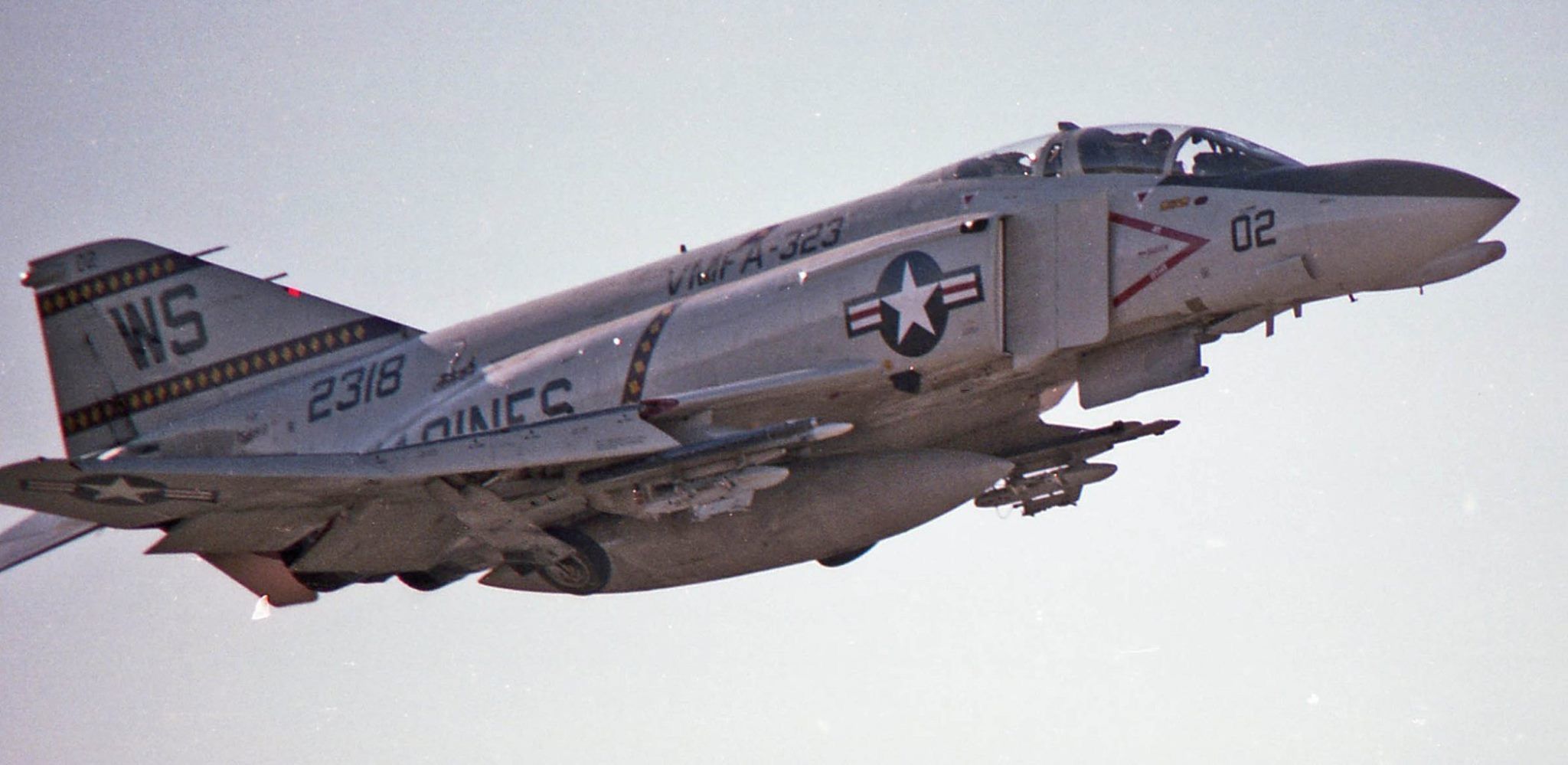
With that said, I thought that possibly a snippet of this, my first work, might just help with the process of “building a fire” under this posterior working toward its completion. The story begins in the year 1980, and the premise is simple, but the telling is not. The protagonists are a son (a Marine Corps F-4 Phantom fighter pilot), a father (a world-renowned UCLA Humanities professor), and a strong-willed mother. The mother has passed and the gravely ill father has penned a diary for his son to read. It relates the story of his parents’ life (previously unknown to him) when they met during WWII in war-shattered Poland.
The “hook” is that his father was a German fighter pilot (shot down and wounded) and his mother was a Jewish Polish resistance fighter. Their love helped them survive the ideology of hate and the son comes to grips with this (and other issues related) as he reads the words of a dying man.
The tentative title: “The Eagle of Judea”
Chapter 27
7:00 a.m., Saturday, December 13th, 1980.
Room PV #301, Neurosciences Critical Care Unit.
Cedars-Sinai Medical Complex, Los Angeles, California.
“Beep, beep, beep.”
“Beep, beep, beep.”
“Beep, be….”
Rudy grabbed the small brown leather box, flipped it open to display a shiny Seth Thomas wind-up clock, and fumbled with the small switch on the back to silence the annoying noise.
“For the love of God, whoever invented the rollaway bed should burn in hell for their sin.” Groaning as he painfully sat up, he heard the mattress springs squeak loudly as he did so. Their metallic protest was as sincere as his.
Turning to look at his father lying in the bed, it appeared that nothing had changed during the night. He vaguely recalled the nurse quietly slipping in every few hours to check the machines, write some notes on a clipboard, and leave. He could not recall if it happened twice, maybe three times. It didn’t matter; the rollaway guaranteed that any attempt at restful slumber would be impossible.
“Coffee, and the sooner, the better,” was the single thought trapped in the sleepy cobwebs of his brain. Grabbing his clothes hanging over the back of the desk chair, he groaned in unison with the metal springs of the bed as he stood to get dressed. A few minutes later, enjoying the ritual first “head call” of the day, thoughts of the diary came flooding back to him, and questions from the night before began another swirling dogfight within his mind.
“Kazandra? Really?” shaking his head, “In my wildest dreams, I never thought of my mother as a Kazandra. Boy, do I need some coffee!”
Thirty minutes later, after a trip to the crowded nurse’s lounge, battling through the fog of cigarette smoke and gossip, he returned with two large Styrofoam cups of the strongest coffee he had ever tasted…it made Marine Corps coffee taste like Kool-Aid. The door to his father’s room was slightly ajar, and as he entered, he was met with the morning shift nurse on her way out bound for the room of her next critical care patient.
“Good morning,” Rudy offered, pausing to hold the open door with his foot as she filed past him into the sterile hallway. She smiled politely as they passed, obviously too busy and too preoccupied for conversation. That was fine with him; he wasn’t really in the mood for small talk.
Pausing to watch her move down the hall, he spotted the last person he wanted to see so early in his day. It was nurse “Ratched” from his initial visit to his father’s room, and she was inbound in his direction. She had delivered the Marine D.I. “in your face” dressing down and was intently looking down at a clipboard as she closed on him. The flashback of her enraged, spittle-laced diatribe flooded back to him in full techno-color, and he recoiled by ducking quickly into his father’s room, allowing the door to close safely behind him. Breathing a sigh of relief, he relaxed, his very un-Marine-like retreat had all but guaranteed the possibility of a second round of her angry ire was now hovering somewhere around zero. Setting one of the two coffee cups on the small desk in the corner, he was mid-gulp into the other when the door suddenly opened, and in stepped the very cause of his retreat! Stifling the urge to send some of the hot liquid back into the cup, he pulled it away too rapidly and, in the process, spilled a fair amount down the front of his blue shirt. The liquid was still very hot, and looking down at the large wet stain on his chest, he instinctively let out an…
“Ah, crap!”
Not seeing him, startled, she turned to face his direction, “Excuse me?’
“Oh, not you…no…. I…. I spilled coffee…. down my shirt,” Rudy stammered, red-faced. She noticed the large brown stain on the nice blue flannel and burst out laughing, and this brought a large grin to his face. Her original angry demeanor was gone; she was now someone completely different. He thought she looked a bit like what the actress Angie Dickenson’s older sister might look like if dressed in a white nurse’s uniform. Her blond hair framed the white nurse’s hat, and her large dark brown eyes were bright with the beginning of a new day. The angry outburst from their initial meeting seemed from a different person. She now appeared to be simply another dedicated nurse, working long hours at a difficult job.
She stopped laughing and turned more serious. “I’m sorry,” she said, “I shouldn’t laugh; that probably didn’t feel very nice. Are you O.K.? Should I call a doctor?” she stifled another laugh.
Even more embarrassed than before, Rudy awkwardly brushed the wet-stained front portion of his torso, attempting to make the spot smaller or possibly lessen the contrast between the dark brown and the soft blue. He meekly replied, “I’m fine, thank you for asking.”
Setting the half-empty cup on the table, he picked up the other and asked, “Would you like a cup of hot coffee? I think I’m going to wait a bit before I attempt to drink anymore.”
Her red lips formed a friendly smile, “No thanks…”
The door suddenly opened once more, and Dr. Patel entered the room. His lab coat looked slept in, but it was the bags under his eyes that told the story; his night had seen very little if any, sleep. He looked tired, but then again, he always looked tired. Seeing Rudy by the window, he forced a small smile and a slight nod, “Good morning, Major.”
The nurse’s smile vanished into a “business-only mask” and she quickly moved to the bed to begin her duties at the various machines monitoring her patient.
Not waiting for a reply, the doctor approached the bed, lifting the clipboard from its holder at the near end. Flipping through the pages, he said without looking up, “I heard from the Nurse’s Desk that you were here all night.” Rudy intercepted him at the bed and extended his hand in greeting. He barely looked up from the charts and graphs to return the handshake. His grip was slight, and his small hands were smooth to the touch.
Rudy could tell that he was not in the mood for small talk, “Yes, sir, I spent the night on that horrible contraption.” Gesturing with his head toward the portable bed in the corner.
“Ummm…. I see.” Was all the doctor could offer, engrossed in the flood of information he was consuming from the clipboard. The pages snapped as he flipped them over and back again. Rudy was not sure that he had even processed his answer, so he decided to remain quiet while the man digested the volumes of information from a dozen or so pages. He looked completely engrossed and concerned about what the clipboard was revealing to him.
To remove any distractions, Rudy quietly moved to the window and slowly opened the blinds. A bright yellow hue from another smog-drenched California morning washed over the green and golden hills of Hollywood. The famous, 50-foot-tall white letters that proclaimed you were now in the land of fame and fortune were barely visible, shrouded in the morning haze. Spread below, the ant-like masses were moving to the non-stop rhythm of life in the big city. The myriad avenues and freeways were teaming with cars and trucks, all of them ignoring the fact that it was a Saturday morning, for the pace of life in Los Angeles was fast. It seemed surreal compared to the slow pace of the world in his father’s hospital room.
Gazing out the window, his mind wandered. Was it from the stress of the last four days, or maybe it was the horrible attempt at sleep the night before. Did it matter? Stress was stress, and he was feeling it in spades. He was lost in the view from the window, his thoughts engrossed in the sheer number of people he saw spreading out in motion before him. What were their stories? Were they tales of love and goodness? Or pain and sadness. Possibly both. Were they moving on a journey of happiness and joy or moving toward a rendezvous with pain? He hoped it was the former, but he knew many were the latter. The story of his mother and father’s early life together was nagging at his thoughts. He obviously knew how their story would end, but what was their complete story? He felt a tugging desire to return to the diary, but first, he and Dr. Patel needed to speak. His heart was heavy with what he expected to hear.
His thoughts turned to his mother and sister, and he longed to be with them again. He wished they were still with the living, and for his father to be healthy. He yearned for all of them to be together again, but he knew it was not to be. As he read the reports, the expression on Dr. Patel’s face foretold his father’s future, and he knew it almost certainly would include his worst fear. His dear father was slipping from him, and no matter how much he tried, this brilliant man in the white lab coat could not change that.
Unnoticed by Rudy, Dr. Patel had finished his review and was quietly standing at the window also gazing out as a drab morning stared back, framing the mood now inside the hospital room. Realizing a few seconds later that he was not alone, and without turning to look at the tired physician, Rudy asked, “How much longer does my father have Dr. Patel?”
Looking straight ahead, he slowly signed and offered the words that three-plus decades as a doctor had not made easier, “I’m afraid he does not have much longer. A day, maybe two. I am very sorry, Major.” Across the years, he had seen those simple words elicit all manner of human emotions: anger, disbelief, numbness, loud wailing, and soft sobbing. Modern medicine could sometimes vanquish disease, but it could never conquer grief. Dr. Patel was not new to this conversation, and he knew that his words were confirming Rudy’s worst fear, but they were the truth. Two facts were clear. First, the man in the bed would not recover. Second, this man, Josef Bergman, would be the 103rd patient who would perish while under his care at Cedars-Sinai Medical Center. Each name added to that list was another reason why he and a peaceful night’s sleep had become disaffected strangers.
Dr. Patel turned to look at Rudy, “My duties require that I must leave now. I will check back with you later today. Again, I’m very sorry, Major.”
As he spoke, he looked intently into Rudy’s eyes, extended his hand, and took the younger man’s hand in both of his. The grip was no longer weak but strong and firm. Sunken dark circles eclipsed his sad brown eyes, the product of countless hours attempting to prolong what awaits all of us, and they spoke more than his words ever could. They silently conveyed that he cared deeply about each of his patients, the ones he could save and especially the ones he could not.
He left the room to a dying father whose last grains of life were slipping through the hourglass of time and to a son staring out a window at a panorama of life that was blurred as if being seen through a veil of tears. How long Rudy stared out the window feeling numb is anyone’s guess. He had no sense of time, but he knew that time sensed him, and it was most assuredly not his ally.
He turned to look at his father, and the soft morning light was filtering through the window frame, illuminating the man that Rudy loved as much as the man loved him in return. For the first time in his twenty-nine years, he pictured a world without this man, and that was a hammer to his chest. The words echoed in his mind, “…. he does not have much longer. A day, maybe two.” It was now more than the persistent feeling of dread that had been his companion since the phone call at NAS Jacksonville five days ago. It was now a medical diagnosis from a physician he trusted. “A day, maybe two.”
He picked up the small leather diary and sat down next to the bed. Taking his father’s hand…it was cold and still when he hoped it would be warm and full of life. It was not and his eyes swelled with tears.
The slow rhythm of soft air from the respiratory machine, the steady beeps and blinking lights of the monitors, and the amber fluids moving through the needles all announced that this man, dearly loved by his only son, was moving unchecked toward eternal salvation.
“Pappa, It’s Rudy. I’m here.”
Nothing.
“Pappa, I love you, and I know you must leave to be with Mother. I have told you before that I know you must be with her. You belong with her, and she belongs with you, but please stay with me for a while longer so I can finish the diary sitting with you. I have to know your story before your time here comes to an end. Please, Poppa, stay with me just a little longer.”
The rhythmic beeping of the monitor suddenly skipped a beat. Then beat twice in rapid succession, then settled back to the previous steady rhythm of a life weakened and frail.
After losing his precious daughter Abigale and then, a year later, the love of his life, Dr. Josef Bergman’s will to live had diminished as each day became harder than the last. He longed to be with his love once more, and for that to occur, his time on Earth must come to an end. Rudy knew in his heart that the diary was an extended “goodbye letter’ from him, a window into his soul for only Rudy to peer through. He knew that his father had heard him, and he also knew that he had to finish the diary while the man was still alive.
Rudy opened the diary and reread the line.
“She went by the resistance code name “Kazandra,” but you would grow to know her as “mother.”
He paused and thought of his mother and how deeply he missed her. Her strength and guidance were eclipsed only by her love for her family. If she were here, she would know just what to do, just what to say to help him deal with all of this. She was indeed one of his pillars during the difficult times in his life, but that pillar was gone, and the other lay dying next to him. He thought back to the circumstances of her passing, and it left a hole in his heart that haunted him.
Her abdominal pains had been kept secret for far too long, but eventually, the frequency and severity became too much even for her, and she sought medical attention. Her efforts were met with a shattering diagnosis of “late-stage pancreatic cancer.” The news rocked all that knew her; still, with the courage and strength that was their way, she and Rudy’s father accepted the news and vowed to fight the disease with everything they had. When they last spoke, Rudy was nearing the end of an overseas deployment, and he had phoned home to Los Angeles for two reasons: first, and most importantly, to see how she was feeling and second, to let them know his return from the Mediterranean had been delayed. A few days before the call, the PLO had attacked a city bus on the Coastal Highway north of Tel Aviv, savagely killing and wounding over a hundred civilians. The U.S. Embassy immediately requested a beefed-up military presence in the region, President Carter agreed, and he was now stuck 5000 miles away until further notice. He had filed the paperwork asking for an emergency leave upon hearing of their delay, but the papers seemed to be lost in the shuffle.
The surgical procedures and chemotherapy treatments had left her weak, and her strength began to fade a little more each day. She knew her time was drawing near, but her love transcended the long-distance line, and she did what she did best: she put her pain and sickness on hold and spoke to her son as a worried mother would when her child was in harm’s way.
He thought of the last conversation they had before she passed. He called from the USO facility at Naval Station Rota, where he had been given shore leave for 48 hours. His Marine Air Wing, stationed aboard the U.S.S. Forrestal, was scheduled to arrive back in Norfolk by late April, but that had changed. The indefinite delay had him feeling horrible about not being with her, and he hoped that hearing her voice might lessen the feelings of guilt coursing through him.
“Mother, how are you feeling?” Rudy strained to hear through the receiver.
He could hear the soft weakness of her voice, “Rudy! I am fine, honey. How are you? Are you eating enough? Are the Marines feeding you enough? Did you get the package your father and I sent you last month?”
Rudy smiled, “Yes, yes, Mother, I received the package…thank you, it was wonderful. I’m doing fine. Yes, the Marines, well, the Navy is feeding us well. Enough about me, Mother; what is the latest from Dr. Wells? Is there any news on the tumors?”
“Oh, Rudy, the tumors are still there, but they have more treatments and ideas about how we will fight them. Do not worry honey, I will be just fine. Rabbi Dershowitz came by yesterday, and it was wonderful. Are you sure you’re feeling well? You sound tired, honey. How are you sleeping? You need to be rested when you are flying your jets, you know.” He could hear her voice getting weaker.
She asked him about the deployment, and he spent the next few minutes explaining how their time was extended due to the issues in Israel, but not to worry, he had filed the paperwork to come home as soon as he could. She replied that she understood and admonished him again to get more sleep.
“Click, click, click.”
Rudy knew that was the signal that he had two minutes remaining on his call. The line of sailors and Marines waiting to use one of the few phones was getting longer by the minute.
“Mother, I’m fine. It’s you who must rest.” Rudy longed to be there with her.
“Rudy, will you do me a favor?” She asked.
“Of course, Mother, what can I do from over here?” His mind was swirling with how he could possibly be of any help to her from the other side of the world.
“The news of the bus attack in Israel, I saw it on the television, and I’m sure that is why President Carter needs you there. Rudy, that evil hatred hunted your father and me during the war, and that evil is still hunting our people. If you and your Marines find them, honey, for our people, for Israel…” her voice trailed off.
“Yes, Mother…what can I do?” Rudy answered
“…be our modern-day warrior, King David, Rudy. Like we did to the Nazis we fought against, Rudy, kill them all, send them all to hell…” The receiver went silent.
Rudy’s heart was breaking. “Mother? Mother?”
“Yes, my dear boy?” He pressed the black hard plastic receiver to his ear; her voice was a whisper.
“I love you, Mother. I love you, and I will be home as soon as I can.” The receiver went silent.
The next voice was that of his father, “Hello, son. Your mother is sleeping. The morphine shots they are giving her take effect quickly nowadays. Any news on when you might be coming back to Norfolk?” He sounded exhausted.
Rudy hung his head and slowly shook it back and forth. He was feeling the same sense of weariness, but he knew he had to put a good spin on it. “No sir, they said we’re on an indefinite delay in theater. I put in for an emergency leave, but my Skipper hasn’t gotten back to me yet. As soon as I know something, I’ll phone you with the details. Is there any good news?”
“That will be fine, Rudy. No, son, I’m afraid that we have not had any of that kind of news in quite some time.”
“Click, click, click.” The one-minute notice sounded in the receiver.
“I have to go now, son. Dr. Wells and his team just came into the room, and I’m sure they have some information from the tests this morning. Please call when you have any word about your returning home.” Rudy could sense he wanted to say something else.
“and Rudy.”
“Yes, father?” He knew the next sentence would be a knife to his heart.
“She does not have… (his voice broke) …. Rudy, she does not…”
“I know, father, I know. I’ll try to get home as soon as I can. I love you, Poppa.”
“I love you too Ru…”
“Click.” The phone connection stopped.
Three days later…
1423 hours, Tuesday, 02 June, 1978
153 Nautical miles southwest of Lisbon, Portugal
U.S.S. Forrestal Strike Battle Group
“Strike, Devil 2, flight of two, angles 3.5, inbound.” Rudy unkeyed the microphone; the sweat beading up in his oxygen mask was irritating the stubble on his face. He should have shaved before the sortie…rookie mistake.
“Devil 2, Strike, you are the only chicks inbound. Push Channel 1, contact Mother on a 5-mile initial, QNH three zero zero one.”
“Devil 2, pushing Channel 1.” His gloved left hand hit the button on the throttle to switch to the next radio frequency in the queue.
“Mother, Devil 2, flight of two, five northeast, approaching initial.” Rudy’s transmission was short and sweet. Exactly the way the Navy and Marine Corps required their pilots to speak on the radio. Clogging up a frequency with needless chatter was the mark of an unprofessional aviator, and Rudy strove to be the most professional pilot in his squadron.
“Devil 2 flight, continue, cleared for the break.” The man’s voice was all business, and the moniker “Mother” seemed to offer a sense of “home and safety.” Aircraft Carrier pilots knew that any feeling of safety only happened when the jet was parked, lashed to the deck with chains, and the engines were shut down. It had been a long, two-hour flight, but this was no time to relax. The most demanding part was still ahead of him.
It had been a long road to get him to where he was now. The Texas summer day four years ago was the high-water mark of his initial flight training, for it was the day he made his first-ever landing (or “trap) on the deck of an aircraft carrier. The U.S.S. Lexington (the “Lady Lex”) was on station in the Gulf of Mexico, steaming 100 miles south of Beeville, Texas. She was conducting initial “carrier quals” training for another class of Navy/Marine Corps pilots destined for sea duty. He and his instructor, Navy Commander James Poole, callsign “8 Ball”, were inbound in their T-2J Buckeye training jet, and the weather could not have been better. Clear skies, calm winds, and light swells. The Buckeye was as stable a platform as anyone could ask for when attempting the one thing that separated pilots who wore the “Wings of Gold” from every other military jet jockey. That thing, of course, was landing an aircraft on a dangerously short, moving “runway” in the middle of the ocean. Navy and Marine pilots had to demonstrate that they could safely do it anytime, anywhere, and in almost any type of weather. If they failed to master the task, they were shuffled off to another job flying something other than a fighter jet…a fate worse than death in the minds of the young pilots.
Although the Buckeye was a relatively easy machine to fly, Rudy knew what lay ahead of him would be the most difficult thing he would ever attempt to do in an airplane. A veteran of 30-plus combat missions over North Vietnam in the A-7 Corsair II off the carrier U.S.S. Oriskany, “8-Ball” was the perfect person to get him past the mental barrier that every Navy/Marine Corps pilot had to conquer. During the pre-mission briefing, he shared with Rudy that during the war, the Navy had conducted studies to measure the amount of stress their pilots were experiencing during flight operations. Surprisingly, they found that the blood pressure and heart rates of most of the pilots were far more elevated during their landings aboard the carrier than they were while actually flying their combat missions. Again, he knew if he could not master getting back aboard the carrier, Rudy’s career as a Marine Corps fighter pilot would be over before it ever truly began. “8-Ball” had coached him through the practice “traps” on the Beeville runway and given him all his tricks for getting it done safely. The ones that Rudy remembered and used on every trap… “Don’t forget to breathe, and don’t squeeze the stick like you’re trying to choke it! Wiggle your toes, relax…and …breathe!”
Most of the day was a blur, but after his three planned “bolters” (where he slammed onto the deck and quickly took off again), on his fourth approach, he lowered the aircraft’s arresting hook and caught the second 2 1/2 inch cable in the stack of four stretched 3 inches above the gently pitching deck. Like all students, he was shocked at how fast it brought them to a jarring stop. Two hours later, after his first catapult take-off from a moving ship, they were back at Beeville Naval Air Station de-briefing the flight, and then it was off to the Officer’s Club for a well-deserved round of beers. That was several years and over one hundred “traps” prior to this one, but it felt like a million years ago.
That was then, this was now. Looking down, Rudy saw that the cobalt-blue water off the coast of Portugal was as smooth as it had been that day in the Gulf of Mexico. He keyed the intercom button and asked his “back seater,” Lieutenant Johnny “Rebel” Carter, to check on Devil 2-2’s position in the formation.
“Reb, how’s dash-two looking?” Rudy asked.
From the aft cockpit, “Rebel” glanced to his right and slightly behind them, then answered quickly, “He’s right four o’clock, Boss.”
Rudy’s roommate, Lieutenant Jerry “Chunks” Caswell, in the other Marine Corps Phantom jet, Devil 2-2, was in the briefed position as they approached the spot to begin the maneuver to “trap” onto the carrier. Rudy brought his right hand up and flashed a “pushing out” gesture to tell “Chunks” to move away and take spacing for the entry into the traffic pattern.; reaching down, he grabbed the lever labeled “HOOK” and moved it to the down position. The indicator changed from “UP” to “DOWN,” telling him that it was ready for the upcoming bone-jarring stop.
Rudy checked his airspeed and altimeter, “350 knots and 800 feet. Looking good.”
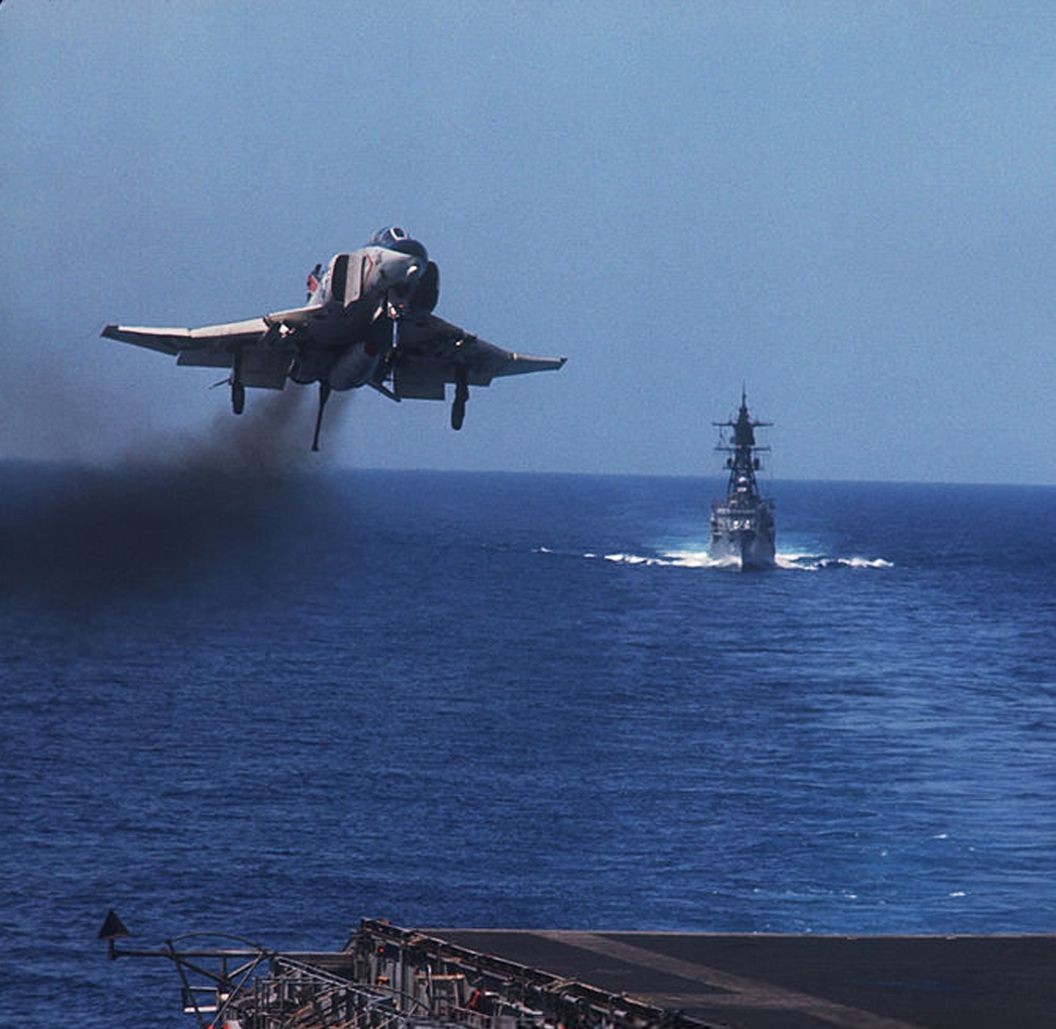
The U.S.S. Forrestal battle group lay ten nautical miles dead ahead, and with clear skies and unlimited visibility, he had no trouble lining up to fly the required ½ mile to the starboard side of the carrier. As he passed abeam the ship’s superstructure, called the “Island” in Navy-speak, he was exactly on the correct speed and altitude for their entry into the landing pattern. Thirty seconds after passing the ship, he executed “the break” (the beginning of his landing) by pulling the two throttles by his left thigh back to IDLE, rolling into a 45-degree, 3 G bank to the left, and extending the flaps and landing gear. He rolled out on a heading exactly opposite of the direction the ship was traveling.
“Mother, Devil 2-1 in the break.”
“Devil 2-1, Mother, continue.”
As the jet began to slow below 200 knots and he started a descent to 600’ above the ocean, he glanced to his left and saw “Chunks” rolling into his break turn at exactly the required 60-second interval for the visual traffic pattern.
It was time to get serious. “Reb…give me the Landing Check” Rudy quipped over the intercom system. The world around him was now measured in seconds, even milliseconds. As if working with a single brain, “Reb” in the aft cockpit was thinking the same thoughts.
“GEAR” called “Rebel” from the aft cockpit.
“Check DOWN,” was Rudy’s reply.
The staccato exchange continued.
“Rebel”, “FLAPS.”
Rudy, “DOWN.”
“Rebel”, “HOOK.”
Rudy, “DOWN.”
“Rebel”, “HYDRAULIC PRESSURE and WARNING LIGHTS.”
Rudy, “CHECK GREEN and OUT.”
“Rebel”, “MASTER ARM.”
Rudy, “SAFE.”
“Rebel,” “HARNESS.”
Rudy, “PILOT … check.”
“Rebel”, “RIO…check. LANDING CHECK complete.”
“Rebel” decided to add his infamous addendum to the checklist. Every pilot that had flown with him had heard it…”Don’t f*ck it up, Boss.”
Rudy smiled beneath the rubber oxygen mask.
What would take a “normal” pair of humans a minute to recite, they accomplished it in 1/4 of that time. It was all the time they could spare, for they didn’t have the luxury of 60 seconds to casually converse. Rudy’s mind was working overtime now,
“…90% RPM, a mile and a half abeam the ship, INDEXER doughnut showing an orange circle…. on speed…”
“…45 degrees from the boat, left 30 degrees of bank, descent at 500 feet/min…”
“…O.K., pass the ship’s wake, roll in the “groove,” INDEXER still shows orange, ship’s MEATBALL is perfect…”
(The term “meatball” refers to the optical landing system on the carrier. Technically, it’s called the IFLOLS, or “improved fresnel lens optical landing system”. It is a system of lights and mirrors positioned to the left of the carrier’s landing area. Since its inception, it has been known by those in the world of Naval Aviation as “the meatball.” Basically, it works like this. If the yellow light (the “meatball”) displays in the middle of the “ladder” in reference to the green datum lights, it signals to the pilot that they are on the perfect path to hit the deck at the precise spot for the aircraft’s hook to snag the third cable out of four that are stretched across the deck {the 3rd wire is what is known as a “perfect 3-wire”}. If it shows high on the ladder, the hook could miss all four cables completely, resulting in a “bolter” or what landlubbers call a “go-around,” if it displays low on the ladder, the aircraft could slam into the fantail of the ship with deadly results… every pilot had seen the films of that exact event during training. It would put “the fear of God” into any new carrier pilot.)
Rudy’s mind flashed the same thought he had every single time he trapped onboard the ship,
“Rebel is right…don’t f*ck this up, Marine…”
At ¼ of a mile behind the ship, Rudy keyed the mic, “223, Phantom ball, state 6.5.”
(Rudy’s brief transmission gave the Landing Signal Officer some very important and required information. He reported the tail number of his Phantom jet, then let the ship know he had the yellow “ball” of IFLOS, and finally, he gave them the amount of fuel remaining in the event of a “bolter”)
Traveling across the water at almost 250 feet/second, his mind now switched into hyper-drive, with events happening nearly faster than he could process them. He was 25 seconds from either slamming his 17-and-a-half-ton flying machine onto the pitching steel deck of the carrier and grabbing the arresting cable with his hook or slamming the two throttles full forward. The two G.E. J-79 engines would almost instantly belch large flames as each produced 18,000 pounds of thrust and launched him off the deck to enter the traffic pattern and attempt it once again. To add a “slight” modicum of stress to the equation, Rudy knew that each “pass” (trap or bolter) was graded by the LSO (Landing Signal Officer) and posted on what was known as “the Greenie Board” in that squadron’s Ready Room. This denoted for anyone that would see it, every pilot’s prowess around the boat…or lack thereof. On this cruise, he was the undisputed king of the “Greenie Board” with several perfect traps. That, however, was in the past; the only one that mattered was the one he had yet to accomplish.
Rudy’s mind was racing, moving his eyes from the aircraft’s orange “INDEXER,” circle showing him at the proper angle of attack and at the proper airspeed. Small, imperceptible movements of his right hand on the joystick kept the jet lined up with the centerline of its 600-foot landing “runway.”
“… lineup is good, INDEXER orange, MEATBALL centered, line up is good, INDEXER orange, MEATBALL centered, line up, INDEXER, MEATBALL, line up…”
WHAM!
Rudy felt the massive G-forces slam him against the shoulder straps as the Phantom’s hook grabbed the steel cable, bringing them to a jarring stop. He looked to his right and saw the yellow-shirted Deck Director moving his hands to raise his tail hook and taxi to clear the deck as “Chunks” was making his quarter-mile call. He precisely followed the signals until that man handed him off to the next Director, who moved his extended arms together, signaling him to fold the wings….”Rebel” confirmed from the aft cockpit they were indeed moving toward their stowed position. The third and last Director in the queue took command of them and deftly moved them around the deck until, finally, he was secure in the allotted parking position and shutting down his engines as the ground crew chained the jet to the ship’s deck. He climbed onto the ladder that the Crew Chief had positioned against his aircraft as a Navy Phantom roared off the bow of the ship, catapulted into the sky precisely as an A-7 Corsair jet slammed onto the deck, sparks flying as its hook grabbed the third cable abruptly bringing the machine to a stop.
Glancing at the Corsair suddenly coming to a stop, Rudy smiled, “A perfect 3-wire…showoff.”
The screaming daily choreography of launching and landing jets on the huge ship marched on. The two-hour-long mission was complete, and he was more than ready to debrief the mission and then grab a hot shower and some chow. Maybe he would stop by the Skipper’s stateroom afterward and see if there was any word on his request for leave.
The Forrestal battle group was scheduled to transit through the Gibraltar Straight and arrive off the coast of Cyprus within the week, but Rudy would not be with them. Thirty minutes later, as he was wrapping up the debriefing, he was summoned to the stateroom of his squadron Commanding Officer, Lieutenant Colonel Lawrence “Bozo” Andrews.
Rudy rapped on the stateroom door.
“Enter!” Andrews was a busy man, for commanding a squadron of over 100 personnel, including 2 dozen pilots and a dozen aircraft, was a daunting task.
“Sir, Lieutenant Bergman reporting.” Rudy moved quickly to stand at attention in front of the massive desk. The man in front of him was a legend; what he had done in combat was the stuff movies were made from. This was his first time alone with him, and through the nerves, he tried to remember he was simply a man who flew jets off the boat, much like him.
“Sir, you sent for me?” Rudy asked rigidly staring at the wall above the man’s head like he was taught in Marine Corps Basic training.
With slightly greying temples framing his “Marine issue” crew cut and small wrinkles at the corner of his close-set, brown eyes, Larry Andrews looked a bit older than his 37 years. Then again, seventy-four combat missions over Vietnam in an A-4 Skyhawk would make any man old before his time. He had seen half a dozen friends die or become P.O.W.s, and the walls of his stateroom were decorated with their photos, taken on the flight line at Chu Lai, South Vietnam. In the corner of one wall was a small plaque displaying his 1972 commendation for the Navy Cross … and the medal itself. Rudy glanced at the plaque, then returned his gaze to the wall.
“At ease, “Rabbi,” I was given this an hour ago.” Looking him in the eye, Andrews handed him the telegram message, offering a heartfelt, “I’m sorry, Rab…we’ll get you home ASAP.”
Rudy read the one-line message and felt a cold numbness like an ocean wave crashing over his body “… mother has died” screamed into his brain.
Within the hour, he was aboard a C-2A Greyhound aircraft bound for Rota, Spain, and 22 hours later, after a connection flight to Madrid, then an Iberia Airlines 747 to Dulles and a Delta L-1011 to Los Angeles, he stood at the white, picket gate in front of his parent’s home. The numbness he felt in the C/Os stateroom had traveled the globe as his companion and would be his constant comrade for many days. The funeral service was a blur, and the next few weeks and stream of well-wishers through his childhood home only served to make the entire experience a protracted, painful ordeal. His father’s days were spent overwhelmed with grief or in silent reflection, and each time Rudy looked at him, the pain and sadness he saw left him feeling helpless and alone.
One very difficult month later, he was back in the cockpit of a screaming Marine Corps F-4 Phantom fighter jet, lost in a sheltered world where he could deal with the pain of losing his dear mother, his biggest fan and a cornerstone of his inner strength, on his own terms.






 BBALL'S LOGBOOK