

What is a hero?
Merriam-Webster defines a hero as:
A: a mythological or legendary figure often of divine descent endowed with great strength or ability.
B: an illustrious warrior.
C: a person admired for achievements and noble qualities.
D: one who shows great courage.
But what IS a hero? All of these definitions? None of these definitions?
What makes a person “heroic?”
I love the examples “A” and “B” above, but I offer that the daily definition is more of a mix of “C” and “D.” History gives us countless yarns, odes, and ballads of the first two, but the people I know who define the word have had precious few tales of their deeds spoken in an ode and nary a ballad sung in their honor.
I know true heroes who have donned the various uniforms of many professions. My dear father, my son, my son-in-law (and son-in-law-to-be), relatives, and friends proudly wore the colors, hues, and camo of our military. Other dear friends and relatives daily donned a different type of uniform and held the “thin blue line” keeping peace in the streets of America. Some have never “raised a hand and sworn an oath” to defend our Constitution, but yet have offered their most precious commodity in acts of service. They gave their time on the hallowed path of service and should also proudly be considered heroes. They’ve spent hours selflessly looking to comfort, care for, heal, and nurture others. Doctors and nurses (like my amazing daughter-in-law) and millions more the likes of social workers, teachers, truck drivers, electricians, firefighters, and nameless numbers who work to keep our society safe and the envy of the world. This, too, must be seen as a most noble (read heroic) cause.
The heroes that raise us.
And the mothers and the fathers. Those wonderful people that day in and day out love and care for those of us who are incapable of caring for ourselves… be they too young or too old. As an “Army wife,” my mother never stood “on the wall”, or conducted a “close order drill” (unless you consider corralling five young children by herself), but she also served, and my incredible oldest daughter and daughter-in-law currently serve in that very same capacity (to include the young children part). My amazing wife Debora, my precious partner of the last thirty years, suffered many of the same issues “serving” as the spouse of a man gone from home fully one-half of the time. Raising our three incredible children and running a loving home with the scant help of an (on-site) husband…yours truly…. was not for the faint of heart. A more difficult job I cannot fathom.
In the Second World War, it was known as “the Home Front,” and a popular slogan was: “They also serve who only stand and wait.” The last definition above from Webster’s speaks of being “noble,” and I can think of fewer traits that deserve that moniker. It also deserves the term “heroic.”
It is as true now as it was back then.
Each year, on the eleventh day of November in America, we honor our heroes in uniform (past and present). We take a day to stop and give thanks to those who serve (and have served) in the role of protecting the freedoms of those of us who never had the honor and privilege to do so. On the 11th hour of the 11th day of the 11th month in the year 1918, the nightmare of “the Great War” (later known as the First World War) came to an end. Back then we called it “Armistice Day”, but thirty-six years hence we (rightfully) changed the title to “Veterans Day”. To this grateful son of a combat veteran, it is a day whose spirit should occupy the remaining 364. My brain knows it, my heart feels it, and I attempt to live it each day.

All truly do “give some.”
Again, returning to the word “hero”, what of those who wear (or previously wore) the uniform of our military services? Are they true heroes? I would offer a resounding “yes”. To bravely volunteer and answer a call to arms and agree to proceed willingly into harm’s way carrying a weapon made to take a life (and possibly watch those around you lose theirs) is a quality that few can comprehend. To pilot an aircraft towards peril through angry German skies, to sail a ship (or submarine) through vast oceans over countless watery graves, to wade through a leech-infested Delta rice paddy, or to creep down a dark hallway in Fallujah is a terror that few of us will ever know. It is, indeed, a human trait that must be called brave, but is it “heroic?” Volunteering to proceed into a dangerous unknown must surely qualify one.
We must come to grips with what happens AFTER those who have volunteered come back to us. Many who have shown that brand of bravery suffer long after the bullets stop flying and the bugles for peace have sounded, for they take their war and their terror with them from the battlefield to home. My father was one of those, and I’ve written of his divorce from the ability to sleep for fear of what he may dream. Some take those terrors to a pre-mature, self-induced grave. The trauma never leaves them, and they swallow the soul-killing poisonous thoughts that the world (and their families) would be better off without them. Recent studies show that more than TWO DOZEN VETERANS A DAY take their own lives in a final search for peace, and this is a tragedy that we cannot ignore. Thankfully, organizations (like The Mighty Oaks Foundation https://www.mightyoaksprograms.org/ ) exist that help to restore those who are owed so much more than our platitudes. The wonderful folks at these organizations save lives, and God bless them for their work. Are they heroes? Yes. Do the folks they work to save deserve our prayers and a “hand up” back to a healthy feeling of worth? Hell yes they do, we owe them at least that much.
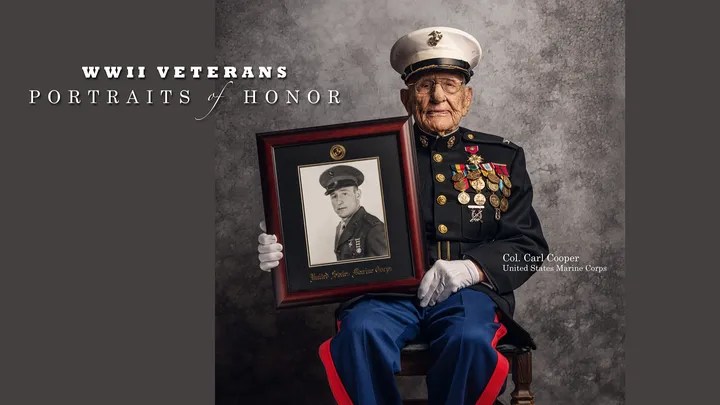
But what of those who serve in uniform but not at the tip of the spear? Are they also heroes? Yes, in my humble opinion, they are, for they willingly sacrifice years of their lives by swearing to put the freedoms and safety of others ahead of themselves. Heroes come in all sizes, shapes, and colors (and M.O.S.’s).
George Ross.
The following is an example of a true “hero.” It is the reprint of an interview I had the honor to conduct for a website I was writing for at the time (now defunct). It is a conversation I was privileged to have with a wonderful “77-years-young” veteran shortly after the horrible attacks of September 11th, 2001. It was originally posted in January 2002.
I hope you enjoy my talk with George.
(My original pre-amble.)
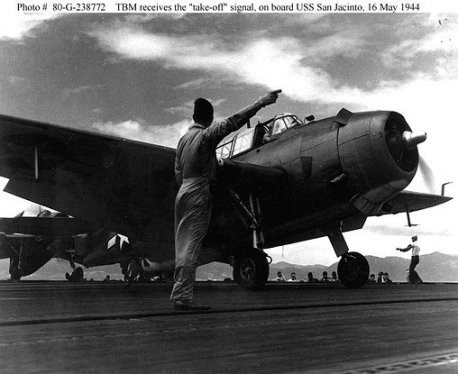
A few weeks ago, I had the great privilege of sitting down to talk with a gentleman by the name of George Ross. He enlisted in the United States Navy in 1943 and served in the Pacific Theatre of Operations aboard the carrier U.S.S. San Jacinto. What makes George’s story so incredible is that he joined up (aware of the strong possibility of serving in a war zone) at the tender age of SEVENTEEN! Coincidentally, he served aboard the ship with the Navy’s youngest aviator, a young man by the name of George Herbert Walker Bush. Through the crucible of combat, they got to know each other, and that friendship has lasted almost sixty years. When they shipped out, one was a teenager and the other not much older, both living in a time and a place that few of us would understand. His story both fascinated and inspired me, and I believe it sheds some light on his generation: their thoughts, their patriotism, and their sense of resolve concerning the task before them.
Before hearing George’s words, I thought a brief history of the ship they served on might be in order.
The U.S.S. San Jacinto.
She became known as “the Little Queen” but began life as more of a bastard child. She was conceived as the cruiser U.S.S. Newark, but the lessons of Pearl Harbor and Midway showed that the real “hammers” of the fleet had now shifted to be the aircraft carriers, or in the language of the times, the “flattops.” She was transformed into what became known as an Independence Class Carrier (a hangar and flight deck were added to her cruiser hull) and was to be christened the U.S.S. Reprisal. After an overzealous bond drive by the citizens of Houston (to replace the sunken cruiser U.S.S. Houston), enough money was left over to “buy” a small carrier, and the U.S.S. Reprisal was to be it. There was a rather large problem, though; the name “Reprisal” simply would not work for those with Texan blood flowing through their veins. It would have to be a “Lone Star” name, and the Department of the Navy knew that the best solution would be to have the good folks of Houston name her. History would come to know this freshman carrier as the U.S.S. San Jacinto, but to those who served aboard her, she was simply the “San Jac.”
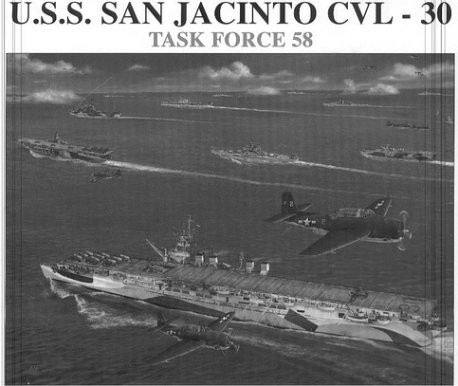
Barely six months after her birth, she dropped anchor in the Majuro lagoon, preparing for a baptism of fire. The target was the Marianas archipelago in the Central Pacific, and D-Day would be 15 June 1944. She was one of the newest members of Vice Admiral Mitscher’s famed Task Force 58, and in the next fifteen months, she would wreak havoc and hell upon the foe. Fate would see her doing battle with her counterpart, the Japanese carrier Zuiho, and to no one’s surprise, the “Little Queen” would come out on top. She would extract an incredible toll from the enemy, her numbers putting to shame some of the fleet’s bigger (and more famous) ships. She would:
-Sink or damage six aircraft carriers, two battleships, four cruisers, and ten destroyers
-Sink 200,000 tons of auxiliary, merchant, or small craft
-Destroy 712 Japanese aircraft (12 by George and his fellow ship’s gunners)
-Expend 980 tons of bombs, 5,436 rockets, 42 torpedoes, 14,740 40mm rounds, 19,160 20mm rounds, 22,530 .30 cal. rounds, and almost a million and a half .50 cal. rounds.
-Fly 11,120 sorties
-Steam 153,000 combat miles
-Spend 471 days in the forward area without rehabilitation
-Spend 357 days at sea
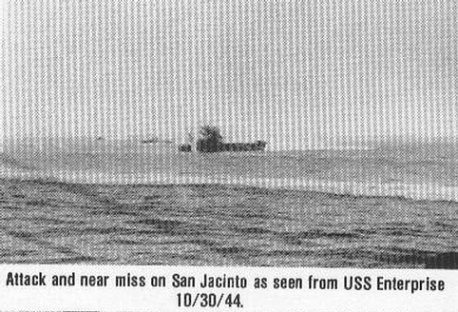
She suffered from many Kamikaze suicide attacks, and though they were never struck full force, her crew would suffer death and destruction from the near misses. Some said that she was “blessed,” but tragedy spared no one. On the afternoon of October 17th, upon returning from a mission, an aircraft blew a tire on landing, firing the guns that were inadvertently left “hot.” One crewmember was killed, and 27 others were wounded (including the ship’s Captain). She was to suffer greater losses to come, but she would also deliver “one helluva punch.” Her gunners saved her time and again, even shredding a plane headed for the “Big E” off the coast of Leyte. Displaying their admiration for the smaller ship and her crew, their signalers would blink the message, “Thank you, Little Queen.” However, what the Japanese could not accomplish, Mother Nature almost did.
In December of that year, fate concocted a mixture of wind and waves the likes of which this crew had never seen. The typhoon was to toss her in its 70-foot waves, and she would pay the price of her fast “cruiser hull,” for it would measure lists of up to 40 degrees. Aircraft broke their lashings, creating havoc on the flight deck, and when all was said and done, the fleet was a mess, sending three destroyers to the bottom. Miraculously, the “San Jac” was still afloat, and she limped back to Ulithi to care for the wounded and be patched up…literally patched up. The powers that be decided to make one carrier from three, so they grafted from the flat-tops U.S.S. Cabot and U.S.S. Monterey and sent her back into the fray (she was to suffer a total of three typhoon encounters).
Her list of battles would read like a page from the history of the war in the Pacific: first Philippine Sea, Yap, Ulithi, Peleliu, Leyte, second Philippine Sea, Luzon, Mindoro, Iwo Jima, Okinawa (where for the first time in the Pacific war, the naval cost in lives was higher than that of the ground forces), Formosa, and the raids on Kure, Kobe, Nagoya, and the Dai Nippon “center of the universe”, Tokyo itself. She would steam more miles in combat and fight more battles than any other carrier during the last year of the war, and she would do it heroically.
Accolades would be many: a Presidential Unit Citation for “extraordinary heroism in action…”, seven battle stars, even a cartoon accompanying the Operation Order for the Okinawa invasion depicting a rather beat-up, rusty light carrier sporting longhorns and streaming the Texas flag…the caption read, “Boy I sure do patrol this range.” (it would be the only such frontispiece of the entire Pacific War). However, her greatest honor would be the message she received as she departed from Tokyo Bay on the evening of Japan’s surrender. It read:
“COMMANDER TASK FORCE TO SAN JACINTO, THE SPARK PLUG IS NOT THE BIGGEST PART OF THE MACHINE, BUT IT IS THE THING THAT MAKES HER HUM. WE WILL MISS THE LEADERSHIP OF THE “LITTLE QUEEN,” THE FLAGSHIP OF THE TEXAS NAVY. OUR BEST WISHES FOLLOW HER AS SHE PARTS COMPANY HOMEWARD BOUND. WELL DONE TO A GALLANT SHIP.”
(The following are George’s words from our interview.)

BB: “First of all, George, I’d like to say thank you for taking the time to sit down and talk to us about your experiences during World War II. There are lots of questions I would like to ask, but the first one might be the most obvious. Why did you enlist at the age of 17?”
George: “I had three brothers, and all were in the Army. I guess I felt that I wanted to do what they were doing…and so, my folks had to sign for me in order to enlist being 17.”
BB: “Could you expound a bit on what it was like growing up in America back then?”
George: “Well, back then, when we used to go to the movies, it was five cents, a haircut was two bits, and a shave ten cents…so it was quite a bit different. But at the time that I enlisted, people were really sticking together and stuff, so I thought it was great to be able to serve my country.”
BB: “Did you follow world events very closely, or would you describe yourself as a “normal” teenager, caught up in their own world?”
George: “History was my favorite subject when I was going to school. As young as I was, and going through what I was going through at the time, I never dreamt that I would see New York and Boston and Philadelphia and these big cities and end up in Pearl Harbor before we went on to the Pacific. So, I really thought that I was making history.”
BB: “Do you remember hearing about Hitler invading Poland, and what were your thoughts when you heard it?”
George: “I was younger, and I didn’t think it was too nice…. I expected him to come over here at any time. So, I was glad to be able to do what I could at the time.”
BB: “What were you doing when you first heard that Pearl Harbor had been attacked, and do you remember your initial thoughts or how it made you feel?”
George: “I remember my Dad listening to the radio, and President Roosevelt was giving his talk about how “it would live in infamy” and stuff, you know, and I guess I was kind of gung-ho at that early age to get involved.”
BB: “How did you find your first days of military service?”
George: “Well, I wasn’t used to taking orders (chuckle)…so I mean, it was a lot different.”
BB: “Where did you enlist?”
George: “I enlisted in Milwaukee, joined the Navy, and went to Great Lakes for my training (14 weeks). From there to Philadelphia, we put the ship to sea (commissioned) in Philadelphia and then went down to Trinidad for the shake-down.”
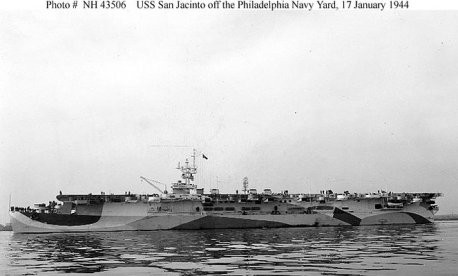
BB: “So, you sailed from Philly to Trinidad. Did you sail through the Panama Canal to reach the Pacific?”
George: “Yes, we did. We went through the Panama Canal, and I had quite an experience there. The ship was so big that you could put one foot on the ship and the other on the land…that’s how close it was. I went off of the ship there. I met some Panamanians, and I exchanged American money with them. I came back aboard ship, and I had a whole fist-full of Panamanian money, and I said, “Boy, look here, did I make a deal!” A guy said, “What did you pay for that?” and I said, “I don’t know, ten dollars.” He said, “You don’t even have two dollars there!” (chuckle) I was learning fast!”
BB: “George, could you describe your job aboard the U.S.S. San Jacinto?”
George: “I was in the deck force and also a gunner…on the 40-millimeter…twin 40s back aft on the fantail.”
BB: “You were part of the gun crew. Can you explain a little about what the “gun crew” consisted of.”
George: “We had “pointers,” who used to sit in the seat, and we had people who would be out on the shield to look for the enemy planes and identify them coming in, and when you would shoot the twin 40s, you had to be careful, because if you were on the deck, the hot shells coming out of there were so fast and so hot, that you would burn your legs. I happen to have one I’ll show you in the basement; I had all the places we were engraved on there, and the name of the ship.”
BB: “Were you physically the “shooter,” or did that rotate?”
George: “That rotated. Sometimes, I would put the shells in; they came in clips of four; it was quite an experience with the different things that you did on there.”
BB: “When you were the gunner, and you shot down an airplane, who got to take the credit for that kill? Did you, as the gunner or the entire gun crew get the credit for who shot it down? Who got to boast about it?”
George: “The ship got credit for it. We shot down 12 enemy planes… the ship’s crew.”

(Sailor wearing a “talker” helmet with communications gear.)
BB: “Were there competitions between gun crews?”
George: “There was. We had a detachment of Marines onboard. And they had their own 40s and 20s and stuff. One of them became pretty famous… Art Donavan played football for the Baltimore Colts. His father was the referee who refereed the heavyweight fights when Schmelling and Lewis were fighting. Art now owns a country club up in Baltimore.”
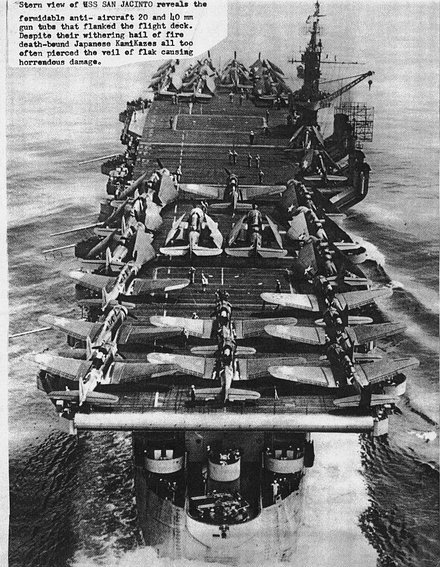
BB: “George, where did you first experience combat?”
George: “We started at the Marshall Islands…was our first, and then went through the Marshalls, Saipan, Guam, Tinian, Yap, Peleliu…………… Okinawa………..was the…”
(George became quite emotional during his answer. I stopped the tape machine…it’s a very personal and powerful moment when a man grieves for comrades who fell so long ago in battle. BB)
BB: “Realizing that unless you have been there, it may be impossible to describe, but could you tell us what it was like?”
George: “On the ship, we had what we called a “General Headquarters.”…I mean, the alarm would go off, and when that alarm would go off…we had a lot of practice and stuff. I played a lot of poker, I loved cards… and the first time, I think I won about $700, and when that thing went off, I was more worried about going in the drink and losing the money than I was about getting hurt! But it was scary. When we did knock down our first plane, everybody on the ship, when we saw this thing hit the water and explode and stuff, we all would holler and clap and … to say, “well by God, we got one of them” …but it was scary.”
BB: “And you were on the deck crew, so I assume you saw accidents during the flight operations. How was that?”
George: “A lot of times, they would go through the barrier. It wouldn’t stop them, and they just had so long to get out of there.”

BB: We’ll talk about Lt.(jg.) George Bush in a minute. He flew the TBM Avenger. Do you remember the other types of planes you had on the carrier?
George: “We had the Corsair.”
(Side notes about Lt.(jg) Bush …)
Reprinted from “Naval Aviation News” March-April 1985 …
Nadeau added that Lt. (jg) Bush had a lot of friends among the enlisted men. “Mr. Bush wasn’t one of your run-of-the-mill officers,” he said. “Being an enlisted man, I couldn’t go into officers’ quarters, and as an officer, he couldn’t go into enlisted quarters. So, we’d meet quite often up on the flight deck by the plane. We’d always be checking our aircraft out. He would look his plane over, and I would look over the armament. We were both very conscientious about the work that we were doing.” Once up on the flight deck, Nadeau said the two of them used to talk about most anything, including the women both of them would later marry.
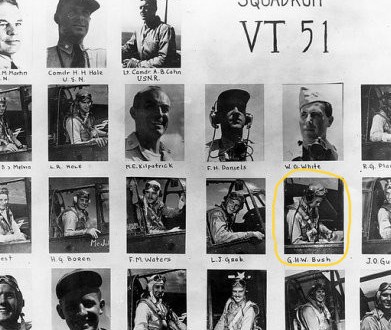
Bush, who received three Air Medals by the time he was discharged in 1945, said, “There is no question that having been involved in combat has affected my way of looking at problems. The overall experience was the most maturing in my life. Even now, I look back and think about the dramatic ways in which the three years in the Navy shaped my life — the friendships, the common purpose, and my first experience with seeing friends die … ” “The Avenger was a great, stable airplane,” he said. “It was the easiest plane to land aboard the carrier. It was reliable and sound.” Bush, who is credited with 126 carrier landings and 1,228 flight hours, remarked that he’s done only a ”little bit of civilian flying” since leaving the Navy. Nowadays. the former Naval Aviator said he is happy to have the pilots of Air Force Two fly him around the world as he fulfills his obligations as Vice President. “They are A-1 pilots,” Bush said. “But their wings aren’t gold.”
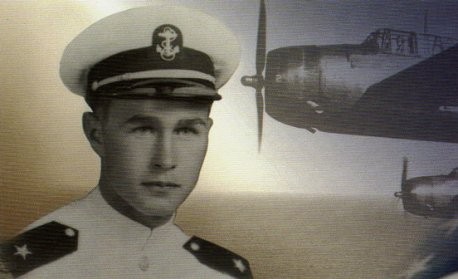
(back to George Ross…)
BB: “You had all types of missions taking place. I’m sure you saw them come back with all sorts of battle damage…”
George: “Right, right, they did. Of course, a lot of them didn’t come back.”
BB: “I remember stories of the ground crews counting the aircraft as they came back. Did you have the opportunity to do that, or were you too busy doing other things?”
George: “No, we had the opportunity to do that, and they would announce…how many planes took off, and “so and so” didn’t come back.”
BB: “That must have been sobering. I know in the European Theater, nose art and “messages” on the bombs were quite a thing. Were you allowed to do that, or did that even take place?”
George: “No, they allowed it.”
BB: “And the messages on the armament? Who got to do that?”
George: “The flight crews got to do that…the people that loaded the bombs and stuff did that.”
BB: “As mentioned earlier, I understand that you met and became friends with Lt.(jg) George Bush. Could you tell us about that?”
George: “Well, him being an officer, and I being enlisted, when I was on the gun crew, and he wasn’t flying, or they would declare a “holiday routine,” which meant that you could be up on the flight deck and sunbathe or do anything that you want, he would walk around and stop and visit with you and stuff. I did have the occasion when he was elected president to be invited to the inaugural, but at the time, I wasn’t fortunate enough to have enough money to go. It was nice to get the invitation, and I have them all framed in my rec room in the basement.”
BB: “Was that a common thing for the flight crews, the pilot-types, to visit?”
George: “No, that was pretty common because, after all, they didn’t get a chance to walk around the ship that much; they had their own staterooms that they used to hang out in. To be around with the crew and to visit…” Hey, where are you from?” “Wisconsin.” “Oh, that’s the dairy state.” Well, one thing led to another, and well, we became pretty close.”
BB: “Were you allowed to fraternize? I mean, when you played in a poker game, did you have officers playing too?”
George: “No…”
BB: “Was there any animosity between the two groups?”
George: “No…no…no….as a matter of fact, when we were anchored over in Ulithi, I had a good friend that I used to play ball with from my hometown. He was a Chief; he had been on the old “Lex” that had gotten sunk, and he was now on the Cowpens, another carrier of the same class as the San Jacinto. I got permission to go over and visit him, and that was a lucky day for me because a Chief in the Navy really had pretty good duty; they had good food and stuff, so I was invited to have dinner with him, and instead of eating beans, I was eating steak that day…. (chuckle)…that was quite a trip.”

BB: “What was your rank, George?”
George: “Seaman First. I could’ve gone for another rating, but you had to study and, being that I enlisted when I was 17, which meant I quit school, well, I didn’t like to study.”
BB: “How about your other shipmates? Could you tell us about some of them?”
George: “We still keep in touch; we have a reunion. Our next reunion is coming up now in September, down in Jacksonville, Florida. Our first reunion was over 40 years after the war. I got a notice, and so I attended, and guys used to say, “Which one are you?” When I got discharged from the Navy, I weighed about 130 lbs. Now I’m 240, but they didn’t stop to think that they were in the same shape that I was in. (chuckle) It was really nice to see the old friends and stuff. We still keep in touch with one another. I got a call the other day from the head coordinator down in Ohio, and another one called, and he’s losing his eyesight and his hearing …it’s kinda sad. He was a Medic First Class…did a great job on the ship.”
BB: “George, what would you consider to be the worst day of the war …for you personally?
George: “Well, we were in three typhoons, and it was bad enough to try and land on this carrier when the weather was right. They had sent out the planes to attack the Japanese, and the storm came in, and they were low on fuel; a lot of them had to go into the drink because they couldn’t make it back; destroyers and other ships picked some up. It was so bad that it took the bow off of the cruiser Pittsburgh; the storm was so fierce that we lost a lot of gun mounts, and planes went over the side even though they were lashed down; they broke loose and went over the side.”
BB: “The best day of the war?”
George: “I think the best day was when they announced that the war was over. The Captain… announced…. that the…. the war…. was over….”
(Here again, George’s eyes clouded with tears. He looked off as if searching for dear friends left in a place and time long ago. BB)
…but all at once, a general alarm went off, and there was a sound like “gong, gong, gong,” …and we thought that someone was horsing around, but the Captain came on and said, “Man, your battle stations!” It was a couple of Japanese planes that didn’t want to give up; they were the Kamikaze planes, and well, we opened fire and got ‘’em…but just hearing that the war was over was pretty good news, and that we’re going home.”
BB: “Could you describe what it was like during one of the Kamikaze attacks?”
George: “Well, normally, when a plane would come in, you could see it real good, but what the Japanese Kamikazes did was come in from the sun. They would get up in the sun so you couldn’t see them from the glare, and then they didn’t just shoot at you; what they wanted to do was dive-bomb you and crash into you. We were fortunate; we had a lot of damage done, but never to the point where we couldn’t continue. But when we did get hit, we thought, “Well, we’re going back to the States now,” …but what they did was take parts off of another carrier and put them on ours, and we never did go back.”
BB: “Did you, in the Pacific Theatre, keep up with the events that were happening at the European Theatre?”
George: “Not so much. We would get Mail Call maybe once or twice a month, and rather than read the letters, I used to grab the hometown paper to get all the news…the Hammond News. Guys used to say, “Ross, where are you from?” They would read the paper and read the ads in there that would say things like..” Wanted to buy: 20 chickens, ten bales of hay”. They got a kick out of that; these guys from Brooklyn and L.A….” Good God, Ross, you live way back in the sticks or something?”
BB: “What did you think after you heard the news about D-Day? I know you must’ve been busy with what was happening in your neck of the woods, but when the news reached you, did you have any thoughts like, “Well, this thing WILL wind down, and it WILL be over someday, and we’ll get to go home.”
George: “Oh yeah, yeah, right. You know it was quite a crew…you didn’t know a lot of them personally, but if you’d be off on shore or something, and someone would get in a fight, and you would hear that they were from the “San Jac,” and you’d be BINGO…right in there.”
BB: “These questions will be not so much about back then but more about what’s happening nowadays. How does a member of your generation, what some have labeled “the Greatest Generation,” feel about what we find ourselves embroiled in now?”
George: “I think we’re doing the right thing. I think President Bush is doing a great job; I feel that we probably should’ve gone all the way when we were over there before in Iraq and settled it then. But I still think we’re doing the right thing.”
BB: “If you could stand in front of a group of today’s military recruits, possibly heading off to war, what would you say to them?”
George: “Oh, that’s kind of hard because I didn’t have anybody to say anything to me. But it doesn’t take you long to know why you’re there and to get the job done. We had a terrific crew out there.”
BB: “Last question, George. I’m sure that in the early days of the Second World War, victory was anything but a sure thing; what would you say to those today who might doubt the will, the resolve, and the sense of duty that we share against the forces of terrorism?”
George: “I have no doubt that we’ll do what we have to do. That’s why we’re the country that we are, why we elect the senators and legislators to the jobs they have, even though they’re of different parties and stuff when it comes right down to the show…they stick together, and I think that’s what makes America what it is today…we hang in there.”
BB: “Is there anything else that you’d like to add?”
George: “Well, I’d just like to thank you for the opportunity to share my experiences, whether they be good or bad. If I had a son today, and he was going into the service, I would have him thank about going into the Navy because as bad as we had it…we still had a good place to sleep and we had good food, and that’s something that a lot of them didn’t have.”
BB: “George, thank you for taking the time to speak with me. The honor of being allowed to share, by your words, your profound experiences as a young man in a war zone is one that I don’t take lightly. Thanks again, George. God bless you.”

God bless America…
… and God bless our veterans. Thank you.
Happy Veterans Day.
‘till next time.
 BBALL'S LOGBOOK