

(Originally published July 2009)
The following tale is one of my favorites in both the remembering and in the retelling.
It occurred during the dawn of my second decade and was certainly one of those “day of days” that occasionally grace our lives. I hope it will remain a heartwarming part of my family lore, and I offer it as a peek into my distant past and as a possible explanation of why I turned out as I did…
For us Baby Boomers, I pose the following question;
Do you remember, as a youngster, watching the television shows of the 1960s?
Those family-friendly themes often depicted one of the kids happily heading off to work with his (or her) dear old Dad. Be he the town constable, the local hardware salesman, or the head clown at the rodeo, the chance to be seen with “the ol’ man” at his employment was a treasured thing. Those early, innocent days of television captured that phenomenon perfectly. Somehow, you knew that in your life, when YOUR Dad walked out the door for work, he was embarking on yet another quest to slay the proverbial dragon and gain riches for the family, thus keeping everyone safe and well nourished. The issue for many of us young lads was that we rarely had an opportunity to see him in all of his glory, doing the actual “dragon slaying,” as it were. The days when you accompanied him to work were usually a litany of “Here’s my desk,” “This is the water cooler,” and “This is Bob,” my boss. Mostly horrifically boring stuff. In that realm, I was privileged far beyond 99% of the other kids in my world, and it was a privilege that gives me comfort in firmly ensconcing my father as one of the true heroes of my life. Having the chance to spend time with him at his workplace was an experience that helped shape and ultimately give direction to my young life. It was an adventure that few can equal because for the first 13 years of my life, my Dad was an Army helicopter pilot.
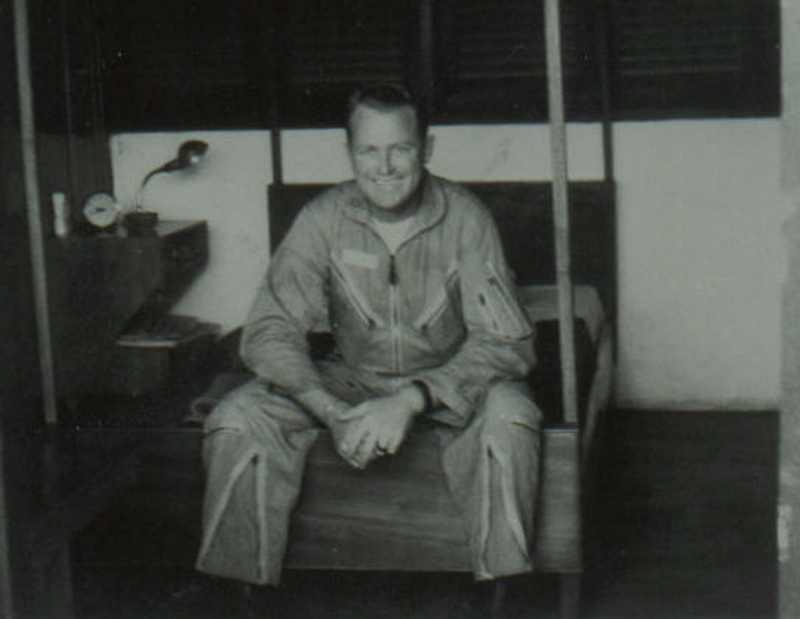
(This is what an ACTUAL hero looks like…at least in my humble opinion.)
Let me back up a bit.
I am my father’s son. To be more precise, I am what he was because he was what I admired and hoped to someday become. We were both fortunate to have spent a large part of our lives with our heads in the clouds. We’ve each logged thousands of hours twisting and turning through the skies, far above the world of the earth-bound folks we served. I am a professional aviator today, in large part because he was one back then., And, as I have gotten older, I’ve come to understand that my love of flying machines was a gift he (slowly and gently) gave to me as a child. In that respect, I owe him a lifetime of excitement, joy, and happiness at my place of employment.
Back to the present.
Over the years, my children have asked many times, “When do I get to go to work with you? My friend (fill in the blank) went to work with their Dad (or Mom), so I want to go to work with you.” From a person in my profession, there is no easy answer to such a question, but I recall a flight thirty years ago (as a brand-new pilot for Northwest Orient Airlines), seeing this play out firsthand. On this day, we were tasked with finishing a long duty stretch with a “milk run” from Great Falls, Montana, over the Bitterroot Mountain range into Missoula for a two-day layover. It was a beautiful late summer evening, clear blue skies fading to dusk, and a very light passenger load, including the 7-year-old son of the Captain, who was accompanying him to do some fishing on the layover. Shortly before pushing back from the gate in Great Falls, Captain “Smith” did something that I will never forget: something that greatly shocked both me and the First Officer (I was working the entry-level position as the Flight Engineer). He excused himself from the cockpit and returned a few minutes later with his son “Timmy” in tow. He introduced him and then promptly proceeded to strap “Timmy” into the First Observer’s cockpit jump seat on the Boeing 727. To our confused looks, he offered the mundane explanation, “Oh, and Timmy will be riding up front with us on this leg.” What the heck?
This was blatantly “verboten” in regards to company policy, strictly against copious numbers of Federal Aviation Regulations, and as far as I was concerned (as a new employee whose job was on the line), probably counter to at least one of two of the Ten Commandments! Again, the airplane was essentially void of passengers, and the three flight attendants could not care less if little “Timmy” sat up front with us. Quick reminder: in those days of the early 1980s, the Captain of the ship was just that…the number one honcho, the “El Hefe,” the “dude in charge,” …. period. What he said was The Law, and that was pretty much the end of it. Dare I say, if I attempted something like that nowadays, I could easily be writing this from a large building with bars on the windows surrounded by high fences. I would love to take one (if not all three) of my kids to work with me someday, but if they harbor any notion of being in the “room in the pointy-end” with me while I am working, they can forget that nonsense. I look like an idiot in stripes, do not fancy windows with bara, and have a distinct aversion to consuming my meals from a metal tray with a plastic “spork”.
The 1960s rocked as a kid.
My days as the child of an Army Aviator were mostly full of excitement, fun, and adventure. To add perspective, those were the magical days of the 60s, and in my world, most things fell into one of three categories: “neat,” “keen,” or just plain “cool” (yes, we spoke like that). Some of the upsides to life back then were events like playing with toys that DID NOT require an internet connection, attending a movie at the base theater for 50 cents (25 for the ticket and 25 for popcorn and a drink), and riding our bikes (sans helmets) long past dusk without an “Amber Alert” being flashed across the heartland. It is not that our parents did not care for us; they just had a far different list of worries than parents do these days. As children (and as a society), we were, in many ways, blissfully clueless. We would watch Mom enjoy a martini and a Salem to calm the anxiety and jitters of (another) pregnancy, and every Sunday evening, we would gather around the black and white Magnavox TV and watch “Bonanza,” not knowing that color TVs (and shows like “16 And Pregnant” and “Here Comes Honey Boo-Boo”) were the frame of our future. When we would pile into the station wagon for yet another family adventure, we would sit serenely bereft of seatbelts as Dad cruised down the street with one hand firmly on the wheel and the other clutching an ice-cold Budweiser. Yep…those were the days.
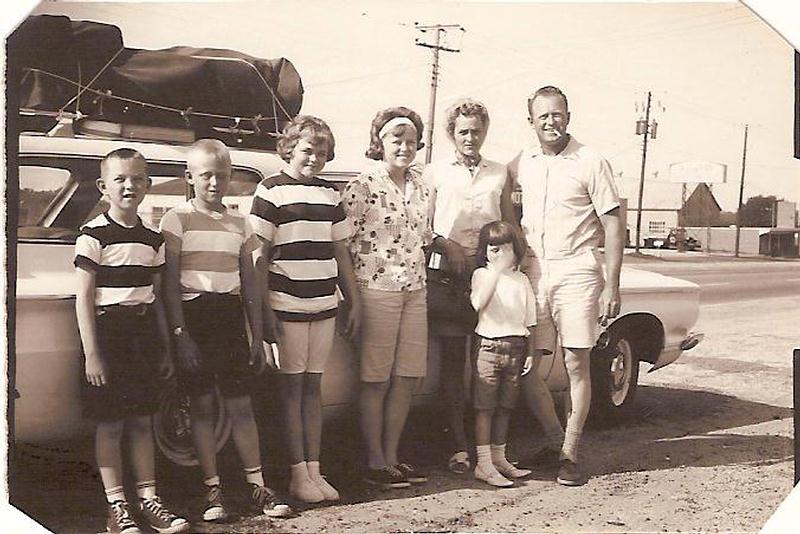
(Just another Ball Family adventure in the mid-1960s… yours truly on the far left. I told you I look like an idiot in stripes.)
The downside for your average fourth grader was ambiguous, but a fact of life. At school, we were presented with stuff that seemed asinine in retrospect. The “big one,” of course, was that when the “Red Horde” (Soviet Union) launched the nukes, we were to stay calm, get under our little wooden school desk, cover our heads, and, for heaven’s sake, “don’t look toward the flash.” As “Baby Boomers,” we now laugh at this idiocy, but back then, we accepted this wisdom without question, somehow believing it would be all OK (so long as we did not look at that dreaded flash). Raising three wonderful children myself, I now understand why parents back then didn’t want to pop our collective bubbles; it would certainly cause more angst than it would cure. Also, back in those halcyon days of childhood, acting out usually meant more than a stern glare, a “time out,” or a “pow wow” to discuss our feelings. It could mean a whack upside the melon or a kick in the posterior (by the size 11 combat boot of the “ol man”) that would make Beckham proud. “Corporal punishment” was a tool in every parent’s arsenal, and 99% of them had no issues using it (I can attest to that from personal experience). For the most part, however, the 1960s were a wonderful time to be a kid, and for this kid, more special than for most. So incredible that riding out to the Army airfield with Dad was just something my brother and I did on a regular basis. Much like getting our weekly “high and tight” haircut at the base PX or tucking in our shirttails before entering the school building, it was just part of our lives, and life was indeed good.
The day of days.
One dreary Fall morning in Munich, circa 1967, my dad rounded up my brother and me, marched us to the Plymouth Fury wagon, and off we motored toward the airfield. “Cool! Another day watching Army pilots do what Army pilots do.” On this cool, misty day, however, our routine was interrupted by an unannounced stop along the way. He pulled into the parking lot of the liquor store on the big Army base and dashed inside. Ten minutes later, he returned carrying a paper bag containing a bottle of the finest Army Aviator’s “go juice” in the world (that would be Jim Beam whiskey for the uninformed), and we took little notice of this other than the extra ten minutes we spent in the car. Our banter regarding the latest playground drama continued unabated, with my dad chuckling as he fired up another Salem cigarette. However, the mood quickly changed when we crossed the MP guardhouse, signaling our passage from the quasi-civilian base housing to the actual military part of our father’s world. We were greeted by a stern-faced guard (weapon strapped in plain sight) and a razor-sharp salute directed toward the Warrant Officer driving the station wagon (and my father’s crisp return). We instantly knew that we were firmly back in his world of deadly serious men in zippered olive drab flight suits, meaningful gaits, heavy-duty vehicles, and loud flying machines. We were in the company of men who did things we barely understood, things that only heroes could accomplish, and we were somehow a very small part of it all. We had been here before, and it was little-boy heaven.
As we entered the building that housed these larger-than-life men, known as Army pilots, we came face-to-face with someone who could throw a wrench into my dad’s plans for the day. We were hell-bent on hanging out “at work” with our beloved Dad, and being turned toward home would not do. In military terms, this man was known as the Officer of the Day, or simply the “O.D.” In civilian terms, he is a person who has drawn the duty (for that day) from the Company’s pool of pilots to be the “unit fireman,” as it were. If anything in the world of that unit needed timely attention, he would be there to make decisions, affix solutions to problems, and generally stamp out whatever fire had sparked to life. On this day, the O.D. was (like my dad) a Warrant Officer, an Army aviator, and most importantly, a good friend of the family. They greeted each other warmly and smiled like Cheshire cats while the paper bag holding the bottle was passed between them with a soft murmur of, “Is it still on?” followed by an almost imperceptible nod. This slight exchange between the two conspirators was barely noticeable, but apparently, it sealed the deal. Whatever the “deal” happened to be.

(My Dad hamming it up for the camera on one of his days as the “OD.” Nuremberg circa 1966.)
In no time, the three of us entered the hangar for my dad’s unit and were greeted by a wave of familiar sights, smells, and sounds. Later in life, I would spend two years working as an “apprentice airplane mechanic” at the aviation university I attended in Oklahoma, and those wonderful sights, smells, and sounds would come home to roost. My boss back in the days of my fledgling career as a professional aviator was a grizzled old mechanic by the name of “Ralph,” and (among others) he shared this snippet of wisdom with me: never trust the work of mechanics from a hangar that gleamed with cleanliness and pristine order, and Ralph lived by that mantra in spades. I am happy to say that this United States Army helicopter maintenance hangar would have made him proud. The smells of cleaning fluid mixed with engine oil, grease, aviation fuel, sweat, and cigarettes permeated the premises, and to these young nostrils, it was the perfume that flamed a passion for these exotic flying machines. My Dad briefly chatted with one of the mechanics, signed something, and before we knew it, we were walking toward a flight line full of rotor-bladed wonders. The tall one in our group was adorned in his flight suit, carrying a helmet bag and privy to the conspiracy afoot, while the two short versions of him sported an air of nonchalance, adorned with typically clueless expressions.
As we approached the far end of the flight line, we found ourselves standing next to a machine that was as familiar to us as our Schwinn bikes lying back home in the front yard. We were preparing to climb into an Army OH-13 “Sioux” helicopter, the one that became world-renowned from the opening scenes of the TV show “M.A.S.H.” He had introduced us to her at an early age, and I learned to be as enthralled by her as I am sure he was. A large amount of his flight time (and the one peacetime accident he had) was logged in that beautiful bubbled cockpit, and many of his flying yarns starred him and his beloved H-13. Someday, I’ll relate the story of the time he attempted to do a loop in one of these little whirlybirds.
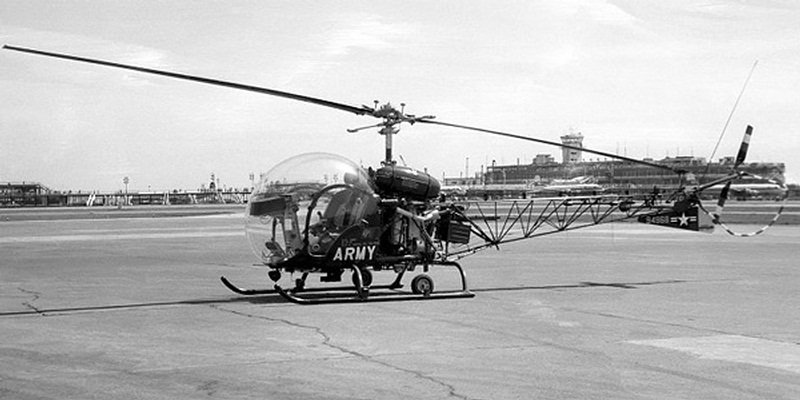
(The Bell OH-13 Sioux…the civilian world knows it as the Bell G-47.)
The OH-13 was not my only airborne love as a young boy, for I was fortunate to spend countless hours with my rear-end firmly planted in the various helicopters that my father flew (and a few airplanes, or as the Army calls them, fixed-wing). I’ve “logged quality time” in the little Bell, the Sikorsky H-34 “Choctaw,” the DeHavilland L-20 “Beaver,” and the Cessna L-19 “Bird Dog,” plus many that my dad never flew but provided me with a guided tour (for instance, the CH-37 Mojave). All reeked of an intoxicating mixture of leather, canvas, avgas, and cigarettes, and these became a vitally important part of my childhood. The standard procedure for us when we would accompany my father to the airfield, where he would be tasked with some paperwork issue or office-type duty, would be for him to locate a machine at the far end of the flight line not scheduled to fly, render said machine inert (I assume by disconnecting the battery cables), and leave us with the following warning: “Play here. DO NOT leave this machine. Move any switch or knob, jerk any lever, or push any pedal, but stay with this machine! Understand?” We, of course, would happily nod while barely hearing the issued statement. We were already engrossed in our collective imaginations and about to depart on yet another adventure. We would spend the next hour or so happily sitting in the pilot’s seats, twisting every knob, throwing every switch, and pulling (or pushing) every flight control apparatus
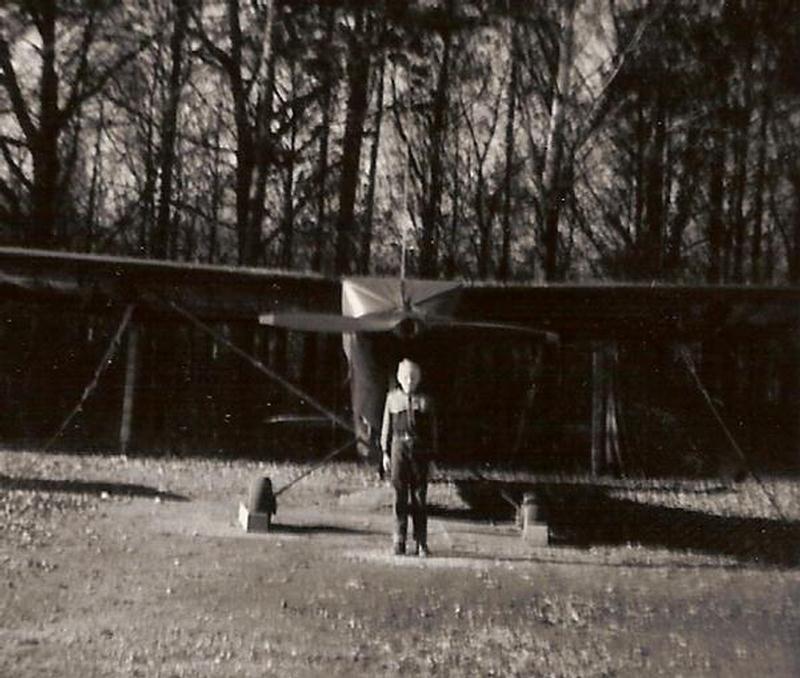
(My brother John in front of a Cessna L-19/0-1 “Bird Dog.” Yes, I took this and the following photo, and clearly show no promise of becoming a professional shutterbug.)
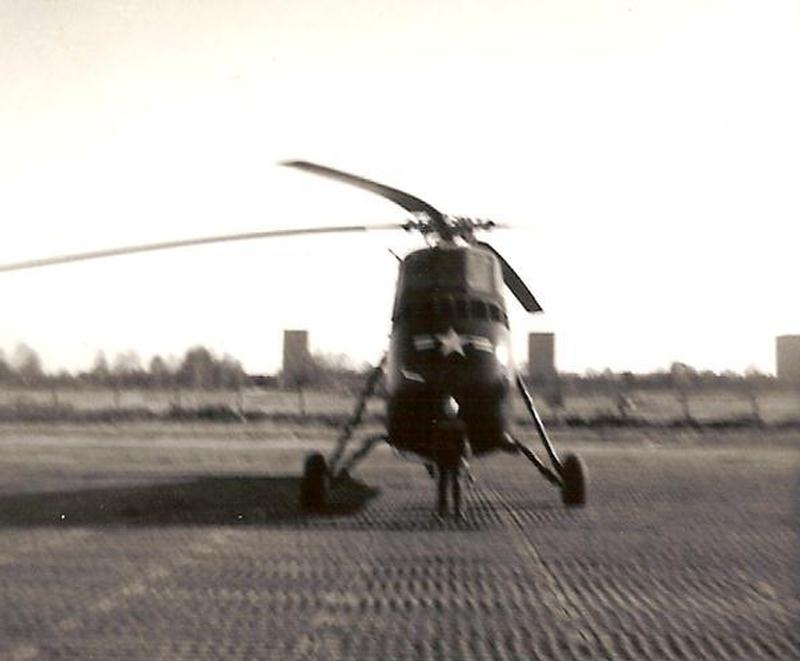
(The CH-34 “Choctaw”…the last type of helicopter my father flew while on active duty.)
The day in question would prove to be radically different in many ways. First, when we arrived at the helicopter, my father did not leave us as he usually did; in fact, he had us climb into the cockpit, then he buckled us up while conducting an abbreviated “walk-around” inspection of the machine. As an average pre-teen, I understood that before one took a flying machine into the air, one had to do something and check something, but I had no idea what that something might be. His absence was short-lived, and before we knew it, he was buckling himself in, grabbing what we knew was a “checklist,” and beginning a routine that was as familiar to him as starting up the family lawn mower. His hands were a symphony of motion, setting dials, adjusting knobs, and moving levers. When finished, he strapped the two flight helmets that “just happened” to be awaiting us in the cockpit onto our little noggins. Within seconds, he was talking to us through the interphone system, and the faintest of ideas began to gestate that this day would not be like the many other days at the airfield with Dad. We sat wide-eyed and speechless.
His next move confirmed that thought. With a practiced flow, he moved all the controls through their range of motion (checking for…well, whatever he was checking for), and his hands quickly set the throttle, mixture, and magnetos. The engine was primed, and after looking out of the bubble cockpit and letting out a loud “CLEAR,” he moved some mysterious switch, and we were treated to the sound of a large engine barely three feet behind us coming to life! Holy Guacamole! He was in the throes of bringing this beast to life! This fact was confirmed as the two big rotor blades above us began their dance of follow-the-leader. Within moments, they were up to speed, and our shell-shocked expressions were met with his unforgettable grin. He was not only going to let us peek into his world as an Army helicopter pilot, but was about to give us a “full Monty” stare. He was taking us with him into his world of the sky, and we sat frozen, our eyes locked onto him, clutching our seat belts and having no idea what was to come next. We were sure of one very important thing. We knew this was not an approved thing, as no other kid had ever mentioned something like this in the middle of a playground dodgeball grudge match.

(My Dad in the cockpit in the skies over war-torn Vietnam…this was the grin that greeted my brother and me…maybe without the worry and stress of being shot at.)
He said something to the Control Tower and slowly began to pull on the collective lever by his left side. The engine started to strain, and the world around us disappeared in a spray of water and wind! The engine revved a bit more, and as if by magic, we lifted into the air! We were flying! Not like the TWA and Pan Am flying we did to move across the country (and the ocean) a few years earlier, but flying as in hovering in a helicopter! As we would later find out, this machine required a “hover check” after a maintenance procedure was completed, and he volunteered for the mission. He took the opportunity to give his young male proteges a ride in one of the machines they had sat motionless in for many an hour. We did some forward and backward flight, as well as some pedal turns, but we generally never got more than a few feet above the ground. That mattered not one bit to us! We were flying as high as if we had just done a max-performance take-off and roared out of a hot LZ. The incredible noise, the vibration, the sounds of him in that staccato “pilot style” voice in the earphones within our helmets. The entire experience was surreal; the up-and-down, back-and-forth dancing under the slapping sound of the rotor blades was an indescribably special moment in my young life, and one that I will (obviously) never forget. He allowed us to lightly hold the controls, so we gingerly grabbed the vibrating cyclic and collective controls and put our feet on the anti-torque pedals. We were “helping” him fly this amazing machine, and it was a thousand times more exciting than any amusement park ride I had ever been on (or since, I might add).
All too soon, we settled back on the original spot of our liftoff, and the “flight” was over. He placed the helicopter exactly where she had been sitting when we arrived, as if the crime had never occurred. He accomplished his shutdown and securing checklists, signed the maintenance forms, and we unbuckled and climbed out, still reeling in a state of shock. As we walked toward the hangar, I turned to look back in awe at the thing that moments before had given me wings. It sat motionless, with two large, drooping rotor blades and all its systems dormant. As it squatted silently, the little bird said farewell with a litany of faint snapping and popping sounds from the hot engine as it cooled down in the damp October air. I am fairly certain it was the adrenaline coursing through my young veins, but at that moment, I felt a connection between that little chopper and myself. I smiled at her, and I swear she winked back at me.
Maybe that day was the beginning of my journey as a pilot; maybe my father saw the spark in me, and that was part of a plan of his to fan the flames. He has been gone for many years now, so I will never know for certain, but I do know that many times over the years, I have felt the same “connection” between myself and my various flying machines. This began early as a fledgling pilot in the small Cessnas, and continues now at work in the large, gleaming airliners. I have developed a habit of gently patting the big Boeing on the metal skin as I enter the fuselage cabin door from the jet bridge, and maybe it’s because I like to feel the strong metal of the machine against my touch, or perhaps I am unconsciously giving it a gentle assurance that I will fly it as smoothly and safely as I am able. I’m not sure of any of that, but I’m certain that on a cool, misty day in Munich, almost fifty years ago, my father took me to work with him, as he had done many times before. But this day was infinitely different; this incredible day at work with my father literally changed my life. In many ways, I left the house that morning a happy-go-lucky, clueless young boy, but came back a few hours later an aspiring pilot.
Addendum: On the ride home, my brother and I were subjected to a thirty-minute speech about how “the last few hours never happened.” He did not go into any particulars; suffice to say that he made sure we understood this was to be a huge secret, just between the three of us – not even my mother and sisters could know about what had transpired. We swore a sacred oath of secrecy that lasted roughly until the very next school day, when we were on the playground. I have no doubt that more than a few of my friends, finding themselves embroiled in a dodgeball grudge match, were distracted by that crazy kid and his crazy story. You know, the one that said he went to work with his dad and got to FLY A HELICOPTER!
Yeah, right.

(Yours truly atop an M4 Sherman tank display somewhere around Dad’s airfield in Nuremberg, circa 1966)
till next time,
BBall
 BBALL'S LOGBOOK
Hey Bball! Very glad to see another of your entries. I really enjoyed reading it. Having someone in your family who showed you aviation at a young age, plus in the way you just told, must have been really special for you. As always, looking forward to more! – Requiem
LikeLike
Thanks R!
My childhood was a very normal life as an “Army brat”. Moving every couple of years…around the country and around the world. However, as I became older, and met kids from the civilian world, I found out that many of my experiences were exceptional. I was one lucky kid indeed…
BTW, I’m loving the cronicles that you are posting up of your training…keep them coming!
-BB
LikeLike
A damned good read. Takes me back; for me sixty years, too. Thanks!
LikeLike
Thanks for the kind words! Sounds like you and I were hatched pretty much during the same “stone age” time frame. I read that you spent some time in the DFW area, where abouts? We settled in south Ft. Worth (Wedgewood) after my Dad separated from the Army in 1969…spent my formative years as one of those “damn Texans”, and then journeyed out when I packed up my little kit bag and headed toward Oklahoma and an aviation university. Never really looked back….
Love your writings, seem to always put a grin on the old puss! Keep up the good work!
BB
LikeLiked by 1 person
Thanks. There was a large complex I frequented when not at Tinker in OKC. Carswell. Says a lot doesn’t it?
LikeLike
LMAO! Yep…. My Dad used to take my brother out to CAFB to get our bi-monthly “high and tight” hairdo (that was required of young boys back in those “dark days” of UN-enlightenment…WAY before the days of boys in skirts and girls being boys).
After the event, we would park up along some avenue in White Settlement (IIRC), and just sit on the hood of the Plymouth (station wagon of course) and watch the B-52s doing touch and go’s. As the crews would “pour the coals to her”, the amount of black exhaust belching out of those eight engines was a sight to behold! It would cause your average “wokester” to faint from “carbon footprint poisoning”! We loved it, and knew it for what it was…turning jet fuel into freedom…
lol.
LikeLike