

(The following intro to this piece I wrote in 2015; the original Logbook “Driving the Bus” was written over a decade earlier on 02 October 2003.)
Greetings from sunny Tokyo!
Actually, not sunny at all (rather dark and dreary).
In a few days, we in America will celebrate another of our milestones. We will look back in time to commemorate the “eleventh hour, of the eleventh day, of the eleventh month” event, the 11th of November. It was the day the final bell of the “war to end all wars” tolled; four years so devastating that it claimed an entire generation of European youth, and many thousands from around the globe. From Sydney to Sevastopol, they marched off to war and never returned. We in the United States know it as “Veterans Day”, and it proudly holds a special place in my heart.
Why is that, you ask? Essentially, one simple reason. Each year on this one day, I ponder my adult life, and I am left with the same conclusion each time: that a part of it has been an abject failure. I know, harsh words to be sure, but brutally honest nonetheless.
I reflect on the fact that I was raised in the family of a veteran, groomed to love my country (and the liberties and freedoms she represents), and for most of my formative years wanted nothing more than to enter military service and do my duty. This would not come to pass, and in that regard, I’ve failed in my quest to repay the wonderful idea we know as America with time spent “on the wall watching and waiting to defend”. My failure to serve would change my life in ways I will never be able to comprehend fully.
I wanted to fly. From my early days, it was my calling, and I heard it loud and clear. I yearned to be in the spot that I have been fortunate enough to call my “workplace” for almost 4 decades…the cockpit of an air machine. Fate would intervene and steer me down a path far different from the one I dreamed of and wished for as a young man. This was envisioned as a path that began with the rigors of military service and culminated in the civilian world of the airlines. I worked hard as a teen, kept (mostly) good grades in school, stayed in shape, and was pointed toward a scholarship that ended with a jet that had the initials USAF proudly painted on the fuselage. It was to be, and my dad and I could not have been more excited. Then the unimaginable happened… I failed.
To be exact, I failed the vision test of the entrance physical of the Air Force ROTC program that I was to attend (at Texas A&M University). Back in the 1970s, part of the physical exam included a test titled the “near vision acuity” evaluation. This involved an Air Force enlisted person placing a ruler on the bridge of your nose, and you reading the letters on the little slide sheet that moved up and down on said ruler. The issue with my vision was inherited from my dear father himself – it was the “problem” of having exceptionally strong ocular muscles related to my far vision. I could swear my dad could see a gnat on the ass of a mule at 500 yards, and I could, too, it seemed! Since my muscles were born of his DNA, I was tested at an amazing far vision of 20/15 (meaning that I could see at 20’ what most folks could see at 15’). Unfortunately, this meant that my near vision muscles were weaker than most, and the best I could do was 20/30 (what you see at 30’, I have to be at 20’ to see). The United States Air Force required no less than a rock-solid 20/20 for pilots, and I could not hack it. Vision enhancers like glasses, contacts, and/or ocular surgery were not allowed.
My dream of service in a military cockpit was over. We were both upset, disheartened, and (yes) disappointed greatly. I felt like I had not only let my country down, but that I had let him down, too. However, he (being the beautiful man that he was) would hear none of that and helped me devise a plan to put me in a cockpit sans the help of the American taxpayers. I would attend an “Aviation University”, graduate with a four-year Bachelor of Science degree (the airlines require such), and have a life amongst the clouds after all.
It worked, and that is essentially the story of my life. Interestingly enough, when I was interviewing for the position at Northwest Orient Airlines roughly 10 years to the day from my failed USAF physical, my near vision muscles had gotten stronger, my far vision muscles had grown weaker, and my vision was a perfect “20/20”. I know now that such was the path for my journey by the good Lord, and it’s been nothing short of an incredible life.
But again, on that one day each year, I give thanks to those who have served, admire those who are serving, and feel a tinge of pain that I was never fortunate enough to be a part of that group of my country’s most honorable men and women. They deserve nothing less than our undying “thanks” for their sacrifices and what they have done for each one of us. The hard work, the long months away from loved ones, and the dedication to keeping our freedoms and liberty cannot be understated.
“Thank You!”
The following piece I penned several years ago regarding a military charter I had recently flown. Part of the addendum that would be the “current one” (not the one at the end of the piece) is that my son grew up to enter the United States Army (through the ROTC system), has deployed to a war zone twice, and is currently serving wearing the twin silver bars of a Captain. The father’s “grip of fear” that I mention in this piece has lived in this dad’s heart, and it’s a dark place indeed. With all that said, his mother and I could not be prouder of him. I will add his two sisters to that list…the older no less, married to an Army officer herself…he too, an exemplary young man.
With that, I give you…
“Driving the Bus”
(Originally penned 02 October 2003)
“You’re just an overpaid bus driver.”
I have heard that little quip from passengers, neighbors, and yes, even friends and family. Over the years, I have spent countless hours trying to explain my world as a professional pilot to those who will never truly understand what it’s like. I’ve told of the many long years of training for all the sundry licenses and ratings, the ugly (and sometimes dangerous) jobs taken to build precious flight time, the frustration of yearning to work for a major airline, and (through no fault of one’s own) failing to land the job. Then, after the grueling interviews and finally getting the nod, being faced with many, many hours of training and check rides, all under the jaundiced eyes of the FAA and company check-airmen. I would be remiss if I failed to mention the “endless journeys” on the treadmill (and in the weight room) to stay in shape for that semi-annual trip under the medical microscope. Getting the job is one thing; keeping it can be an entirely different battle.
Strangely enough, even the folks who should “almost” understand what my world is like (the cabin flight attendants) mostly do not. They see us sequestered into our little closet with windows, but they are only allowed in when things are at the dullest point in the flight — the segment at cruising altitude. I have heard them say after a long duty day, “But why are you so tired? You just sat there all day?” It can be very frustrating, for although I’ve spent countless hours attempting to let “earthbound” folks peek into my world in the cockpit, it seems to have been for naught when I hear that infamous “bus driver” comment.
Truth be told, sometimes that is exactly how I feel when at work.

(My closet with windows, a Boeing 757-300. Anchorage to Minneapolis/St. Paul.)
My journey into a professional cockpit began in my third year of high school with obtaining my Private Pilot License. Still, for flying to become a vocation, I would need further training. I received my Commercial Pilot License in the summer of 1976 while attending an aviation college in Oklahoma, and my very first passenger-for-hire mission was what we termed a “Lake Texhoma tour”. I was tasked with loading a couple of locals into one of the university’s “mighty” Cessna 172s and spending the next hour flying them on a sightseeing tour over the expanse of that huge lake on the border between the Lone Star and the Sooner States. It was not anything on the order of a Grand Canyon tour, but this rather large body of water offered some rather cool viewing. During those hot summer months, these flights were inevitably sweaty and quite bumpy, and the barf bags were known to return filled to overflowing, but it was “professional flying”, and I loved it. I had finally turned the corner in my aviation career, and when I turned the Cessna keys in at the flight school counter after the flight, there wasn’t a wad of my dollars attached to them… cool. It was pretty awesome to actually be getting PAID for flying an airplane, and a bit heady for this shy 20-year-old.
Nowadays, my “tours” take me from one end of this planet to the next. The jet that I call home flies to several continents and dozens of cities. I’ve seen most of them…many, many times. I can share a wealth of information about them; for example, Milwaukee boasts the best airport bookstore in the system, runway 33L in Baltimore has such a large hump in the middle, when you’re on one end of it… you can’t see the other end, Air Traffic Control will ALWAYS keep you “high and hot” on the arrival to the south runways at Orlando…so you better configure for landing the jet early, and there is a better than even chance you’ll get moderate turbulence below 300′ while landing on runway 06R in Anchorage when the wind is out of the south…but 06L will be smooth as a baby’s bottom.

(On a final approach for Runway 06R in Anchorage.)
Oh, and the crew hotel in Tokyo can be as noisy as the Super Bowl at halftime, and for God’s sake, do not get the chili at the Bangkok airport…you AND your spouse will regret it. Does this sound like the rantings of a person who has been to these airports/towns hundreds of times? Yep, I am afraid it does, and sometimes when the alarm sounds at 0500, I have to look at the phone book to see which city/country I just woke up in. The flying is wonderful and exciting, but sometimes the travel … not so much.
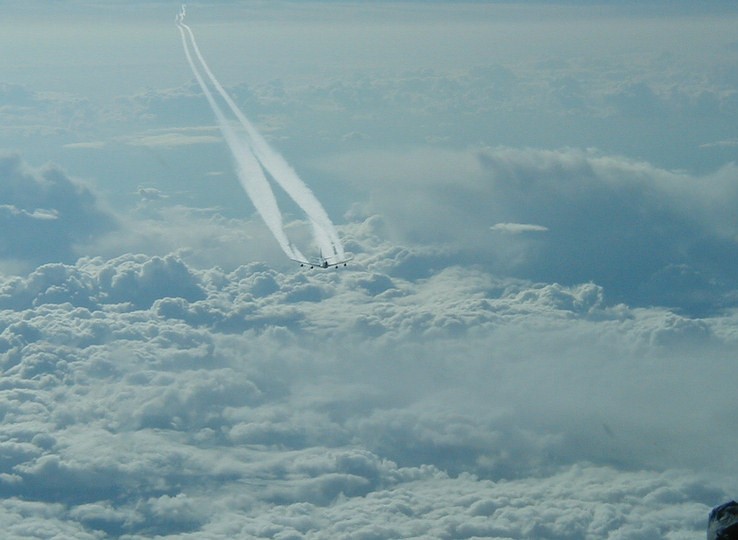
(A UPS 747 a few thousand feet below us, heading northwest bound over Canada toward Anchorage.)
A few weeks ago, I flew a trip that would put an end to all that for a few days. It was advertised as a charter, but not just any charter flight. We fly all sorts of “offline” flights in the airline business, and I have done my share of them. Most have been sports charters, and I can honestly say that picking up a load of “20-something NFL millionaires”, and kissing their (at times) prima dona posteriors all the way across the country is not my idea of fun. Some guys love it…. I do not. These superstars can be a bit less than nice at times, but I guess that’s O.K. when you feel (and are constantly told) that your feces have no odor; maybe that is just the way they learn to act. This charter, however, would be something different; far different. It was what is known as a “CRAF” flight. CRAF stands for Civil Reserve Aviation Fleet, which means that basically the airlines supply aircraft and crews to the military folks (“MAC”, or Military Airlift Command) for transporting personnel across the USA and around the world. One of my first MAC flights was back in 1987 when I was a Second Officer on the 747, and I remembered it as being massively “different”…but in a good way.
What makes these trips so different? First, there are the destinations. Mostly places I have never been. On this particular junket, we were scheduled to leave at 0600 on day 1, ferry the aircraft from Minneapolis to Grey Army Airfield on the massive Ft Hood Army reservation on the outskirts of Killeen, Texas. Ever been to the sprawling metropolis of Killeen? Me neither. Despite spending my formative years on Army bases worldwide and my teen years in north central Texas, I have never had the pleasure of logging quality time in Killeen. After a scheduled hour on the ground, we were to embark a plane load of troops, deliver them to Victorville, California, then ferry the airplane empty back to Ft Hood. A two-day layover was scheduled, followed by a trip to take more troops back to Victorville. After that, the First Officer and I would ferry the empty aircraft through the middle of the night to Andrews Air Force Base just outside of Washington, D.C., arriving at approximately 0430. A short nap at the hotel would be in order, then we would be tasked with dead-heading home later that day. So, with the prospect of flying to several new airports and ferrying the aircraft empty on three out of the five scheduled legs, I was rather excited about releasing the brakes on this one.

(The aviation flight line at Grey Army Airfield. I logged many an hour on flight lines like this with my dad when I was a youngster.)
Ferrying…or “repositioning” the jet is a different animal altogether. After all the hoopla that the cockpit door has seen since 9-11, it’s strange to tool around the country with the flight deck door open and the cabin attendants free to come and go as they please (in cruise flight). During take-offs and landings, the door is closed, and one of the flight attendants is allowed to occupy a jumpseat if they like (someone will always take the offer, it seems), but after 10,000′, we open the “cell door” and they can visit freely. I think it’s a GREAT way for them to peek into that world I spoke of earlier, and I would champion a cause that would require all newly hired flight attendants to ride at least one leg in the cockpit. This would allow them (many of whom have never been around a small airplane, much less an airliner) to gain lots of insight into what running a cockpit can entail. It would show them a slew of important things. When we are busy, how busy are we, and why do we always seem to be doing nothing when they enter the cockpit at 35000’? Plus, it’s always fun to have someone sitting on the jump-seat that is not sporting a badge with F.A.A. printed all over, or some sweaty, bad-breathed pilot-type that’s been wearing the same coffee-stained uniform for the last three days.
With that said, there is one other important thing that makes these flights very special to me, and that is that I am given the opportunity to serve the most amazing people by safely flying them where they need to be. I’m talking, of course, about the young men and women who serve in our armed forces…in the case of this trip, the United States Army. I am blessed to have been raised in this “family of honor”, and I deem it a high privilege to chauffeur these wonderful folks from point A to B.
What makes them so special, you might ask? I’m not sure I can explain it fully, but I’ll give it a try. It is a look, a walk, and an air about them that most civilians do not have. My Dad had it, my “Uncle” Wade had it (he was not really my uncle, but he and my dad were best friends from their early Army chopper days), and these “kids” sure as hell had it. It is as if they are aware that they are carrying America’s history of long-forgotten battles on their young shoulders. When they speak with you, they look you square in the eye, and they aren’t afraid to let loose with a “yes, sir, or yes, ma’am” when it’s appropriate. They seem to understand that they have a purpose to their existence, and that purpose is wrapped in the service of keeping our freedoms with honor and integrity. They are indeed the best that America has to offer, and, again, I am privileged to serve them.
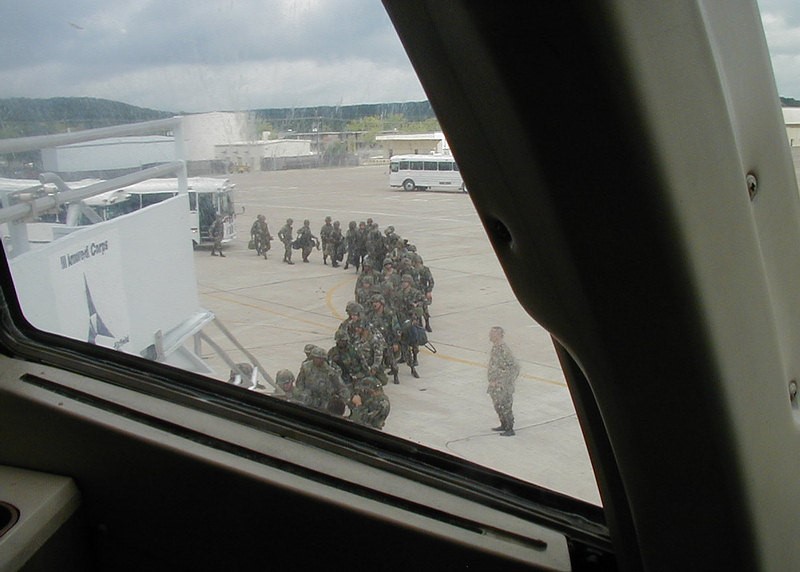
(Some of my special charges for the day.)
One of the curious by-products of being raised as an “army brat” is that I can recognize and decipher that bizarre collection of symbols and insignias that every soldier lives by; I’m talking unit patches and rank. I was raised knowing that the beautiful gold shield with the black stripe and horse silhouette is, of course, the storied”1st Cavalry Division (Airmobile)” of Vietnam fame. The four green stars linked within the tilted square can only be the deadly “4th Infantry Division” (or Four Ivy), and I know that the “Hell on Wheels” patch is the feared “2nd Armored Division”.
From a mile away, I can spot a patch from the “All American Division” …the “82nd Airborne” that pioneered jumping behind enemy lines, or the “Screaming Eagles” of the “101st” who fought the Nazi’s to a standstill in the freezing snow of a tiny Belgian town. And who, of course, can forget the “Big Red One” patch of the legendary “1st Infantry Division”… the unit that began it all in the bloody Meuse-Argonne forests of the First World War? All these Army units have histories bathed in honor and blood, and I teethed on their lore.
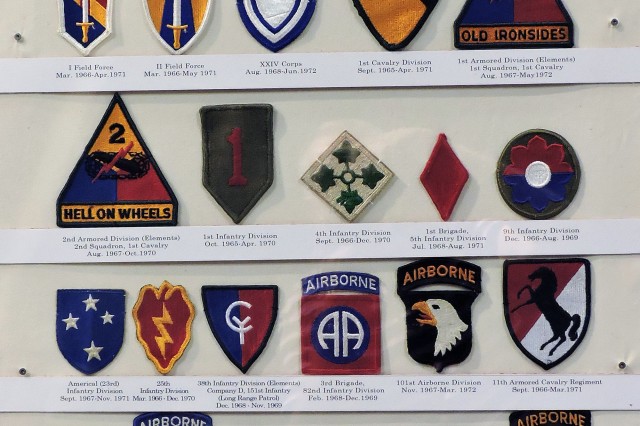
(Some of the famous patches of the United States Army.)
The maze of confusion known as rank sends most civilians into a tizzy. Still, I can tell the difference between a Staff Sergeant and his boss, the Master Sergeant, with the “three up and three down”, a “butter bar” Second Lieutenant from a Chief Warrant Officer, a gold-leafed Major from a silver-leafed Lieutenant (or “Light”) Colonel’ and I know that nobody loves seeing a “full Bird” Colonel headed their way. But of course, history has shown that the most important of all ranks is the “dog face” PFC, or Private First Class, for they are the backbone of the infantry. Throughout time, in the heat of battle, it has been the NCOs (non-commissioned Officers…Sergeants and the like) and the “dogfaces” that have carried the day. The generals get the glory, while the grunts get the Purple Hearts.
I was schooled at an early age about tradition and respect, and in the military, one of the principal forms of respect is the salute. I was told that you salute the rank and not the person, and that EVERYONE salutes a Congressional Medal of Honor wearer, no matter their rank or stature. I watched my dad salute lots of higher ranks, and he always seemed to mean it, but it was truly special when someone snapped off a crisp salute his way, for the respect and reverence that it intoned always made me walk a bit taller next to him. He taught me that serving a cause higher than “self” (for instance, one’s country) is the most noble and honorable thing a young person can do, and I have never wavered in that belief. I loved growing up in the Army family, and a few months ago (when we were all glued to our television sets), I had many thoughts of just how proud he would have been to see “his” Army, and how they were faring in battle.
The last days of my father’s active service were many years ago, and all the soldiers in my life then were much older than me. Now I wear the face of four (plus) decades, and all the troops on this trip seemed to be young…. very young. Hell, most of them seemed to be just kids. Both times we landed in Victorville, I stood at the cockpit door to say goodbye to each of them, and I swear that I saw my 16-year-old son’s face under many of those helmets. As a father, it was scary as hell, but I’m sure their fathers feel that grip of fear far more than I do. It has been said many times that “war is a young man’s game”, and I guess it’s a true statement. However, that does not make it any easier for the young widow or the grieving family. These young men and women serve in a very dangerous profession.
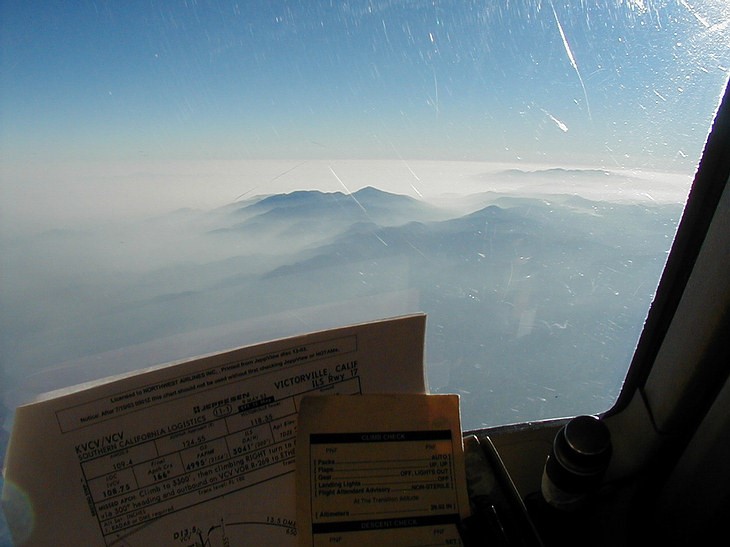
(Peering out my cockpit window as we descend inbound to KVCV (Victorville, CA). If it looks hot, it’s only because it was.)
Even “the brass” sitting in first class seemed young. Heck, the Captains looked 20, the Majors 25, and the “full bird colonel” looked all of 30 years old. I’m not joking …they really seemed (to me) to be that young. With the current events in Iraq and elsewhere in the world, there is a very good possibility that these folks will be deployed to a combat zone sometime during their time in uniform. If they do deploy, there is always a chance that some of those young, fresh-faced, Harry Potter-reading, “I was carrying a Gameboy last year, and now I’m toting an M-16″ kids won’t…. well…. You know…. make it back…. and that breaks my heart.
My Father once told me,” Son, the Army took me out of the slums of Dallas, got me my High School G.E.D. (my Dad had dropped out of high school), sent me to night school to gain a college degree, taught me a trade, and showed me the world. All my country EVER asked in return was to fight her battles twice on foreign soil. Once, as a medic in Korea, and once as a pilot in Vietnam…. and I think that was a pretty fair trade-off on my part.” I have never forgotten those words. I am convinced that many of the kids I flew across the country have grown up in “soft” America, where they’ve had everything from MTV and Windows XP to “soccer moms” to make their lives easier… but all that has ended for them now. They are being shown the “hard” world, where bad guys fly airplanes into buildings, where RPGs take off arms and legs, and where your buddy’s life can mean more to you than your own.
In the last few years, I have had my doubts about the youth of today. I have wondered if they could stand up to the inevitable challenges that evil will throw at folks who live in free, honest, hardworking, and decent societies. History tests each generation, but could these youngsters step up to the plate, like the “20 somethings” that braved the trenches of the Argonne, the beaches of Normandy, and the jungles of the Ia Drang? I can honestly say that after what I have seen from Iraq in the last many months, and my CRAF trip a few weeks ago, I no longer have those doubts. These kids can handle it.
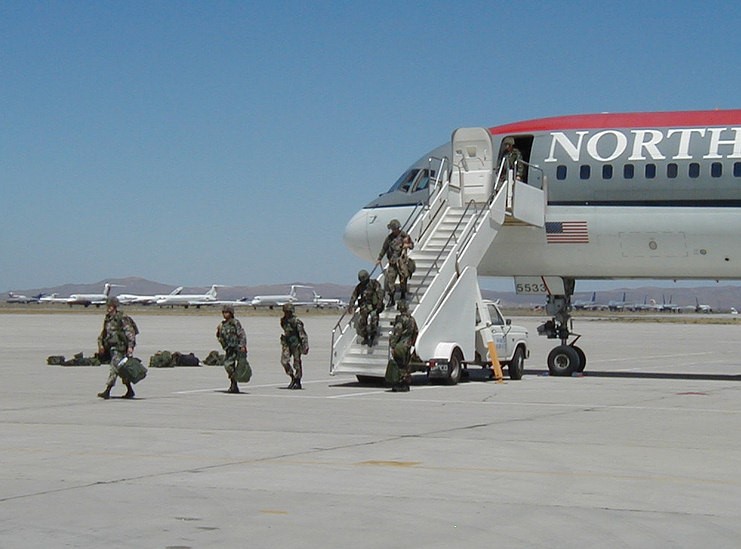
(Off-loading in Victorville.)
So, when someday a precious grandchild is sitting on my knee and they ask,
“Granddad, what did you do in the war on terrorism?”
“Oh, I flew my airliners around the country and the world, always working hard to fly safe and protect my passengers from the bad guys.”
“But Granddad…what did you DO during the war against the terrorists?”
The real answer will be:
“Oh, honey, that’s easy….
I drove the bus that the heroes rode on…. I proudly drove the bus.”
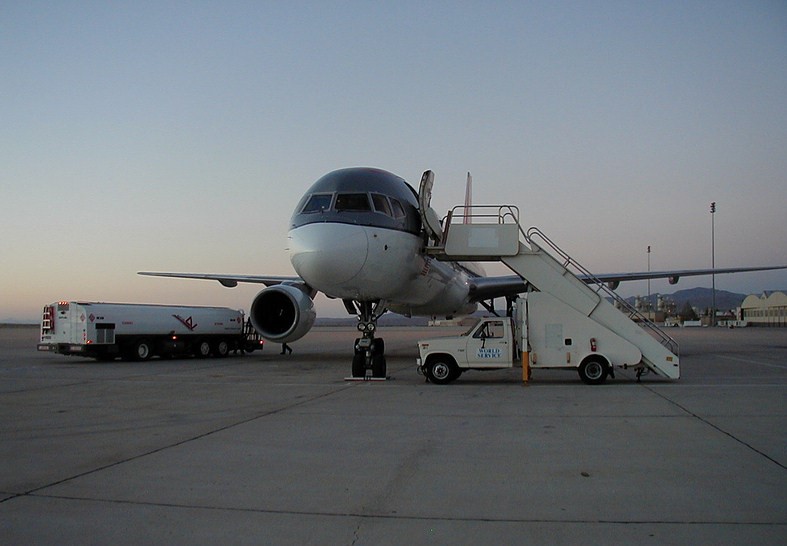
(The hero’s bus.)
One final note:
God bless all the coalition troops, and special prayers to my two nephews who are serving. Recruit Jason Hobbs is just beginning his journey of service, and Specialist Nicholas Stewart, 2/3rd ACR, 7th Infantry Division (Light), United States Army, deployed in Iraq. We love you, Jason, and Nick, and we are very proud of you and your comrades. Do your duty well, gentlemen, and return home safe.
till next time,
BBall
.
 BBALL'S LOGBOOK
A very good story BBall and very true in all respects. Australians call the 11 hour /11 day/ 11 month 1918, Remembrance Day or Armistice Day, its when the guns on the Western Front in Europe finally fell silent after 4 years of the most wasteful war in our modern history. From the Australian perspective this war touched just about all Australian family’s, which from a total population at that time of fewer than five million, 416,809 men enlisted, of which over 60,000 were killed and 156,000 wounded, gassed, or taken prisoner. My Great Grandfather and his brother from my fathers side fought in France and came home, but the brother died of wounds when he got home, my Great-grandfather was 42 years old, both were volunteers. That was my fathers side. On my mothers side my Great grandfather also fought in France, and Russia, fighting the “Reds” and died back in Australia in a hunting accident.
As one of those “coalition” soldiers (Australian Army) I served my country as a professional Infantry soldier for 30 years in two theatres of war and in 3 conflict zones, i lived and breathed it, id still be doing it but my body finally objected to the continual punishment i subjected it too, so my head said time to go, i am paying for it now, but gladly. I would do it all again if i could. What does it all mean to me ? I dont seek glory or recognition, i dont grandstand about what ive done or not done. What i truly believe is that to have what Australia and the free democracy’s of the world have we need to put up or shut up ! And my option is to put up and defend to the last breath and not waste those sacrifices made in all the wars that my country has fought. My duty as a breathing human is to remember and honour those that have gone before, and the reasons they went, they went willingly and in most cases they went happily, knowing what was in store, Lest we forget them !
To your Nephews BBall, i wish them well and advise them to trust their mates, keep their rifles clean, and never take their eyes off the “ball” !
Warmest Regards
Strut
LikeLiked by 1 person
Strut my friend,
Thanks for the kind words. As the son/father of a warrior, I can only say “thank you” for your service to a democracy that has answered freedom’s call each and every time it was heralded. It’s people like you that allow people like me to taste liberty and freedom every day of my life. Again…thank you.
My nephews have all retired from their military service, and are (mostly) doing very well in life…the oldest recently married. I’m proud of each and every one of them, and I know that they’re very proud of their time spent “on watch”.
My son is doing well. He leaves Alaska in a few weeks for his next duty assignment, which (as of this writing) is looking to be Okinawa. His Mother and I are not “completely” happy about he and his lovely wife being so far from our embrace, but that is his decision, and we back him 100%. He’s grown to be a man that I’m proud of, and although I’m sad that he never met the man that was my template (my father), I’m sure they would’ve been fast friends, and warmest comrades.
Thanks again for your patronage here at my little corner of Al Gore’s internet. I write because I love to, and I write because folks like you seem to be bored and don’t mind wasting moments of your life digesting my blather. Seriously though, thanks for stopping by.
Have a great day my friend..
LikeLike